
The greatest pricing risk facing businesses today is not rising tariffs. It is relying on pricing models built for a trading environment that no longer exists.
Cross-border pricing: turning tariffs and trade shifts into advantage
17 August 2026
Tags
Tax
International expansion
Yet Africa is moving in a different direction. While many economies are becoming more protectionist, the African Continental Free Trade Area (AfCFTA) is steadily lowering barriers to intra-African trade, creating the world's largest free trade area by participating countries. This divergence presents African businesses with a unique strategic opportunity: to redesign cross-border operating models around regional integration while the rest of the world adjusts to increasing fragmentation.
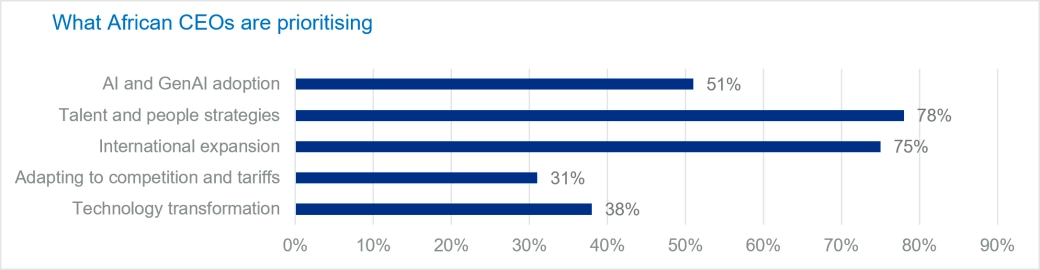
The optimism reflected in the 2026 Africa C-suite Barometer suggests that many African business leaders recognise this opportunity. 93% of executives expect growth in 2026, 75% intend to expand into at least one new market over the next five years, and 31% rank adapting to competition and tariffs among their highest strategic priorities. More significantly, 57% report that trade and tariff developments are already reshaping their expansion strategies.
- 40Developed new efficiencies in response to tariff pressures
- 37Adjusted pricing models due to competition and tariffs
- 36Adapted international expansion plans accordingly
These findings suggest that African businesses are not waiting for uncertainty to pass. They are adapting their operating models to compete within it. However, expansion alone does not create competitive advantage. As businesses redesign supply chains, establish regional procurement hubs and enter new markets, they also change how value is created across their organisations. Those changes have a direct impact on pricing. The assumptions that underpinned pricing decisions only a few years ago may no longer reflect today's commercial reality.
Cross-border pricing has therefore become far more than a transfer pricing compliance exercise. It is increasingly a strategic capability that influences profitability, investment decisions, customs outcomes, tax certainty and long-term competitiveness. Organisations that treat pricing as an integral part of business strategy will be better positioned to capture the opportunities created by Africa's growing economic integration.
Pricing Is becoming the new competitive advantage
As tariffs, supply chains and regional trade patterns evolve, pricing is becoming one of the most important strategic decisions businesses make, not simply because it determines profitability, but because it shapes investment, competitiveness and long-term growth.
For decades, multinational businesses designed their cross-border operations around a relatively stable set of commercial assumptions. Production was concentrated where costs were lowest, supply chains were optimised for efficiency, and pricing models evolved incrementally alongside predictable trade relationships. In many organisations, cross-border pricing was reviewed periodically, often driven by annual budgeting cycles or tax compliance requirements rather than broader strategic considerations.
Those assumptions no longer hold. Today's pricing decisions are shaped by a far more dynamic combination of forces. Tariff policies are changing more frequently, supply chains are becoming increasingly regional, foreign exchange volatility continues to influence profitability, and customers expect businesses to respond more quickly to market conditions. At the same time, advances in digital technology and data analytics are enabling organisations to monitor margins, costs and commercial performance almost in real time.
Collectively, these developments are transforming pricing from a transactional activity into a strategic business capability. This transformation is evident across global markets. According to the World Trade Organization (WTO), businesses are increasingly diversifying production locations and sourcing strategies in response to geopolitical uncertainty and changing trade patterns.
Rather than concentrating manufacturing in a single jurisdiction, many organisations are developing regional production and distribution networks that improve resilience while reducing exposure to supply chain disruptions.
Africa is becoming an important part of this transformation. The continued implementation of the AfCFTA is encouraging businesses to think beyond individual national markets and towards integrated regional operations. The World Bank estimates that full implementation of AfCFTA could increase Africa's exports by approximately US$560 billion by 2035, driven largely by manufactured goods and deeper regional value chains. For businesses, this is more than a trade statistic. It represents a fundamental shift in how products are sourced, manufactured and distributed across the continent.
The strategic implications extend well beyond customs duties. As organisations redesign supply chains, establish regional procurement hubs and expand into neighbouring markets, they are also redefining where commercial decisions are made, where value is created and how profits are generated. Pricing therefore becomes the mechanism through which these operational changes are translated into commercial outcomes.
In other words, pricing is no longer simply a reflection of business strategy. It is becoming one of the tools through which business strategy is executed.
From cost optimisation to value optimisation
One of the most significant shifts taking place today is the transition from cost optimisation to value optimisation. Historically, businesses sought competitive advantage by locating production where labour or manufacturing costs were lowest. Pricing strategies reflected this objective, rewarding efficiency and economies of scale.
Today's environment demands a different approach. Business leaders are increasingly balancing cost efficiency with resilience, flexibility and speed to market. A regional manufacturing hub may not always deliver the lowest production cost, but it may reduce logistics risks, improve customer responsiveness and shorten delivery times. Similarly, a regional procurement centre may create additional administrative costs while generating stronger purchasing power and greater supply chain resilience.
These decisions change the economics of the business. Consequently, pricing models should evolve to reflect not only cost structures but also the value created by different functions within the organisation.
This represents a fundamental change in thinking. Instead of asking: "How do we minimise costs?" Leading organisations are increasingly asking: "How do we maximise value across our regional operations?" That distinction is becoming increasingly important for businesses operating across Africa's evolving trade landscape.
The new cross-border pricing advantage framework
Trade disruption affects businesses in different ways, but the commercial response typically follows a common pattern.
At Forvis Mazars, we see four interconnected decisions that increasingly determine whether businesses merely adapt to change or convert it into competitive advantage.
| Trade shift | Business response | Pricing response | Strategic outcome |
|---|---|---|---|
| Rising tariffs and changing trade policies | Review sourcing and procurement | Reassess customer and intercompany pricing | Protect margins while maintaining competitiveness |
| Regional integration through AfCFTA | Establish regional manufacturing and distribution hubs | Align pricing with regional operating models | Capture economies of scale and improve market access |
| Foreign exchange and logistics volatility | Diversify suppliers and optimise inventory | Introduce more dynamic pricing reviews | Improve resilience and reduce earnings volatility |
| Greater regulatory transparency and digital tax administration | Strengthen governance and commercial oversight | Align pricing with economic substance and business reality | Enhance certainty while supporting sustainable growth |
The framework highlights a broader shift taking place across multinational organisations. Pricing is becoming an integral part of strategic planning rather than an outcome of it.
Instead of reviewing pricing after commercial decisions have been implemented, leading organisations increasingly evaluate pricing implications while designing new operating models. This enables management teams to understand not only the financial impact of strategic decisions, but also their commercial sustainability across multiple markets.
The rise of regional operating models
One of the most significant consequences of AfCFTA is the gradual emergence of regional operating models. Historically, multinational groups often established separate operating structures for each jurisdiction in which they conducted business. Manufacturing, procurement, sales and distribution activities were frequently organised at the country level, reflecting fragmented markets and relatively high barriers to intra-African trade.
Regional integration is beginning to change that logic. As trade barriers reduce and connectivity improves, organisations are increasingly evaluating whether certain business functions can be performed more efficiently at a regional level. Procurement may be centralised to improve purchasing power. Manufacturing may be consolidated to serve multiple neighbouring markets. Shared service centres may provide finance, technology or customer support across several jurisdictions.
These developments fundamentally alter how value is created within an organisation. Pricing therefore becomes more than a mechanism for allocating costs. It becomes a means of recognising where strategic decisions are made, where commercial risks are managed and where economic value is generated.
Businesses that align pricing with these evolving operating models are likely to be better positioned to support regional growth while maintaining consistency across markets.
Why transfer pricing still matters
As commercial strategies evolve, transfer pricing becomes increasingly important, not because regulations have fundamentally changed, but because businesses have. Every strategic decision discussed in this article has transfer pricing implications. A regional procurement hub changes purchasing responsibilities. A centralised distribution model changes inventory and market risks. A shared service centre changes how support activities are delivered and remunerated. A redesigned financing structure changes how capital is allocated across jurisdictions.
Transfer pricing provides the framework for ensuring that these commercial changes are reflected consistently in how profits are allocated between related entities.Viewed in this context, transfer pricing should not be regarded as a standalone compliance obligation. It is part of the broader governance framework that supports cross-border business.
Robust pricing policies help organisations demonstrate that commercial arrangements accurately reflect the functions performed, assets employed and risks assumed by each entity, while also providing greater certainty in an environment where tax authorities are increasingly relying on data analytics, cross-border information exchange and coordinated compliance activities.
The most effective organisations therefore do not separate commercial strategy from transfer pricing strategy. They integrate them.
Looking ahead
The next decade will not be defined solely by higher tariffs or deeper regional integration. It will be defined by how effectively businesses adapt to them.
Throughout history, trade has continually reshaped the competitive landscape. Organisations that responded early to structural shifts have consistently outperformed those that waited for stability to return. Today's environment presents another such inflection point.
For African businesses, the opportunity is particularly compelling. AfCFTA is creating the foundations of a more integrated continental market at precisely the moment when businesses around the world are reassessing their supply chains, pricing strategies and investment priorities. Organisations that recognise this convergence have an opportunity to redesign how they create and capture value across borders.
Cross-border pricing sits at the centre of that opportunity. It is no longer simply a mechanism for determining the price of transactions between jurisdictions. It has become a strategic capability that influences where businesses invest, how they allocate capital, how they respond to market volatility and how confidently they expand across Africa.
Businesses that continue to rely on pricing models designed for a different trading environment may find themselves responding to change long after competitors have already adapted. Those that embed pricing into strategic decision-making, continuously align commercial and tax outcomes, and build the agility to evolve alongside changing trade dynamics will be better positioned to compete in an increasingly integrated African market.
Ultimately, the organisations that succeed will not be those that merely navigate tariffs and trade shifts. They will be those that transform them into competitive advantage.
Contact us

Ernest Akonor Country Leader - Accra

Timothy Aryee Accra

Peter Nwofia Partner - Tax - Lagos
