

Diversification moves to the centre of growth strategies
InsightsC-suite barometerC-suite barometer: outlook 2026C-suite barometer: 2026 mid-year insights
Diversification moves to the centre of growth
4 June 2026
Mid-year findings point to a meaningful shift in C-suite strategies, with a clear indication of what matters most for businesses in the long-term as they navigate current market conditions. Diversification comes through strongly as the defining approach business leaders are taking – from their operations, businesses models and expansion plans, to future funding and their products/services. We’re also seeing organisations diversifying resources in response to world events, reallocate boosts to investment and redirect target trade destinations. Gone are the homogenous approaches to strategic growth plans. What we have now is this heterogeneous approach of deliberate diversification and a further evolution of adapting in uncertainty.
The top trends impacting businesses play a central role in this shift as we see more of the uncontrollable external factors like economic trends, energy prices/shortages and geopolitical instability compete with key priorities for investment, transformation and operations. Nonetheless, growth remains a key focus, expansion plans are being redirected with the aim of boosting trade relationships, returns in AI investments are emerging and leaders are steadfast in their optimism, if not as confident in their ability to manage the key trends.
At the start of the year, our study pointed to organisations investing with confidence, leaning into change and backing transformation. That sense of ambition remains but the intensified instability in the current climate has, in most areas, become less predictable. Leaders are now navigating a more intricate set of pressures, from geopolitical uncertainty and shifting energy dynamics that threaten to distract from essential priorities to transform their businesses through AI and manage expansion challenges of supply chain management.
External trends impacting businesses are shifting

What is striking in this latest pulse is not a retreat from growth, but a recalibration of how it is being pursued. Investment levels remain strong, despite a dip overall, but it doesn’t show any radical drops. No, leaders are treading carefully, spreading their bets and shifting the direction of capital to these essential priorities.
Understandably, C-suite executives are allocating more towards areas that provide stability and continuity in the near term. We are seeing a renewed focus on supply chains, supplier relationships and operational resilience, alongside a more selective approach to expansion.
Investment priorities
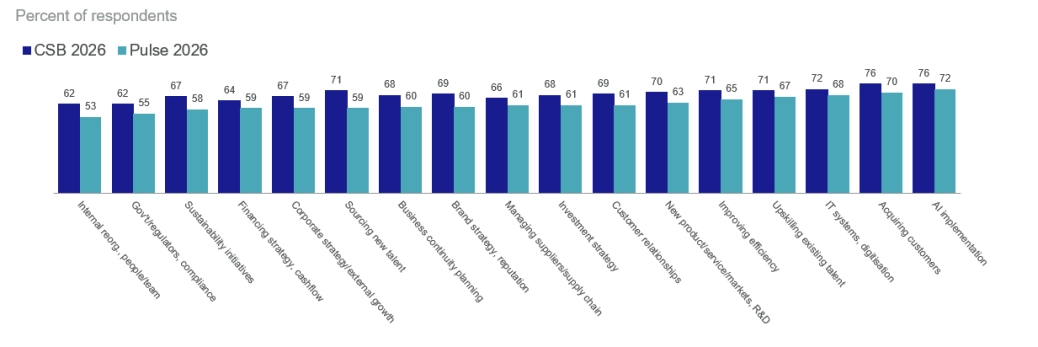
The way businesses access funding for growth is evolving. Strategic alliances and joint ventures are becoming more prominent as organisations look for flexible ways to scale and open up new opportunities without over-committing capital – and private equity funding is not far behind in appetite. Together, these shifts point to something more fundamental than short-term caution. They may signal a broader rethinking of strategy.
Diversification is increasingly at the centre of this, moving from the margins of strategies. Across markets, capital allocation, operating models and partnerships, leaders are moving away from concentration and towards a more distributed approach to growth. Expansion is still happening, but it is being directed with greater care towards markets that offer more favourable opportunities as well as conditions. In turn, trade relationships are being reassessed and, in many cases, redirected. Importantly, technology investment has not been drowned out by the noise of escalating geopolitical conditions. It continues at pace and now with a clearer emphasis on outcomes as concrete returns from AI investments are beginning to emerge from organisations.
This more deliberate, diversified approach reflects a growing awareness of the limits of control. While optimism about growth remains high, confidence in navigating the conditions shaping that growth has dropped drastically. Many of the forces influencing business performance today sit outside any organisation’s direct influence and are becoming harder to anticipate or mitigate. As a result, decision-making is becoming more measured. Capital is still deployed, as we can see, but with more scrutiny. Expansion continues, but with more built-in flexibility. In this context, strategies built on singular bets are now increasingly exposed.
The organisations that are adapting most effectively are those treating diversification as tactical design choice rather than a reactive adjustment. They are spreading exposure across different markets and models but doing so with intent – aligning choices to where they can create and sustain value, rather than simply diluting risk. That requires more coordination across the business, clearer prioritisation, and a stronger link between investment decisions and outcomes. It also requires a shift in how diversification itself is viewed, which shouldn’t be as a short-term solution.
Traditionally, it has been framed as a defensive measure, something to protect performance in uncertain conditions or in response to performance issues. What we can see now is that it’s being viewed and approached differently: as an enabler of growth in an unpredictable world and where uncertainty is the norm. When done well, diversification creates the flexibility needed to enable organisations to respond more quickly to change, take advantage of opportunities as they emerge, and avoid becoming overly dependent on any single market, model or assumption – essentially, for the long-term.
The challenge for leaders now is to apply that thinking with discipline. Deciding where to diversify, how far to extend, and how to balance resilience with ambition will define the next phase of strategy for many organisations, but the priorities will vary depending on the size, sector and geography. This is particularly true in areas such as AI, where the focus is moving decisively from intent to demonstrable and responsible impact.
At this point, the overall picture is now one of continuity – in adapting to build resilience while supporting ambitions, but also a change in approach. Growth has not become harder to achieve; it remains within reach. It has simply become more conditional on managing it in a challenging environment. Against the current backdrop, resilience comes from building flexibility into strategy, as diversification shifts from a choice to a critical condition for this growth.
Key contact

29 Jan 2026
C-suite barometer: outlook 2026
Our study uncovers a business world embracing change, investing in technology and people, and reimagining strategies to stay ahead of disruption and competition. Success now rests on adaptability as much as ambition.

4 Jun 2026
C-suite barometer: 2026 mid-year insights
At the start of the year, our C-suite barometer uncovered a business world embracing change, investing in technology and people, and reimagining strategies to stay ahead of disruption and competition. Six months on, the latest mid-year insights point to diversification as the defining condition for growth.