- Most (96%) C-suite leaders in financial services reported a positive growth outlook but only 36% were very confident in managing the external trends that have the biggest impact on their business – down 16 points from last year.
- Economic uncertainty (37%), increased competition (35%), energy prices or shortages (33%) and political tension (32%) are the factors most likely to hold back growth for businesses in the financial services sector.
- The top external trends having the biggest impact on businesses are confirmed by leaders as economic factors (37%), energy prices and shortages (31%), the emergence of new technologies (30%) and new or higher regulations (also 30%).
- For leaders in this sector, transforming company IT and technology remains the top strategic priority (41%), followed by new or revised talent strategies (28%), international expansion (27%) and private equity investments (27%).
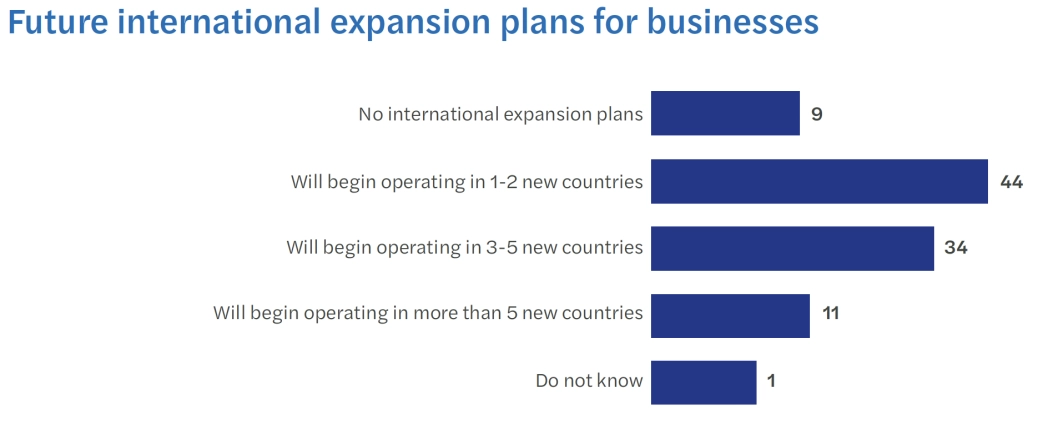
- A majority of leaders (89%) plan to expand internationally to at least one country or more in the next five years, with the U.S. confirmed as the top destination at the start of the year.
- Three quarters of executives in financial services have dedicated digital transformation strategies, prioritising efficiency and productivity, security, risk management and growth.
- Korea faces distinct and mounting risks: the rapid expansion of household debt, the vulnerability of its export-driven economy to global slowdowns, rising credit and investment losses, and increasing public distrust due to repeated internal financial scandals—all of which have prompted stronger regulatory intervention.
Forvis Mazars in Korea, a leading international audit, advisory, and consulting network, has published its 2025 C-suite barometer: Financial Services sector view, drawing insights from more than 1,700 financial services executives across 35 countries. The report explores how industry leaders are navigating today’s complex global landscape, addressing digital transformation, talent acquisition, regulatory headwinds, international expansion, and sustainability priorities, with particular relevance to the structural dynamics of the Korean financial market.
The recent reveals that 96% of financial services executives maintain a positive outlook for growth in 2025, yet only 36% expressed strong confidence in managing the external trends affecting their business, a 16-point drop from 2023, underscoring a widening gap between ambition and readiness.
Digital transformation and talent strategy top the industry’s strategic agenda. The report finds that a significant majority of financial services firms have already implemented dedicated digital transformation strategies, and 76% of executives confirmed the presence of such plans. Meanwhile, 66% indicated active plans to adopt generative AI, reflecting growing interest in leveraging advanced technologies beyond conventional automation.
Emmanuel Dooseman, Partner and Financial Services Leader at Forvis Mazars Group, mentioned, “Simply adopting new technologies or hiring talent is no longer sufficient. Financial institutions must build integrated, agile capabilities that embed these assets across the organization. A good example is regulatory reporting, a historically burdensome area now undergoing accelerated transformation through AI and automation. We're seeing improved reporting efficiency and accuracy, and more importantly, the potential to evolve into predictive and insight-driven reporting.”
International expansion also remains a key focus. 89% of financial services firms plan to enter at least one new market over the next five years, with the U.S. remaining the most preferred destination. Asset managers, in particular, identified overseas growth as their second-highest strategic priority, driven by the dual goals of diversification and access to new investor bases.
Interestingly, sustainability reporting has slipped down the list of priorities. The percentage of firms producing sustainability reports fell from 82% to 52%, while 61% of executives view ESG reporting requirements as a cost rather than a strategic opportunity. The report attributes this shift to regulatory complexity and data quality challenges, pointing to the need for stronger technology-driven ESG strategies and third-party data partnerships.
Je-Han Kim, Audit and Financial Services Partner at Forvis Mazars Korea, emphasized that the challenges facing the financial services sector are not unique to Korea but are deeply intertwined with global developments. “The Korean financial industry, particularly insurers, has seen sustained and stable growth in recent years, fueled by a strong flow of capital into high-yield alternative investments, PF loans, and real estate trust products. This trajectory closely mirrors the broader outlook shared by financial services leaders around the world. However, Korea also faces distinct and mounting risks: the rapid expansion of household debt, the vulnerability of its export-driven economy to global slowdowns, rising credit and investment losses, and increasing public distrust due to repeated internal financial scandals—all of which have prompted stronger regulatory intervention. Looking ahead, the Korean market must pursue growth, but with a far more robust and clearly defined approach to risk management.”
As the financial services sector navigates a perfect storm of regulatory change, geopolitical instability, technological acceleration, and talent shortages, the 2025 C-suite Barometer offers a clear view into how global and Korean firms are recalibrating strategy in real time.
The full report is available at: forvismazars.com/kr
– ENDS –
Contacts
Tae-Hee Kong, Marketing and Communications, Forvis Mazars in Korea
Tae-hee.kong@forvismazars.com / +82 (0)2 3438 2457
Heather McMaster, Group Head of PR and Content
Heather.McMaster@mazars.co.uk / +44 (0) 20 7063 4165
About Forvis Mazars
Forvis Mazars Group SC is an independent member of Forvis Mazars Global, a leading professional services network. Operating as an internationally integrated partnership in over 100 countries and territories, Forvis Mazars Group specialises in audit, tax and advisory services. The partnership draws on the expertise and cultural understanding of over 35,000 professionals across the globe to assist clients of all sizes at every stage in their development.
About Forvis Mazars in Korea
Forvis Mazars in Korea (Forvis Mazars Sebit Accounting Corporation) is a member of Forvis Mazars Group, a leading professional services network. Specializing in audit, tax, advisory, and outsourcing, Forvis Mazars in Korea supports local and foreign-invested companies operating businesses in Korea and globally. With expertise and cultural understanding, our 100+ professionals assist clients of all sizes at every stage of their development.
Visit forvismazars.com/kr to learn more.