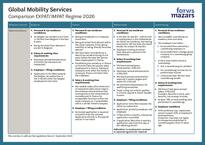
| Main conditions | 1. Personal & tax residence conditions: - No Belgian tax residency nor lived in 150 km from Belgium in the last 5 years
- Being recruited from abroad or posted in Belgium
2. Salary & working time requirements - Minimum annual remuneration: €70,000 (No minimum for researcher)
3. Employer / filling conditions - Application to be filled towards the Belgian tax authorities in the 3 months after the Belgian employment start date
| 1. Personal & tax residence conditions: - Being an employee or a company Executives
- Being recruited from abroad within the same company (intra-group mobility) or being directly recruited abroad
- Not have been considered as a French tax resident during 5 civil years before the year the person takes employment in France
- Establishing tax residency in France as from the date the person takes employment in France. Tolerance measures exist when the family is coming to France a bit later than the employee.
2. Salary & working time requirements - Net taxable salary after deduction of exempted salary must respect the reference remuneration that corresponds to the remuneration normally paid in France for comparable functions within the same company or, if unavailable, within a similar French company.
3. Employer / filling conditions - No formal application is required to benefit from the scheme. Application directly in the payroll and/or in tax return
| 1. Personal & tax residence conditions: - In the last 24 months - before start of employment in the Netherlands:
No Dutch tax residency; Not having lived within 150 km from the Dutch border for at least 16 months - Employee is being recruited from abroad or posted to the Netherlands
2. Salary & working time requirements - Minimum annual gross remuneration: €48,013
- Maximum annual remuneration: €262,000
- Minimum annual remuneration required if master degree and under 30: €36,497
- No minimum remuneration for qualifying researcher
- Expat-ruling can only be applied in a Dutch payroll to Dutch taxable income
3. Employer / filling conditions - Application to be filed towards the Dutch tax authorities
- Application jointly by employer and employee
- If filed within 4 months, retroactive application is possible
- If application filed after 4 months; application only from first day of the following month
Addendum to employment contract or separate agreement required | 1. Personal & tax residence conditions: - Must establish Luxembourg tax residency from start date;
- The employee must either:
- be recruited from abroad by a Luxembourg employer; or
- be seconded from a foreign group company to a Luxembourg group company.
- In the 5 years before arrival in Luxembourg:
- Not a Luxembourg tax resident
- No Luxembourg income tax on professional income
- Lived more than 150 km from Luxembourg border
2. Salary & working time requirements - Minimum fixed gross annual salary: €75,000;
Excludes: Benefits in kind, cash benefits, tax-exempt income; - At least 75% of total working time performed in Luxembourg.
3. Employer conditions - 30% workforce cap: Impatriates cannot exceed 30% of employer's total workforce;
Exception: Cap does not apply to companies established in Luxembourg less than 10 years ago.
|
|---|
| Tax benefits | Above the minimum remuneration, tax free costs proper to the employer up to 35% of this gross minimum remuneration can be granted. | - Additional compensation linked to the exercise of a professional activity in France (impatriation premium) is tax-exempted (or option for flat premium up to 30% of the net taxable remuneration)
- The portion of the remuneration linked to the days worked outside of France in the interests of the employer is tax-exempted
-> Tax exemption applies within certain limits. - 50% tax exemption for foreign passive income: investment income, capital gains, intellectual and industrial property rights
| - Tax free allowance up to 30% if minimum annual remuneration is reached. As of 2027, the tax free allowance is up to 27%.
No tax free allowance above maximum annual remuneration. - Qualifying expats could opt for deemed non-resident taxpayer status, which gives an exemption for taxation on wealth/assets. Note that this status is abolished per 2025 for new applicants. For 30%-ruling holders as per December 2023, the special status can be applied until ultimately 31 December 2026.
| The 50% exemption until maximum gross annual remuneration of €400,000. |
|---|
| Social security benefits | Above the minimum remuneration, tax free costs proper to the employer up to 30% of this gross minimum remuneration can be granted. | Expatriates may be exempted from the schemes of basic and supplementary old-age insurance ("pension opt-out scheme"). | Tax free allowance up to 30% if minimum annual remuneration is reached. As of 2027, the tax free allowance is up to 27%.
No tax free allowance above maximum annual remuneration. | The impatriate tax system is only a income tax relief. |
|---|