

Operation Excellence - Precise Cost Reduction: Redefining Financial Efficiency
"Why do we earn so much but keep so little?"
"What should be the first step when profit warnings appear?"
"Where is the cost out of control?"
"What should be the first step when profit warnings appear?"
"Where is the cost out of control?"
In today's highly competitive business environment, improving profit and efficiency has become the core issue for enterprises to achieve long-term success. Many businesses face challenges that affect their profitability and production efficiency, ranging from improper processes to insufficient resource allocation. Ultimately, these issues often manifest in financial reports—declining profit margins, tight cash flow, and rising operation costs.
Precise cost reduction is not simply about blindly cutting expenses. Instead, it involves using scientific methods to identify and correct underlying structural problems.
In practice, we typically approach our clients' issues from the following perspectives.
Step 1: Identifying the Problem
- Financial Data Review – Analyse in detail the revenue, costs, expenses, and cash flow, we identify unusual fluctuations or structural deviations.
- Understanding Operational Model – We gain a deep understanding of the company's business processes, organizational structure, and resource operation model to pinpoint areas of inefficiency or resource waste.
- Industry Benchmarking – Leveraging extensive industry knowledge, we benchmark against comparable peers to identify potential gaps and quantify areas for improvement.
Identifying the problem is the first step in cost reduction and efficiency enhancement. Only by clearly pinpointing the root causes of the issues can we formulate effective and sustainable solutions.
Step 2: Locating the Core Issues and Building a Cost Reduction Map
In the process of cost reduction and efficiency enhancement, accurately pinpointing the core issues and systematically organizing a clear "cost reduction map" is a critical step for successful implementation. We generally follow the logic outlined below:
- Identify Cost and Efficiency Bottlenecks – By combining financial analysis, process reviews, and management interviews, we identify key areas that lead to profit erosion and inefficiency.
- Systematically Identify Cost Reduction Opportunities across the Value Chain – We break down the entire value chain, from R&D, procurement, and production to sales and back-end support, to identify cost reduction potential and evaluate the impact at each stage.
- Prioritize Cost Reduction Opportunities – We categorize cost reduction opportunities into high, medium, and low priorities based on the "impact level × feasibility" matrix, ensuring the most efficient use of resources.
- Create the Cost Reduction Map – All potential cost reduction opportunities and pathways are systematically organized and visualized, creating a cost reduction map that serves as a guide for subsequent solution development and implementation.
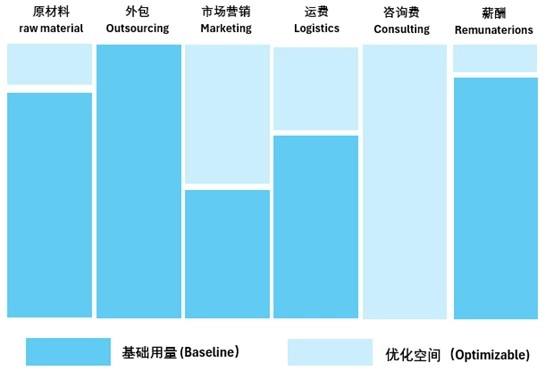
Precise cost reduction is not about cutting everything; it’s about systematically identifying and focusing on the areas where adjustments will yield the most value. By strategically pinpointing the right opportunities, businesses can optimize their resources and drive more sustainable improvements without unnecessary sacrifices.
Step 3: Quantify Goals and Implement
Turning "potential" into "cash flow" is the true essence of cost reduction. Precise cost reduction is not just about identifying opportunities; it’s about transforming those opportunities into tangible financial results.
Based on the cost reduction map, we help businesses set measurable and trackable optimization goals, and through project management, ensure that each cost reduction measure is effectively executed. We typically design key elements as follows:
- Set Quantifiable Goals – For example, reducing raw material costs by x%, improving labor efficiency by x%, and shortening the cash cycle by x days.
- Develop an Execution Roadmap – Clearly define the responsible person for each cost reduction initiative, set timeframes, and establish key performance indicators (KPIs).
- Allocate Resources and Provide Incentives – Ensure key cost reduction projects are provided with the necessary resources, and establish a reasonable incentive mechanism to create a feedback loop for execution.
- Ongoing Monitoring and Adjustment – Regularly review and identify any deviations, dynamically adjusting plans to ensure the financial outcomes are achieved.
Precise cost reduction is not a quick sprint but a detailed, result-oriented management process. We believe that only through real execution can cost reduction truly make an impact.
Step 4: Summarize and Enhance, Build a Sustainable Cost Reduction System
After the cost reduction plan is implemented, we help businesses review the entire process, extract key experiences, and solidify methods to create a continuous optimization system. This ensures that cost reduction is no longer reliant on individuals or one-time efforts, but becomes an intrinsic driving force for business development.
In addition to continuous evaluation, we also implement data-driven decision-making tools, such as creating dashboards, to enable management to monitor the progress and effectiveness of cost reduction efforts. By institutionalizing the cost reduction process, businesses can foster a culture of ongoing improvement, ensuring long-term sustainability and continued financial success.
Conclusion
In corporate financial management, both revenue growth and cost control are equally important. Revenue generation increases income, while cost control improves profit through precise cost reduction, optimizing resource allocation. Precision cost reduction is not just about cutting costs—it's about smartly managing profits, enhancing operational efficiency, and improving long-term profitability.
If you’re looking to optimize costs and improve financial efficiency, we can provide you with customized cost reduction solutions. Our expertise will help you precisely identify cost-saving opportunities and implement more efficient profit management. Let’s work together to empower your business for sustainable growth!
Read more related insights:
- “Precision Cost Reduction: Apparel Industry Enterprise Case Study”
- “Precision Cost Reduction: Manufacturing Enterprise Case Study”
Contact

Steve MOU Hailong Senior Manager, Financial Advisory Services - Shanghai

Sirita XU Wenqian Manager, Financial Advisory Services - Shanghai

Precision Cost Reduction Case Study
Background: An apparel fashion brand faced increasing cost pressures in recent years. Although their sales revenue grew, profit margins continued to decline, and operating costs kept rising. The main issues were found in raw material procurement, production processes, and inventory management. By collaborating with us, the company aimed to optimize their cost structure, improve financial efficiency,...