

Home or away – remapping expansion and trade plans
InsightsC-suite barometerC-suite barometer: outlook 2026C-suite barometer: 2026 mid-year insights
Home or away – remapping expansion and trade plans
29 July 2026
At the start of the year, C-suite executives had a clear mandate: invest, expand and compete. Now, six months into 2026, our mid-year findings reflect a heightened set of global pressures, with sharply different local realities depending on where you are in the world and where you want to expand. While the appetite for expansion remains overall, it’s the destinations of choice for operations and trade that have materially changed, alongside the route for potential success. In this short period, the pursuit of growth has been rerouted at a time when expansion is no longer a linear exercise in market entry – it’s now essential for executives to treat it as a dynamic process of redistribution and diversification targeted for long-term resilience.
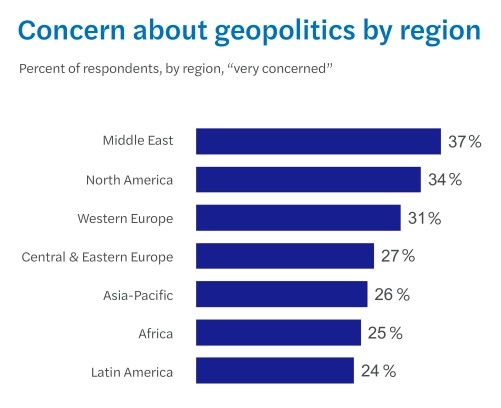
Our latest insights show a major divergence in how businesses view recent global events and geopolitics, with significant concerns as most would expect in the Middle East, but less so in regions such as Asia Pacific. Yet lower concern does not mean lower exposure: the region is experiencing some of the most tangible commercial consequences of shifting global trade flows.
Businesses recognise the need to be far more selective about where they extend operations, the relationships they enter for trade and ultimately where they see the biggest and most stable areas for expansion. How they fund it and the right conditions for operations still need to be in place first regardless of the geopolitical, economic and regulatory instability in their destination of choice. It’s this gap that’s producing a differentiated strategy and a remapping of expansion plans.
The backdrop was defined by transformation and competition priorities, with AI leading the charge of disruptive trends having the biggest impact on businesses and regulatory requirements being the biggest challenge leaders faced when expanding into new territories. It was no surprise then that top destinations of choice included the US, Germany and Canada as what could be perceived as more stable operating shores.
Now, against a backdrop of geopolitical and economic disruption that is becoming increasingly difficult to manage and control its impact on operations, energy, supply, pricing and political friction weigh far more heavily on decision-making, operations and expansion strategies.
Asia-Pacific provides a particularly clear example of how these geopolitical tensions are reshaping commercial realities. As US tariffs continue to impact access for Chinese exports, more goods are being redirected towards regional markets, increasing competitive pressure across the region through competitively priced, increasingly high-quality Chinese products. For businesses in Asia-Pacific, the consequences from US-China tensions are therefore not simply geopolitical: it's changing trade flows, pricing dynamics and the competitive landscape in which they operate. The first sign of this rerouting is geographic.
Increasing trade plans
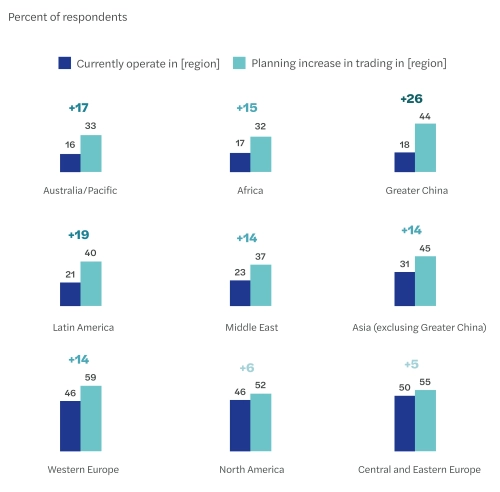
The largest gaps between existing operating presence and planned trade increases are not in the most established markets, but in places where many organisations are currently less embedded. Greater China shows the biggest jump, with only 18% currently operating there versus 44% planning to increase trade – a gap of 26 points. Latin America shows a 19-point gap with 21% of organisations currently operating there and 40% looking to boost trade relationships, while Australia and Asia-Pacific show a 17-point gap of 16% operations to 33% boosting trade. Africa also stands out, with 17% confirming current operations and 32% planning trade relationships. This suggests that leaders are not simply doubling down on their largest existing footprints. They are redirecting activity towards underweighted regions that offer commercial upside, diversification value or both.
The second shift is that proximity is no longer the only logic shaping route-to-growth decisions. Findings show that international businesses still tend to operate and expand into adjacent regions, but Central and Eastern Europe is an exception: it’s drawing strong growing trade interest from all other regions worldwide, not just neighbours, and is the only region to do so. That makes it more than another destination on the expansion map. It is starting to emerge as a strategic anchor – part growth market, part balancing market, part resilience play.
The third and perhaps most commercially relevant development is that expansion is being reordered around operational readiness. The investment index remains relatively strong at 62%, but it has fallen seven points in six months, and the areas receiving emphasis have changed. Supply chain and supplier management is the only area across all business operations to have gained ground, while the likes of investment in sourcing new talent, sustainability and brand reputation have all dropped. This is an important distinction, especially given the urgency with which leaders have tried to tackle talent scarcity as a hindrance to growth over the last few years. So, when looking at the shift in investment, leaders are not stepping back from expansion; they’re simply having to prioritise the foundations that make it durable – focusing less on the optics of scale, and more on the operational backbone that supports it and on building the roads of supply certainty that make their destinations reachable and delivery capable.
This is also visible in how businesses are choosing to scale. Strategic alliances and joint ventures are now the leading source of growth funding at 50%, ahead of private equity at 44%. In this environment, partnerships are doing more than filling capital gaps. They offer access to customers, local infrastructure, knowledge and lower-risk entry routes. Expansion is becoming less solitary and more networked.
Meanwhile, AI is quietly changing the quality of these decisions with clear returns now being reported on AI investments. This matters because it gives leadership teams a stronger internal efficiency base from which to expand – especially as it has already created real headroom in productivity, most notably in the TMT and financial services sectors.
Considered collectively in expansion planning, the findings point to a more sophisticated model than the one many leadership teams were planning to pursue at the start of the year. Growth plans have become more conditional, more distributed and more operationally disciplined. The smartest organisations are no longer asking only where demand sits; instead, they’re asking which destinations strengthen the portfolio, which relationships reduce exposure and which operating environments enable growth to continue when volatility persists.
That is the real diversification: expansion should no longer be treated as a race for reach, but as an exercise in rerouting towards resilience. To achieve this, more than ever, strategic expansion cannot be set from a single vantage point. Seeing the big picture matters, but so does understanding the local conditions that will determine execution. The most effective organisations are those that operate with both perspectives in view.
Key contact

15 Jun 2026
AI enters its ROI era
Artificial intelligence continues to sit at the heart of C-suite’s transformation ambitions – fuelled by promise, experimentation and competitive pressure. That finding in our barometer remains intact, but the reality over the past six months has sharpened. Chief Transformation Officer, Florence Sardas, reveals fresh findings from our latest mid-year insights, which shows AI has moved on from intent,...

15 Jul 2026
Divergence defining business
The global business narrative at the beginning of the year was one of alignment on the need to adapt amid uncertainty: strong growth expectations, shared priorities around technology investment, and this broadly consistent response to disruption. That consensus is now fragmenting. Our latest findings, six months on from the initial business outlook, reveal a widening divergence of ambition across...