


Payroll Newsletter Q4 2026
6 October 2026
Tags
HR & payroll
Global mobility & employment tax
Employment
Newsletter
1. Introduction of alternative penalties into the Belgian Social Criminal Code
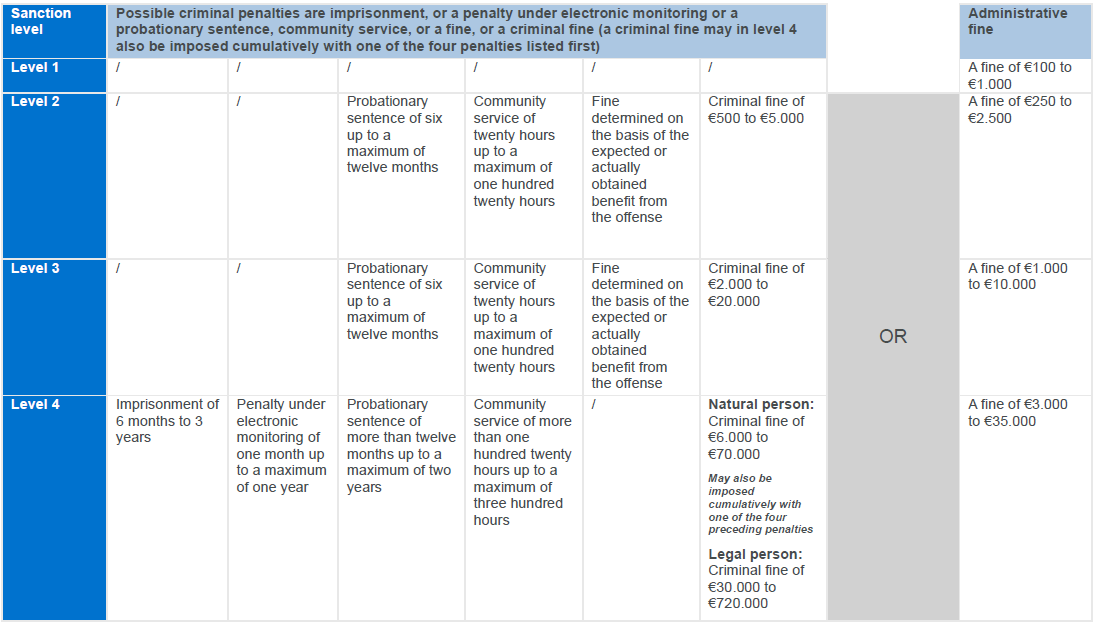
As of 1 September 2026, important amendments to the Belgian Social Criminal Code entered into force. The most significant change is the introduction of alternative penalties for social law infringements.
Until now, sanctions mainly consisted of administrative or criminal fines and, for the most serious offences, imprisonment. Under the new rules, courts can now also impose alternative sanctions for level 2, 3 and 4 offences, including probation penalties and community service penalties. For level 4 offences, these sanctions may even be combined with a criminal fine.
Belgian authorities and courts now have a broader and more flexible range of sanctions available to address violations of social and labour legislation. The reform gives judges greater flexibility to tailor sanctions to the specific circumstances of a case and reflects a broader move towards a more proportionate and modern enforcement system. It also strengthens the position of labour inspectorates, the labour auditor’s office and the courts by providing a wider range of sanctioning tools, including electronic monitoring and financial penalties linked to unlawfully obtained economic benefits.
To ensure the effectiveness of these new sanctions, the legislator has introduced substitute penalties where a probation penalty or community service penalty is not carried out.
In addition to the introduction of alternative penalties, the reform updates terminology, aligns sanction levels with the new Criminal Code and introduces several technical amendments relating to fines and penalty calculations.
2. Mandatory working time registration from 2027
As of January 2027, all employers in both the private and public sectors in Belgium will be required to record their employees’ working time through an objective, reliable and accessible system. This requirement is a consequence from European case law, which has established that employees’ rights relating to maximum working hours and minimum rest periods cannot be effectively enforced if working time is not properly monitored.
Under the new draft legislation, employers will be required to maintain a record of employees’ daily and weekly working hours. The objective is to ensure compliance with the rights granted under the European Working Time Directive and to provide greater visibility over any overtime worked. While employers will be required to record and retain this information, they will not need to submit it systematically to the authorities. Any digital system, such as a time-tracking app, a badge system or integrated scheduling software, can be tailored to the company’s needs, taking into account specific departments and roles (e.g. employees with fixed versus variable work locations, remote workers, technicians or field staff, etc.).
Although the legislation is expected to enter into force on 1 January 2027, the Ministry of Employment has indicated that companies will have until 1 April 2027 to fully comply with the new obligations. Since there is currently only draft legislation, it is only once the law has been effectively enacted and published that it will be clear exactly which practical rules, exceptions and penalties will apply.
3. Obligatory internal regulation for private investigation: deadline is approaching
Reminder: employers have until 16 December 2026 to comply with the PIA.
The Belgian Private Investigation Act (PIA), which entered into force on 16 December 2024, requires employers conducting internal investigations involving employees to have an internal regulatory framework in place by 16 December 2026.
Although many organisations associate the PIA with private detectives, its scope is much broader. The legislation also applies to internal workplace investigations concerning, for example, suspected fraud, theft, conflicts of interest, breaches of company policies, competitive activities and other forms of employee misconduct, such as collecting evidence in the event of termination for an urgent cause. But even if an employer wants to verify a candidate’s professional background to ensure that he can trust the candidate enough to enter into an employment contract, this constitutes a private investigation.
Note that the obligation is not only limited to large organisations or companies that frequently conduct investigations. Any employer that may investigate employees in the future should assess whether the PIA applies to its activities.
What must be in place?
Before launching an investigation, employers must have a regulation that clearly authorizes private investigations and sets out the rules governing them. The regulation should specify who may conduct investigations, which situations may trigger an investigation, which investigative methods may be used and how investigations will be carried out in practice.
No specific format is required. The framework may take the form of a company policy, an annex to the work regulations, a collective bargaining agreement or another appropriate internal instrument.
Risks of non-compliance
Investigations conducted after 16 December 2026 without the required framework may be declared null and void. As a result, findings may be disregarded, evidence may become unusable in legal proceedings and employers may face challenges when defending disciplinary measures or dismissal decisions.
Organisations should not wait until an investigation becomes necessary. A compliant internal investigation framework must be in place by 16 December 2026 to ensure future investigations can be conducted lawfully and that any resulting evidence remains enforceable.
How can we help?
Our legal team can support you in navigating this new regulatory framework, ensuring you understand the applicable requirements and assisting you with the draft of the mandatory policy.
4. Mandatory check in and out at work registration postponed until 1 April 2027
A Programme Act of 30 May 2026 extends the mandatory IN and OUT presence registration existing in the cleaning sector to construction activities in immovable property generally and to the supply of ready mixed concrete, for sites where the total value of the works is at least €500,000 excluding VAT. The advance registration will no longer be possible and registration must take place at the moment the person enters the site and again when leaving it. The obligation applies not only to employees, but also to self-employed persons and subcontractors.
This planned extension of the mandatory Check In and Out registration has now been postponed until 1 April 2027. As a consequence, the current check in system remains applicable.
The postponement gives all employers concerned additional time to prepare for the new registration requirements. Further practical information is expected to become available through the Check In and Out at Work platform.
5. Vacation pay for blue-collar workers: temporary increase in contributions as from October 2026
The Belgian Council of Ministers has approved a draft Royal Decree providing for a temporary increase in the social security contributions financing the annual holiday scheme for blue-collar workers, for the period from 1 October 2026 to 31 December 2033.
The measure aims to strengthen the financing of the scheme following the exceptional assimilation of certain days of temporary unemployment due to force majeure for the calculation of vacation pay.
How will employers be affected?
For employers employing blue-collar workers, the measure would result in a temporary increase in the quarterly employer contribution used to finance the annual holiday scheme. The exact extent of the increase has not yet been specified.
While the measure has not yet entered into force, we are closely monitoring the situation and will keep you informed of any updates.
6. Voluntary overtime: new social security treatment confirmed
Since 1 April 2026, employees may perform up to 360 voluntary overtime hours per year, or 450 hours in the hospitality sector, without the need for a specific justification or compensatory rest.
A Royal Decree has now confirmed the social security treatment under this new system. The net remuneration paid for up to 240 voluntary overtime hours, or 360 hours in the hospitality sector, is not considered remuneration for social security purposes and is therefore exempt from ordinary social security contributions, which is now in line with the tax treatment since these hours are tax exempted as well.
What does this mean for employers?
Employers can therefore use voluntary overtime to meet additional staffing needs under a favorable social security regime.
For 2026, employees who performed relance overtime between 1 January and 31 March 2026 will not benefit from the full quota of 240 exempt voluntary overtime hours. The relance overtime already performed will be deducted from this quota. A similar deduction applies in the hospitality sector where other exempt overtime schemes have already been used.
This social security treatment applies retroactively as from 1 April 2026.
7. New update on Restricted Stock Units
Restricted Stock Units (RSUs) are a key component of compensation packages offered by (multinational) companies to attract, motivate and retain top talent.
However, a recent court decision by the Belgian Supreme Court can significantly change the landscape. The court decision confirms that RSUs granted to employees (subject to the Belgian social security regime) should now be considered as a remuneration subject to Belgian social security contributions, increasing the overall cost of these plans significantly.
What are the potential implications for employers?
Companies offering RSUs should carefully assess the impact of this decision on their compensation and reward strategies, including:
- Increased employer social security contributions;
- Employee social security contributions on vested RSUs;
- Potential exposure to historical liabilities and audits;
- Increased focus on compliance and reporting requirements.
Key takeaway
Companies with equity-based compensation plans should assess the impact of this development and determine whether adjustments to their reward strategies may be necessary.
Our Global Mobility team is closely monitoring these developments and is available to support companies in assessing the potential impact on their workforce and compensation strategies.
8. Employment bonus: higher net pay in 2026 for lower-paid employees
Several changes introduced in 2026 have strengthened the employment bonus for lower-paid employees. Since 1 September 2026, adjustments to the thresholds of the social employment bonus have allowed a broader range of employees to benefit from a reduction in their personal social security contributions.
At the same time, the fiscal employment bonus has been enhanced for very low-paid employees, with the increase already reflected in the calculation of wage withholding tax since 1 August 2026.
The result: a potentially positive impact on the net salary of eligible employees, without a corresponding increase in their gross salary.
9. Benefit in kind: a new 20% tax threshold
As from income year 2026, a new tax rule limits the proportion of benefits in kind (BIKs) valued on a lump-sum basis within remuneration packages. Where these benefits represent more than 20% of taxable remuneration, the portion exceeding this threshold is considered excessive.
Exceeding this threshold results in a separate 7.5% contribution payable by the employer (or the company paying the remuneration) on the excess amount. The benefits concerned include, among others, company cars, certain IT and telecommunications equipment, company-provided accommodation, as well as certain stock options. Benefits valued at their actual value are not subject to this 20% threshold.
In practice, employers should therefore review their remuneration packages and closely monitor the 20% ratio in order to anticipate any additional tax costs.
10. Group insurance/hospitalisation insurance request for notification
If your company has set up an extra-legal/employer group insurance (employer pension scheme) or hospitalization insurance for its employees, it is important to notify your payroll provider in time.
This information is crucial to process the payroll administration as completely and correctly as possible. With respect to the employer contributions to the group insurance, a special social security contribution is due (equal to 8.86% on the paid premiums) and is processed in the quarterly Belgian social security return for the fourth quarter of 2026.
11. The replacement of Belgian public holidays occurring in weekends in 2027
With respect to the replacement of Belgian public holidays that occur during weekends in 2027, it is important to respect a specific deadline in case the company wants to fix another replacement date. The decision to replace this public holiday must be taken at company level and needs to be communicated to the employees, before 15 December 2026.
A copy of the notice must be annexed to the work rules and must be sent to the Social Legislation Inspectorate. The following Belgian public holidays will coincide during a weekend in 2027:
- Labour Day: Saturday, 1 May 2027
- Assumption Day: Sunday, 15 August 2027
- Christmas Day: Saturday, 25 December 2027
12. Business travel expenses by using own private car
Under Belgian social security rules, amounts paid by an employer that genuinely reimburse expenses borne by the employer are excluded from the concept of “remuneration” for social security purposes, provided that certain conditions are met.
Regarding travel expenses when the employee (or a director) who does not receive a company car and uses his/her private car for business travels (i.e. no commuting), the employer may grant the employee a lump sum allowance to cover the expenses proper to the use of the private car for professional purposes.
The reimbursement of these business travel expenses can be done in two ways:
- Reimbursement upon expense notes based on the actual expenses incurred;
- Reimbursement by means of a fixed mileage allowance of €0.4452 per kilometer (amount as of 1 October 2026).
This lump sum mileage allowance is adjusted quarterly by the Belgian government. As an alternative to the quarterly rate, an annual rate was published on 16 June 2026 (Circular no. 767) € 0.4761 per km, applicable for the period from 1 July 2026 to 30 June 2027.
Both the quarterly rate and the annual rate are accepted by the NSSO as a “serious norm” for the exemption. However, an employer that opts for the annual flat-rate system for the period 1 July 2026 to 30 June 2027 must maintain that system for the whole period and cannot switch to the quarterly system during that time; conversely, an employer already on the annual system as of the third quarter of 2026 could only move to the quarterly system starting 1 July 2027 at the earliest.
13. Comparison EXPAT/IMPAT tax regime 2026
Thanks to the close collaboration across our network of Global Mobility specialists, Forvis Mazars is pleased to share a high-level comparative overview of the expat tax regimes currently in force in Belgium, France, the Netherlands and Luxembourg.
Discover at a glance the main differences, benefits and eligibility criteria across these four jurisdictions by consulting the full comparative overview here.
Our Global Mobility experts would love to discuss potential applications of such EXPAT/IMPAT tax regimes to you business.
14. Reimbursement of home charging costs for company cars – CREG rates for Q4 2026
The Belgian energy regulator (CREG) has published the electricity rates applicable for the fourth quarter of 2026.
These rates determine the maximum amount per kWh that employers may reimburse employees for charging their company cars at home without giving rise to an additional taxable benefit, provided that the applicable conditions are met.
| Region | Q4 2026 (1 October - 31 December 2026) |
|---|---|
| Flemish Region | €0.3225/kWh |
| Brussels-Capital Region | €0.3688/kWh |
| Walloon Region | €0.3779/kWh |
15. Indexation of lump-sum expense allowances as from 1 September 2026
As from 1 September 2026, the following maximum lump-sum expense allowances have been indexed:
- Homeworking allowance: the maximum monthly allowance for structural and regular homeworking has increased from €160.99 to €164.21. It is intended to cover office-related expenses incurred when working from home, such as heating, electricity, office supplies and general maintenance costs.
- Daily meal allowance: the maximum allowance for business travel within Belgium has increased to €22.08 per day. For employees who permanently are on the road for business travels in Belgium, a fixed monthly allowance of up to 16 times the daily amount, corresponding to a maximum of €353.28 per month for full-time employment, may be granted.
- Accommodation allowance: where an overnight stay is required, the maximum additional allowance has increased to €165.60 per night.
Lump-sum allowances enable employers to reimburse certain work-related expenses without requiring employees to submit supporting documents for each individual cost. However, the allowance must remain justifiable in light of the employee’s role and working circumstances and the same expense cannot be covered through another reimbursement. It is important that a written agreement explicitly states which expenses are covered by a lump sum amount and which expenses are out of scope.
16. Important year-end information for the Belgian December Payroll
- Deadline: Submit December payroll data by 4 December 2026.
- Vacation days: All legal vacation days for 2026 must be taken before year-end (unless force majeure).
- If no data is received by 4 December, remaining vacation days will be processed based on current records; unreported days will be treated as worked. Therefore, ask your employees to take their remaining vacation days or inform if they should be paid out.
Payroll modifications for 2026
In February 2027 Forvis Mazars will prepare and file the Belgian annual tax forms 281.10 for all your employees based on the income of the previous year (i.e. 2026). The employees will require this tax form in order to prepare and file their individual income tax returns.
We are already aware of the payments that have been processed through the payroll in 2026. At this point, what we still require is information on all relevant payments that you have made to your employees that have not been processed via the payroll.
In order to prepare the annual tax forms correctly without extra administrative costs, we kindly ask you to provide us with the amount of the reimbursements of expenses proper to the employer outside of the payroll per employee and per type of reimbursement.
17. Deadlines
| Belgian social security contributions | Due dates |
|---|---|
| 1st advance of Q4/2026 | 5 November 2026 |
| 2nd advance of Q4/2026 | 5 December 2026 |
| 3rd advance of Q4/2026 | 5 January 2027 |
| Balance Q4/2026 (October – December) | 31 January 2027 |
| Wage withholding taxes (monthly basis) | Due dates |
|---|---|
| October 2026 | 15 November 2026 |
| November 2026 | 15 December 2026 |
| December 2026 | 15 January 2027 |
| Belgian personal (resident) income tax return – Income year 2025 (assessment year 2026) | Due dates |
|---|---|
| Filing on paper | 30 June 2026 |
| Filing electronically via Tax-On-Web (simple) | 19 July 2026 |
| Filing electronically via Tax-On-Web (complex) | 16 October 2026 (*) |
(*) Depending on the complexity of the income tax return, in accordance with the instructions of the Belgian tax authorities.
| Belgian non-resident income tax return – Income year 2025 (assessment year 2026) | Due dates |
|---|---|
| Filing on paper and electronically | 20 November 2026 |
Want to know more?

Kim Matthys Director | Employment Law - Ghent

Eva De Bruyne Senior Payroll Manager - Ghent
