
Moving Towards "Self-Fulfilment": China's Premium Consumption Embraces Structural Transformation
The report also reveals five strategic insights:
- The premium market is polarising: Brands must adopt differentiated communication strategies for the "resilient, growth-oriented younger segment" and the "value-conscious group."
- Premium consumption is being redefined from the inside out: The narrative is shifting from status display to craftsmanship, exclusivity, and personal meaning.
- Chinese brands have crossed a threshold: With a wallet share of 34%, they have become core competitors that all brands must confront.
- Value-added services are a growth engine for brands: 75% of consumers link value-added services to purchase decisions, and 89% link them to loyalty.
- Consumers will become more digital, more discerning, and more Chinese in outlook: Nearly half of respondents plan to increase luxury spending once the economy recovers; brands that invest early will capture the opportunity.
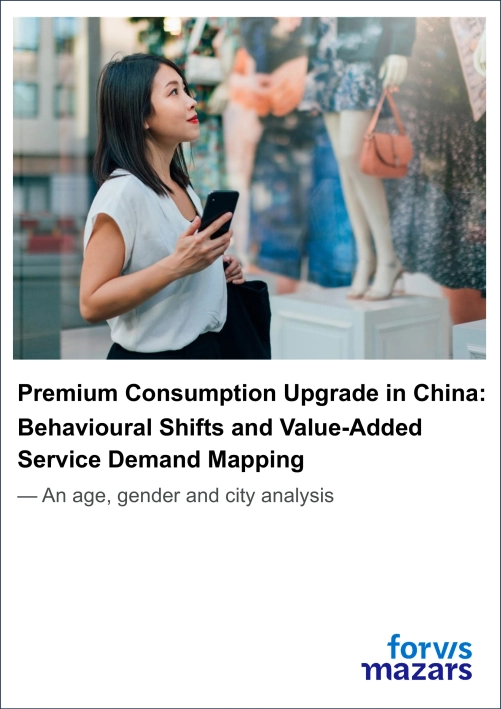
Forvis Mazars releases a survey report Premium Consumption Upgrade in China: Behavioural Shifts and Value-Added Service Demand Mapping—An age, gender and city analysis
The survey was conducted via questionnaire in Q3 2025, collecting 4,604 valid responses and covering four generational groups: Baby Boomers, Generation X, Millennials, and Generation Z. It analyses changes in Chinese consumers' premium consumption behaviour, future expectations, and demand for value-added services, providing actionable data support and decision-making references for product strategy, service design, and resource allocation. This report is the latest outcome of Forvis Mazars' systematic research on Chinese consumers since 2019. Across previous editions on luxury consumption psychology, shifts in lifestyle consumption, sustainable consumption attitudes, and insights into the new generations, to this latest edition focusing on premium consumption upgrade, Forvis Mazars continues to track the structural shifts in Chinese consumers' value judgments and service expectations.
"The era of relying on Western heritage prestige alone is over. The next competitive frontier in China's luxury market demands authentic cultural resonance, operationally excellent value-added services, seamless digital-physical integration, and a genuine commitment to sustainability," said Dr. Julie Laulusa, Managing Partner of Forvis Mazars in China. "The market continues to evolve. Only by clearly understanding the true nature and fundamental shifts of premium consumption upgrade, and by understanding consumers more precisely, can brands make more forward-looking decisions. The brands that will lead this vast market in the future are those that make the right investments today."

Dr. Julie Laulusa, Managing Partner of Forvis Mazars in China
The report notes that China's premium consumption remains in a transitional phase where stabilisation and adjustment are occurring in parallel. Compared with two years ago, 38.7% of respondents reduced premium spending; however, under economic recovery expectations, 49.2% of consumers plan to increase premium spending. Consumption drivers are shifting from external display to intrinsic motivation: self-reward (62%), pursuit of a better quality of life (54%), and everyday needs (47%) are the main reasons for increased premium consumption, with the "everyday premium" trend clearly evident. In terms of price structure, nearly 90% of consumers' single premium transactions are concentrated below RMB 20,000, with the sub-RMB 5,000 segment forming the core of the market. Divergence across consumer groups also shows a clear gradient: Tier-1 cities, Generation Z, and female consumers are more driven by emotional fulfilment, while Tier-2 and below cities, Baby Boomers, and male consumers are generally returning to functional consumption, placing greater emphasis on the practical satisfaction of daily needs.
At the brand-choice level, nearly half of consumers report a broader brand mix than two years ago, and the market is shifting from a concentrated brand landscape to a more diversified and open one. Chinese brands have entered the core competitive tier, accounting for 34% of premium consumption share, projected to rise to 38%, and growing across all generations and income levels. 69% of respondents said they increased consumption of Chinese brands over the past two years. Chinese brands' strong categories are expanding from mass segments such as apparel and footwear, hotels and travel, and consumer electronics into higher-value, more specialised segments such as bags and leather goods, and jewellery and watches. Chinese brands are now competing on the same stage as international brands, continuously building market influence through product strength, brand storytelling, and service capabilities—no longer relying solely on "value for money" to break through, but truly standing at the forefront and redefining the value standard of "what is premium."
Meanwhile, value-added services have become a widely expected baseline element in premium consumption. The report data further validates their strategic weight — three-quarters of respondents view value-added services as "important" or "very important" in purchase decisions, and 89% recognise their positive role in driving loyalty, with the highest recognition among younger and middle-aged consumers. Value-added services are evolving from a supporting factor into a key pillar for premium brands to build long-term relationships and achieve differentiated competition. This finding also formed the basis for discussion at Forvis Mazars' CIIE roundtable, "The experience economy: The next frontier of consumer competition." Centred on the report’s core insights regarding value-added services and consumer experience, the event brought together senior executives from fashion brands, premium spirits, and innovation consulting to jointly explore brand growth paths in the experience economy era.
Notably, the report does not stop at trend insights but proposes eight actionable strategic recommendations for brands, covering reframing value propositions, building a value-added service ecosystem, responding to Chinese brand competition, implementing segment-specific strategies for different generations, investing in phygital infrastructure, building a China-native communication architecture, launching circular economy programmes, and managing long-term customer relationships. These recommendations provide a clear action framework for brands to adapt to the new cycle of China's premium market and fully demonstrate Forvis Mazars' role in supporting corporate decision-making through professional research and enhancing long-term brand competitiveness through pragmatic methods.
Dr. Julie Laulusa added: "Since 2019, this marks Forvis Mazars’ fifth research milestone or China’s consumer market. Markets ebb and flow, yet we firmly believe that what truly matters is not fleeting data, but how consumers’ understanding of value is evolving. Through long-term, systematic observation, we seek to help brands understand Chinese consumers’ shift from ‘external signalling’ to ‘internal gratification’, and turn fragmented insights into shared, actionable directions. Forvis Mazars stands ready to partner with brands. Amid shifting market dynamics, we see the bigger picture; rooted in the local landscape, we will jointly build a more resilient and sustainable future.”