
"As OEMs and suppliers strive to adapt and gain a competitive advantage, AI presents a critical opportunity to slash the high energy costs of automotive part production.”
Emmanuelle Bertuzzi Partner, Forvis Mazars in France

Emerging technologies are now seen as key to enabling car manufacturers and their suppliers to become more competitive. According to the latest Forvis Mazars C-suite barometer, artificial intelligence (AI) was the top investment priority for car manufacturers’ technology transformation plans, followed by data security, infrastructure, revenue growth and operational agility.
In particular, the ability to use AI effectively in the research and development (R&D) process is now seen as key to gaining a competitive advantage in the car industry. As CEOs look to adapt, an advanced, data-driven strategy that leverages AI helps drive down costs by greatly reducing the time needed to develop and produce parts.
The race to adapt and develop faster than before can also be applied across the production ecosystem. For example, introducing new AI-powered production planning tools can yield significant savings in time management and quality control. It also helps to maximise human resources by redeploying staff to more advanced data-driven roles as car manufacturers shift from manual to technology-led business models.
"As OEMs and suppliers strive to adapt and gain a competitive advantage, AI presents a critical opportunity to slash the high energy costs of automotive part production.”
Emmanuelle Bertuzzi Partner, Forvis Mazars in France
In addition, manufacturers are looking to use AI to align the development process with the production platform. AI-driven production platforms can seamlessly integrate with the development process, resulting in significant time and cost savings.
In the past, building R&D centres in low-cost countries held attractions for the car industry. However, the increasing use of AI requires CEOs to consider the location of R&D centres and where AI expertise is based. Having AI developers sourced elsewhere creates complex regulatory, legal and operational risks.
Such an approach can trigger conflicting jurisdictional requirements. Questions about where human responsibility lies can significantly raise cybersecurity and IT risk levels, particularly when data must be stored locally or when access is restricted. Supply chain security and data ownership rules are further considerations. In addition, uneven AI regulations can also create compliance problems regarding standards, transparency and ethics. While cost savings are key, careful consideration of the right balance between the efficiencies gained and the risks involved is vital.
CEOs know that implementing AI requires significant investment, but any implementation decision is only as good as what it aims to achieve. Whether it’s for cost savings, production efficiency or R&D, each project should clearly reflect its goals and identify where AI can help ensure those goals are met.

“When implementing AI, it’s critical that you are clear on why and how you are using it. The second critical point is the efficiency of implementation: you need a strong but flexible plan and you need to back it up with the investment levels.”
Christian Back Partner and Group Head of Automotive, Forvis Mazars in Germany
It’s also important to build in plan corrections along the way. AI implementation is non-linear: the speed of AI’s evolution alongside external economic and geopolitical factors requires a flexible approach to AI-critical strategies, investment and training.
According to the latest Forvis Mazars C-suite barometer, automotive leaders’ main supply chain investment priorities include integrating new technologies and growth ambitions in current markets. In the long term, the integration of new technologies will help reduce the reliance on, for example, rare earth for electric car batteries. At the same time, there is a shift from global to regional production to reduce transportation costs and reliance on distant markets.
However, as deglobalisation of the car industry continues, any 'local-for-local' approach to reduce costs and source components and raw materials closer to home creates both opportunities and challenges along the supply chain. Not least, requiring manufacturers to reinvest in local expertise to maintain any competitive advantage.

“As geopolitical instability increases, the reliability of the supply chain is becoming a hot topic in the automotive industry. It’s pushing more players to look at local suppliers as well as using emerging technology to reduce reliance on rare earth materials.”
Matthias Frye Senior Manager, Forvis Mazars in Germany
In addition, geopolitical instability is raising questions on the reliability of supply chains, compounded by tariff-driven cost increases. The agility to understand and assess the impact and risks on a location-by-location basis is essential. It requires a data-driven strategy and skilled talent to source alternatives and protect margins in real time.
In response to competition and the need to grow, OEMs and, increasingly, automotive suppliers are looking beyond core markets. Among the most challenging external trends are economic uncertainty, and increased competition. Diversifying resources is the key operational shift in reaction to global trade disruption for leaders in the sector, according to the Forvis Mazars C-suite barometer. By identifying and applying existing strengths to new market opportunities, CEOs can diversify revenue streams, optimise performance and maximise value.
Outside automotive, growth opportunities lie in the agriculture and defence sectors, where leveraging existing car fixture expertise can be applied. The high level of automation already present in the industry also helps to efficiently transition into these new markets.
In terms of growth opportunities within the sector, data-driven diversification involves suppliers monetising proprietary insights, while product licensing extends revenue streams. Longer-term, shifting consumer mindsets toward a ‘feature-on-demand' model when purchasing cars offers potential for transformative growth.
To thrive amid automotive disruption, integrating emerging technology is essential. An advanced data-driven approach leveraging AI can drastically reduce production cycles, drive efficiencies and unlock new opportunities, allowing companies to foster growth and remain competitive.

Every year, we conduct research to understand the priorities and issues at the heart of our clients’ businesses. Our C-suite barometer gathers the views of executives from all over the world, giving us valuable insight into key topics on their agenda, the trends and transformations they expect to impact their company, the challenges and opportunities they are facing and their outlook for the year...
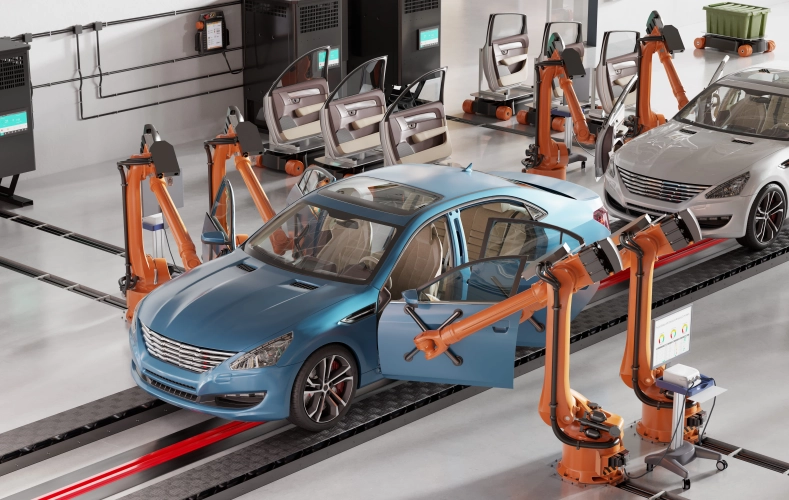
Profound disruption is reshaping the automotive landscape as electric vehicle growth and new market entrants intensify competition among traditional OEMs and suppliers. While technological advancements fuel this disruption, they also offer significant opportunities for cost optimisation and diversification.

The automotive industry has long been synonymous with precision engineering and just-in-time production. But, as vehicles become increasingly connected and supply chains grow more complex, cyber security has emerged as one of the sector's most pressing challenges and recent high-profile incidents have made it impossible to ignore.

Manufacturers understand the potential of AI but need to do more to prepare their organisations for transformation. Technology upgrades, expert advice and a rigorous approach to use-case selection will ultimately deliver real-world results.

AI increasingly occupies a central role in digital transformation initiatives. For many companies, however, large-scale deployments are not yet a reality. Some are preparing to launch AI transformation projects. Others are adjusting their approach after initial experiments generated mixed results. How should organisations approach the opportunities created by a transformative technology?




This website uses cookies.
Some of these cookies are necessary, while others help us analyse our traffic, serve advertising and deliver customised experiences for you.
For more information on the cookies we use, please refer to our Privacy Policy.
This website cannot function properly without these cookies.
Analytical cookies help us enhance our website by collecting information on its usage.
We use marketing cookies to increase the relevancy of our advertising campaigns.