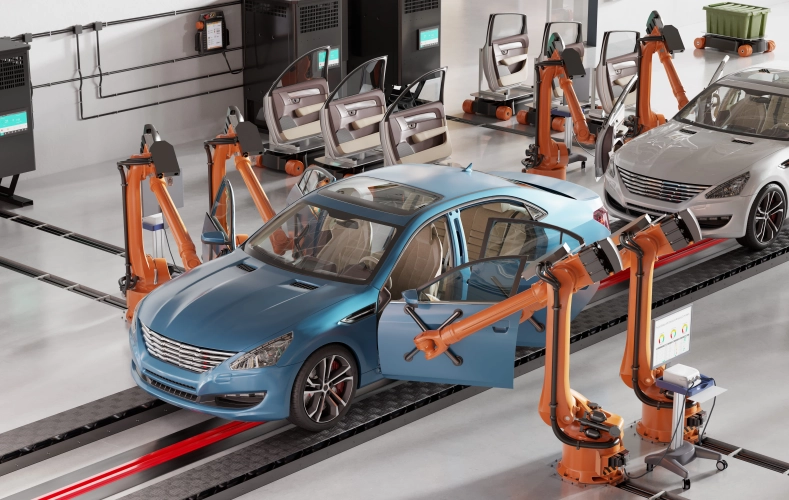
In addition, many companies are overwhelmed by the size of technology transformation and AI-led projects. However, often small steps can be taken to achieve substantial wins. Simple projects such as automating manual payment processes and integrating data into enterprise resource planning (ERP) systems help improve processes. Starting with small, incremental technology projects that highlight the benefits of change can help build confidence and demonstrate value before stepping up transformation projects.
Demonstrate value before scaling up and apply caution
The race to implement AI is reshaping businesses in the sector both top-down and bottom-up. Two-thirds of manufacturing C-suite leaders say that AI is having a major impact on their company, up 16 points since 2025. Four in five have already restructured their teams to implement AI.
Uptake of AI across companies is strong, with operational optimisation and automation the primary AI drivers for manufacturing leaders. However, many are still navigating early-stage implementation.
To progress efficiently, manufacturers should focus on developing targeted use cases that align with core business needs, proving value before scaling up. Taking a strategic and cautious approach to AI adoption also helps avoid costly mistakes.
Supply chain resilience remains a top priority
C-suite barometer results show that manufacturing leaders’ main supply chain investment priorities are the integration of new technologies and the growth of operations in current markets.
Following lessons from the Covid pandemic, the need for manufacturers to diversify suppliers and reduce dependence on single or hostile regions continues as pressure from geopolitical tensions, tariffs and global events builds. To counteract disruption and mitigate risks, nearshoring and building local supplier networks are growing trends.
Rising costs are also taking their toll. While many manufacturers are having to pass increased supplier costs on to customers, they are also seeking efficiencies and redesigning products to manage price pressures and reduce reliance on a single supplier where possible.
Navigating growth and competitiveness amid uncertainty
Although slightly down from previous C-suite barometer results, optimism on growth prospects remains relatively high among manufacturing leaders. The most challenging external trends to growth are economic uncertainty and increased competition. Diversifying resources is the key operational shift in reaction to global trade disruption for leaders in the sector. More than half of companies are also pursuing services consolidation.
For many companies, it’s a question of survival: learning to live in a business environment constantly underpinned by uncertainty. As a result, some manufacturers are taking a conservative approach and pulling back from expansion goals to protect balance sheets.
However, where growth pockets remain strong, manufacturers are expanding and actively seeking mergers and acquisitions. Specifically, large infrastructure projects in the technology, AI and energy sectors continue to create opportunities for manufacturers. Increasingly, however, executives are adopting a cautious approach to counteract an expected pullback in infrastructure spending.
How C-suite leaders can remain competitive
As the manufacturing landscape evolves, gaining a competitive advantage demands hyper-agility and targeted, strategic change. Rising costs and the risk of AI-driven obsolescence require a smart approach. In this environment, being on the 'bleeding edge' can be a liability.
|
| Manufacturing leaders need to rethink their approach to technology transformation. Being competitive is no longer about simply acquiring cutting-edge technology: it’s about acquiring the agility to adapt emerging technology once it has been flushed out. Adapting proven digital solutions not only adds operational resilience but also helps to avoid expensive failures.”
Bryan Wright, Partner and National Manufacturing Sector Leader, Forvis Mazars US |
Success now hinges on balancing strategic technology adoption with calculated caution and peer benchmarking. A robust digital blueprint is essential to guide manufacturing leaders through their technology transformation journey.