
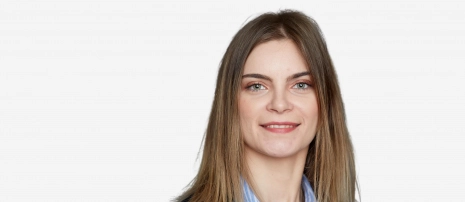
The accounting profession: between the new reality and popular myths, with Silvia Tătavu, Senior Manager
14 November 2025
The accounting profession has been one of many that have rapidly evolved in recent years, shaping its form from traditional number-crunching to a dynamic field that serves as the foundation for strategic decision-making and business growth.
Our colleague, Silvia Tătavu, Senior Manager, Outsourcing – Accounting, joins us today for a discussion about transformation, both within the accounting field and her career as a whole.
In our conversation, Silvia shares her perspective on the recent transformations the accounting profession has faced, the skills that matter most in today’s market, as well as the insights young professionals need to know at the beginning of their careers. Together, we discover not only what a day in the life looks like for someone in her role, but what the future has in store for professionals in accounting.
All the insights below!
Our colleague, Silvia Tătavu, Senior Manager, Outsourcing – Accounting, joins us today for a discussion about transformation, both within the accounting field and her career as a whole.
In our conversation, Silvia shares her perspective on the recent transformations the accounting profession has faced, the skills that matter most in today’s market, as well as the insights young professionals need to know at the beginning of their careers. Together, we discover not only what a day in the life looks like for someone in her role, but what the future has in store for professionals in accounting.
All the insights below!
Hello, Silvia, thank you for taking the time to join our chat today! Firstly, for us to get to know you a little bit better, what is your role in the company and what your career journey has looked like so far?
Hello, everyone, my name is Silvia Tătavu and I’m currently a Senior Manager within the Outsourcing – Accounting department of Forvis Mazars in Romania. My role involves overseeing the accounting services we offer to our clients, while ensuring compliance and efficiency across our outsourced accounting processes.
I joined the company in 2018, and from that point on, my journey has been shaped by a consistent focus on growth, impact, and continuous improvement.

What tasks and responsibilities do you handle? Take us through a day in your life as a consultant and as a manager. How is your relationship with your team and how does that drive your daily wins?
Each day is a dynamic mix of ad hoc requests, problem-solving and a bit of organised chaos.
I start my mornings by discussing with my team, checking in and aligning our priorities. From then on, I make sure our accounting processes run smoothly and in compliance with our internal procedures. I’m deeply involved in optimising workflows and communicating with clients to shape solutions that fit their needs.
As for the relationship I have with my team, our connection is built on trust and open communication. I work closely with each team member, fostering a space where ideas are shared and challenges are tackled together. Their energy keeps me going, as well as our common love for colourful Excel sheets. I’m grateful to work alongside such talented people.
To all the members of my team: thank you for always bringing your best, supporting one another, and making this journey exceptional. Let’s keep pushing boundaries and achieving greatness—together!
How different is your role from that of an accountant offering in-house services?
My role differs quite a lot from that of an in-house accountant.
While an in-house accountant typically focuses on the financial operations of a single company, handling tasks like bookkeeping and internal reporting, my role involves managing outsourced accounting services for multiple clients or entities at the same time. This means I need to adapt to different business models, regulatory environments, and reporting requirements. For example, some of our clients operate in manufacturing, others in retail, technology, or professional services. Each sector has its own specific challenges, and exposure to this diverse range of business environments drives continuous growth and development.
As a team, we pride ourselves on offering the best quality services to our clients, which are particularly tailored to their needs. How do you keep your balance when shifting your focus from one client to another?
The first step towards achieving a balance between clients is understanding their needs and expectations. Each client has its own rhythm, priorities, and working procedure – thus, making sure our time as a team is organised as efficiently as possible is an important element in the equation. I rely on planning and regular check-in sessions to keep everything aligned.
What really helps is the strong relationship I have with my team. We communicate openly, support each other, and share insights that make transitions between clients smoother. Their support allows me to adapt quickly and maintain my focus, no matter how dynamic the day becomes.
The professional landscape within your area of expertise has changed quite a bit in the last few years. Looking back, even to your time as a student, what were your expectations about the accounting profession at the beginning of your career, compared to the reality of the job?
Looking back to my time as a student, I saw accounting as a very structured and number-driven profession, focused mostly on financial statements, compliance, and routine tasks.
In reality, the profession has evolved significantly. Today, my role involves much more than just numbers, it’s about strategic thinking and adaptability. Technology, global processes, and client expectations have reshaped the accounting landscape, making it more dynamic and interconnected than I ever imagined.
How has technology transformed your daily work as an accountant, and what emerging tools are you most excited about?
Technology has completely reshaped my daily work as an accountant. Tasks that used to be manual and time-consuming, such as invoice processing, reconciliations, and data entry, are now automated, allowing me to focus more on analysis and client advisory. Tools like AI-powered platforms have made it easier to manage multiple clients, with the extra time being redirected towards our people and strategy.
What new skills have you developed in the past few years that you didn't expect to need in your job?
Over the past few years, I’ve developed several skills I didn’t expect to need when I first started accounting. But I can say that one of the most surprising has been flexibility and adaptability to AI technology.
Looking ahead, how do you see the accounting profession evolving in the next 5 to 10 years? What skills would you recommend that young professionals develop now to succeed in this changing landscape?
The accounting profession is going through a profound transformation. In the next 5 to 10 years, accountants will move further beyond traditional compliance and reporting roles into tech-enabled skills.
My advice would be to embrace automation and learn to speak fluently “Excel” and “AI”, as they’ll be your new best friends.
Besides the more technical aspects, what I recommend to young professionals is to be curious, to have a mindset of continuous learning and to learn how to adapt to new ways of working.
As the accounting profession shifts and evolves, in your role as a consultant, how have you navigated the journey of moving beyond the traditional number-crunching towards becoming a driver of strategic business decisions for your clients?
The evolution of the accounting profession has indeed opened up exciting opportunities to move beyond traditional number-crunching. In my role as a consultant, I’ve embraced this shift by focusing on how financial insights can impact strategic decisions.
Finally, if you could debunk one myth about your profession, that would help a young person at the beginning of their career, what would that be?
One myth I’d love to debunk is that accounting is just about numbers. In reality, it’s a profession rooted in trust, strategy, and impact. For anyone starting out: your insights matter, and your journey can be as dynamic and impactful as you choose to make it. Keep your curiosity up and your coffee strong!
Contact us

Alexandra Săndulescu Employer Branding Communication Specialist - Bucharest
