

[Event Recap] Vietnam's Reform and Policy Landscape in a New Era
28 May 2026
At the CEEC Mid-Year Economic Outlook Event, Vietnam Forward: Navigating Growth in a Changing Global Economy, held on 26 May 2026 in Ho Chi Minh City, Minh Nguyen, Partner and Head of Advisory Services at Forvis Mazars Vietnam, presented on Vietnam’s reform and policy landscape. Below is a summary of the key points from his presentation.
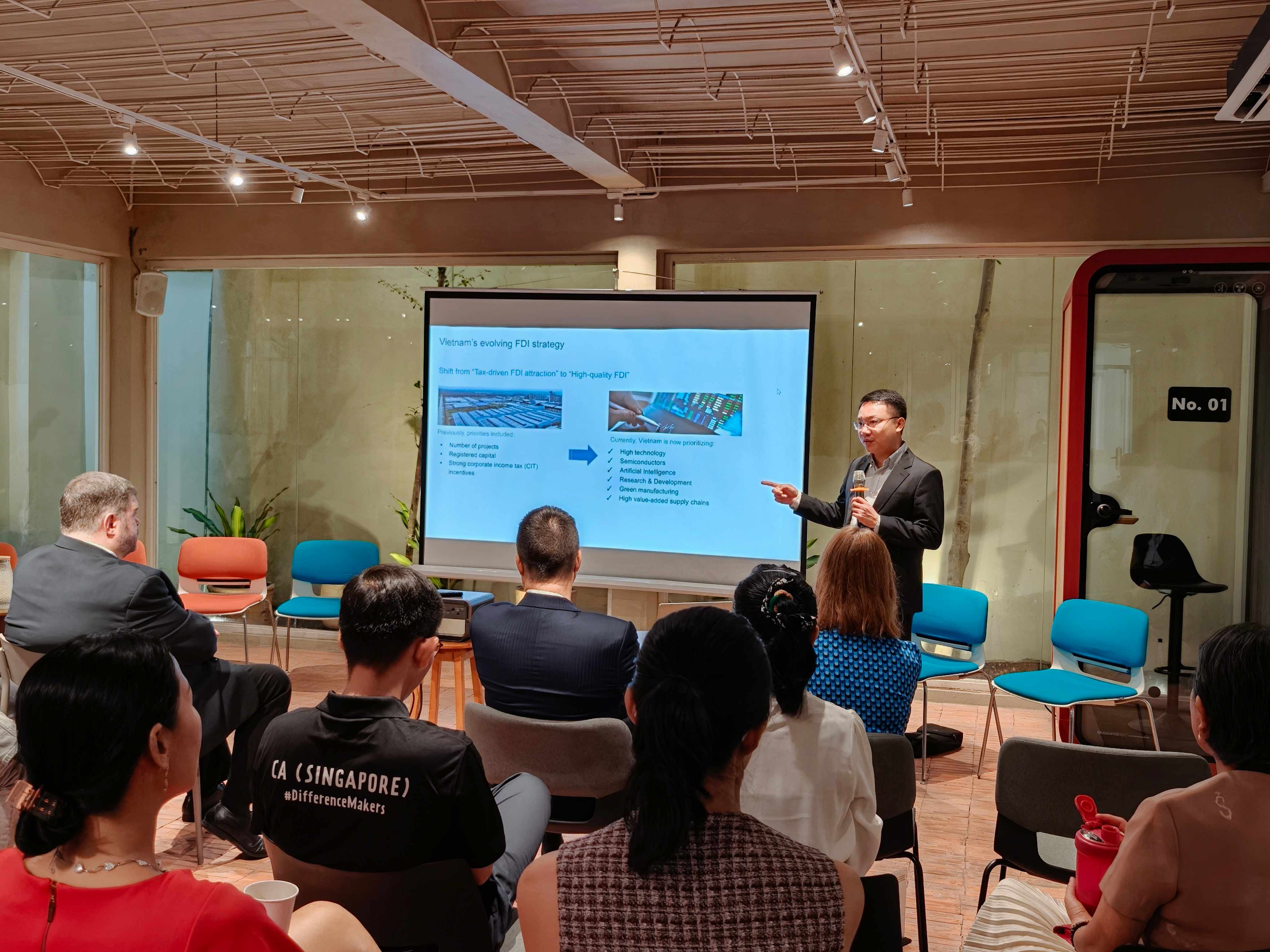
From tax-driven FDI to high-quality FDI
Vietnam is shifting from a tax-driven FDI attraction model toward a stronger focus on high-quality FDI. While previous priorities included the number of projects, registered capital and strong corporate income tax incentives, current priorities include high technology, semiconductors, artificial intelligence, R&D, green manufacturing and high value-added supply chains.
As Vietnam prepares to adapt to the Global Minimum Tax, the government is gradually shifting toward broader non-tax support measures, including infrastructure support, human capital development, R&D support, land incentives/support and administrative facilitation.
Vietnam is also accelerating the development of high-tech and semiconductor industries to integrate more deeply into global supply chain diversification. Key priority sectors include semiconductors, electronics, AI and data centers, and chip packaging and testing.
Competitiveness priorities for Vietnam’s next growth phase
Infrastructure remains one of the largest bottlenecks for scaling up FDI projects, with priority investments including expressways, ports, logistics systems, airports and power infrastructure.
The government is working to reduce licensing friction, digitalize administrative procedures and improve the overall investor experience, with a target of cutting 30% of administrative procedures. However, implementation remains uneven across different localities.
Vietnam recognizes that its low-cost labor advantage will gradually diminish. Therefore, the government is investing in STEM education, digital skills, semiconductor workforce development and vocational training upgrades to support the transition from a low-cost labor destination to a skilled workforce destination.
The presentation also highlighted the role of the private sector as a key growth driver. This is closely related to FDI, as the government aims to strengthen linkages between FDI firms and Vietnamese enterprises, increase local content and enhance the capacity of domestic suppliers. FDI continues to be strongly encouraged, while greater regulatory scrutiny applies in sensitive sectors such as data, fintech, telecommunications and strategic infrastructure.

Global economic integration
Vietnam continues to leverage major trade agreements, including EVFTA, CPTPP and RCEP, as well as various strategic partnerships, to maintain its position as a global export manufacturing hub.
Green growth and ESG expectations
Vietnam is actively promoting Net Zero by 2050, renewable energy, ESG compliance and carbon reduction. As a result, new FDI projects are increasingly expected to be greener, more energy-efficient and more compliant with EU and US supply chain standards.
Explore More
For further insights on Vietnam’s investment and regulatory landscape, explore our latest insights or contact our team to discuss how these developments may affect your business in Vietnam.
Contact us

13 Apr 2026
Foreign Loan
Here's what every Finance expert in Vietnam needs to know about foreign loan compliance from SBV registration to tax implications.

3 Feb 2026
Internal Transfer in Vietnam
Internal transfers are commonly used to deploy foreign experts into Vietnam, but companies face a compliance dilemma: labor rules vs CIT deductibility of salary costs. Learn key risks and what to monitor.

2 Feb 2026
Investing in Vietnam’s Healthcare
What foreign investors need to know about Vietnam's healthcare market, demand drivers, legal risks, scalable models, and AI-enabled care.

24 Jul 2026
Circular 99/2025/TT-BTC
On 27 October 2025, the Ministry of Finance officially issued Circular 99/2025/TT-BTC ("Circular 99") providing guidance on the corporate accounting regime. The Circular has been effective since 1 January 2026 and applies to financial years beginning on or after that date. Vietnamese enterprises should now ensure that their accounting policies, systems and reporting processes reflect the new requirements.

22 Apr 2026
Unlocking Vietnam's Venture Capital
In April 2026, Ho Chi Minh City's People's Committee approved the establishment of a local venture capital fund with an initial charter capital of VND 500 billion (~USD 19 million). The announcement marks the first concrete application of Vietnam's newly established state-backed venture capital architecture.