
International Financial Center (IFC) in Vietnam: Strategy, Enacted framework and Peer comparison
Download full PDF below.

Vietnam has moved from pilot-stage discussion to an operational legal regime for its International Financial Center (IFC). The framework is now anchored by a National Assembly resolution and a package of implementing decrees, structured around a "one center, two destinations" model spanning Ho Chi Minh City and Da Nang. For international financial institutions and service providers evaluating Vietnam, this shift matters because it converts what was previously policy intent into an enacted, licensable regime, with defined tax incentives, a differentiated foreign exchange mechanism, and IFC-specific rules that in certain regulated areas now prevail over general Vietnamese law.
From an investor perspective, the IFC design introduces questions that are typical for special regimes:
This report summarizes (1) Vietnam’s stated positioning and hub differentiation, (2) the enacted legal stack at a high level, and (3) a benchmark scorecard for comparing Vietnam’s IFC regime with global IFC archetypes.
Vietnam's IFC initiative is framed as a national effort to build a globally competitive financial services platform under a dedicated regime, accelerating the country's integration into international financial markets. The "one center, two destinations" model is a unified IFC with differentiated positioning for each city, designed to reduce internal duplication and align product focus with each location's comparative advantage.
Ho Chi Minh City  | Da Nang  |
The city is oriented toward a comprehensive financial ecosystem serving the Indochina and Mekong region. Typical focus areas: banking and capital markets; fund/asset management services; fintech and payment infrastructure; professional services ecosystem. | The city is positioned as more niche, tightly integrated with innovation and sustainable finance themes. Typical focus areas: green/sustainable finance; innovation and controlled testing of new models; digital assets and digital payment pilots; trade-linked finance and services. |
Implementation planning documentation also points to the development of new markets and innovation rails, suggesting the IFC is expected to support both traditional financial intermediation and newer market platforms.
Vietnam's IFC is now supported by a comprehensive, dedicated legal framework, a significant shift from the earlier pilot-stage policy discussions to an operational regulatory regime.
What this means for financial institutions: together, these instruments now provide the foundational legal infrastructure for licensing, supervision, and day-to-day IFC operations.
Vietnam's IFC follows an ecosystem approach: functional zones for trading, banking, securities and related services, supported by institutions including dispute resolution mechanisms designed to be credible to international participants. Implementation planning materials also reference sandbox-style support for fintech, suggesting these areas may be prioritized early.
Because detailed scope still depends on implementing instruments and licensing practice, investors typically assess "activity scope" in three layers:
(1) Explicitly prioritized sectors:
(2) Licensable and operationally supported activities:
(3) Practically bankable given compliance and dispute resolution reality: Projects that comply with high-standard Environmental, Social, and Governance (ESG) frameworks and utilize the newly established specialized dispute resolution mechanisms.
A competitive incentive package has been introduced to attract global financial institutions and high-value investment.
The 38th edition of the Global Financial Centers Index (GFCI), published in September 2025, ranked Ho Chi Minh City #95 out of 120 centers assessed, ahead of Bangkok (#102) and Manila (#104), but behind Jakarta (#91), Labuan (#60), Kuala Lumpur (#45) and Singapore (#4). Da Nang received 53 assessments in the prior 24 months, still short of the 150-assessment threshold required for index inclusion.
The instrumental factors used in the GFCI model are grouped into five broad areas of competitiveness: Business Environment, Human Capital, Infrastructure, Financial Sector Development, and Reputation.
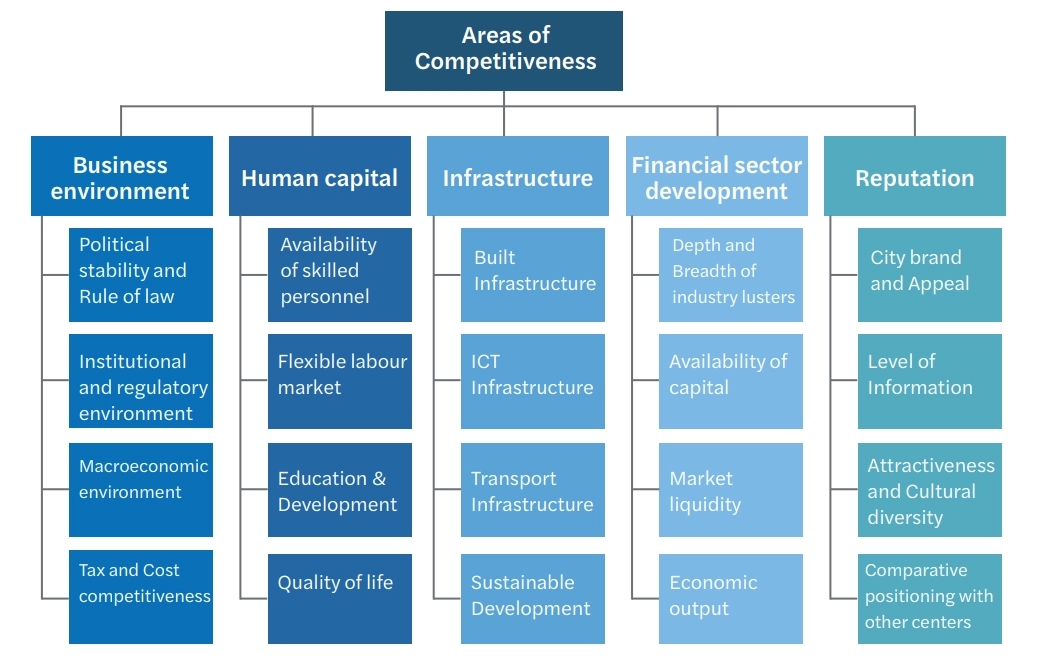
Interestingly, Decision 114/QD-BCDTTTC organizes implementation of Vietnam IFC into five major task groups:
(1) Legal framework
(2) Infrastructure and urban space
(3) Financial services and markets
(4) Human resources and ecosystem
(5) Coordination and supervision
Contrasting with the five factors embedded in GFCI model demonstrates strong areas of overlap, highlighting the targeted approach of the Vietnamese government.
GFCI area | Government issuance | Overlap | Key divergence / GFCI expectation |
| 1) Business environment | Special legal framework; governance & supervision; dispute resolution direction; inter-agency coordination | High | GFCI reflects broader factors: stability, predictability, regulatory quality, ease of doing business. Gap lies in consistency of enforcement and overall system experience beyond IFC zone |
| 2) Financial sector development | Development of modern ecosystem: new markets (commodity, carbon), fintech, digital banking; HCMC as full-service hub; Da Nang as sandbox/digital assets/payments | High | GFCI emphasizes market depth, liquidity, institutional clustering, product sophistication. Current framework defines direction but less clarity on speed of execution |
| 3) Infrastructure | Focus on transport, telecom, logistics; dedicated infrastructure task group; roadmap for key projects and connectivity | High | Alignment on intent; divergence depends on delivery timeline and service quality meeting global standards (physical + digital infrastructure) |
| 4) Human capital | Talent development & attraction; fintech ecosystem; international living environment | High | Gap in scale and speed: availability of senior global talent and specialist expertise (derivatives, risk, compliance, arbitration) |
| 5) Reputational & general factors | Emphasis on international standards, transparency, dispute resolution, supervision | Partial | GFCI is perception-driven: trust, track record, global recognition. Gap depends on consistent outcomes and credibility over time |
Over the next 24 months, key indicators to track include: (i) issuance of implementing instruments and consistency of guidance, (ii) early licensing outcomes and timelines, (iii) operationalization of dispute resolution institutions, and (iv) evidence of supervisory capacity and cross-agency coordination.
In conclusion, implementation of IFC must be carried out effectively, comprehensively and with purpose to avoid regulatory integrity failures and execution foundering. Done right, it can reshape how Vietnam finances growth, manages risk, and positions itself in global capital networks with spillovers into real economy competitiveness and institutional quality.
Contact our Legal and Financial Advisory teams to discuss how Vietnam's IFC regime applies to your institution's Vietnam strategy.
Download full PDF below.




The Government has issued six key decrees implementing the new construction law framework, all effective from 1 July 2026. These decrees form the core implementing framework of Vietnam’s new construction regime and introduce substantial changes affecting the development, procurement, execution and management of construction projects. The six decrees are Decree No. 206/2026/ND-CP, Decree No. 207/2026/ND-CP,...

Vietnam has elevated AI within a broader industrial and digital capability agenda through Decision 1131/QD-TTg (11 strategic technology groups and 35 strategic technology products) and enacted its first standalone Law on Artificial Intelligence (Law No. 134/2025/QH15) on 10 December 2025, effective 1 March 2026, introducing a risk-based classification concept (high/medium/low). This article summarizes...

This guide sets out how venture capital (VC) firms and crypto funds should approach digital asset valuation as Vietnam moves toward a licensed, onshore digital asset market. It covers the principal categories of digital assets, from cryptocurrencies to stablecoins, the valuation methodologies suited to each, and the Quantity Theory of Money (QTM) as a strategic framework for analyzing tokenomics.

On 27 October 2025, the Ministry of Finance officially issued Circular 99/2025/TT-BTC ("Circular 99") providing guidance on the corporate accounting regime. The Circular has been effective since 1 January 2026 and applies to financial years beginning on or after that date. Vietnamese enterprises should now ensure that their accounting policies, systems and reporting processes reflect the new requirements.

Vietnam's International Financial Center is now backed by enacted law. See the legal stack, tax incentives, and how HCMC and Da Nang compare to global IFC hubs.
This website uses cookies.
Some of these cookies are necessary, while others help us analyse our traffic, serve advertising and deliver customised experiences for you.
For more information on the cookies we use, please refer to our Privacy Policy.
This website cannot function properly without these cookies.
Analytical cookies help us enhance our website by collecting information on its usage.
We use marketing cookies to increase the relevancy of our advertising campaigns.