Administrative traceability and timesheet integration in 2026
In 2026, payroll accuracy depends entirely on data quality. Before running any gross-to-net calculations, your administrative foundation must be secure. Any discrepancy between employment terms and the data entered into your payroll engine invalidates the entire payslip run, creating immediate reporting risks.
Auditing historical personnel files
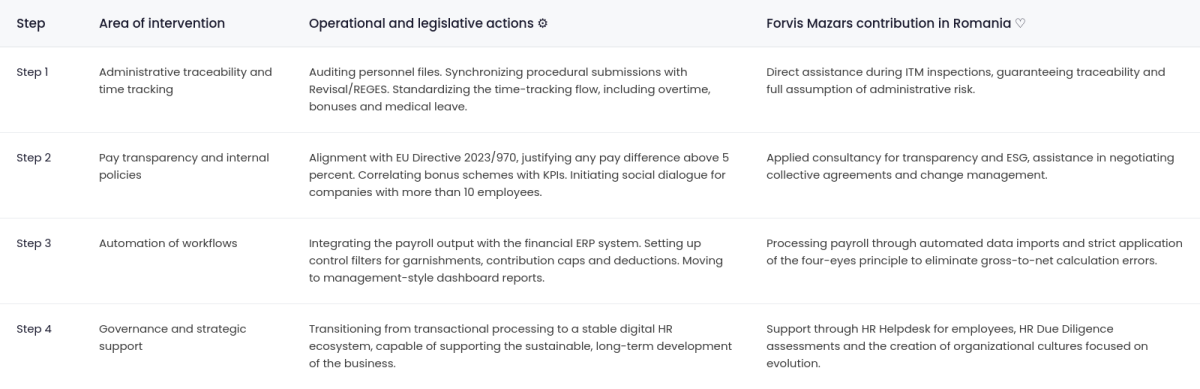
Administrative traceability starts with supporting documents. During routine inspections, labour authorities (ITM) check the exact match between declared amounts, bank transfers, and their legal basis (individual employment contracts and addenda).
A missing document, a delayed suspension notice, or an unrecorded salary update turns routine operations into legal liabilities. Building a compliant system requires regular audits of all personnel files to ensure every salary element is backed by a signed contract.
Synchronising procedures for REGES-ONLINE
Managing the general registry of employees requires operational discipline. Labour legislation imposes strict reporting deadlines for every event, from registering new contracts before day one to reporting salary adjustments or terminations.
Missing these deadlines results in fines applied per incident. To eliminate this financial risk, your payroll design must include clear workflows. Data must move between departments based on strict internal deadlines, ensuring timely .rvs file submissions to the REGES-ONLINE portal.
Standardising working time and timesheets management
Actual working time is the main variable in monthly salary calculations. Without accurate, manager-approved timesheets, payroll processing operates on flawed data.
To ensure seamless integration between timesheets and the payroll engine, your system must track:
- Overtime hours and their compensation path (time off in lieu or overtime pay).
- Specific time-based allowances, such as night shifts, weekend work or work on public holidays.
- Accurate mapping of absences and sick leave, backed by original certificates.
Aligning with 2026 requirements: pay transparency and internal policies
2026 calls for a reset in how organisations build and communicate their pay structures. With the new European regulations now in effect, blanket salary confidentiality is giving way to an obligation to objectively justify remuneration packages.
Implementing pay transparency requirements
The application of Directive (EU) 2023/970 is reshaping how earnings are administered. Companies are now required to guarantee and demonstrate equal pay for work of equal value. Any pay disparity must be justified exclusively through neutral, measurable criteria: skills, effort, responsibility and working conditions.
Where mandatory statutory reporting reveals a pay gap of more than 5% that cannot be explained by objective criteria, the employer is required to remediate the situation and initiate a joint pay assessment. Preparing for this legal threshold means conducting an internal pay equity audit without delay, recalibrating salary grids and correctly mapping job classifications within the payroll system.
Updating internal regulations and HR policies
Purely formal HR documents can no longer cover today's operational reality. The Internal Regulations and organisational policies must rigorously document new approaches to compensation and ways of working.
Bonus schemes now need to be directly tied to clearly defined KPIs. A bonus awarded without a transparent, objective calculation formula will be treated as a significant legal vulnerability under the new transparency rules.
At the same time, flexible benefits and remote working arrangements need to be reviewed from a tax perspective. Correct classification of benefits in kind, compliance with monthly non-taxable thresholds and their proper documentation on the payslip are all priority items in any tax inspection.
Governance and social dialogue management
Setting pay policies is no longer a unilateral exercise. Under the updated social dialogue legislation, initiating collective bargaining has become a mandatory procedure for all employers with at least 10 employees.
Employee representatives and trade union structures play an active role, and negotiations require concrete data. The payroll system must be configured to quickly generate aggregated, anonymised reports on salary levels and income structures. Making this data available is the legal foundation for negotiating and registering a valid Collective Labour Agreement (CLA), protecting the company from the risk of fines and administrative blockers.
Automating workflows and securing quality controls in 2026
In today's payroll architecture, manual processing is a direct operational risk. Technology is no longer just a calculation tool, it is the central pillar of risk management. In 2026, securing the system requires a digital ecosystem that prevents errors before they produce financial or fiscal consequences.
Financial system reconciliation and ERP integration
Payroll does not operate in isolation, it drives a significant proportion of a company's operational expenditure. Native integration of payroll output with the financial system (ERP) ensures complete money traceability and eliminates the need for manual data entry.
Automatic generation of cost files and accounting entries guarantees that transferred amounts match budget execution precisely. Automated workflows also allow tax declarations to be generated directly from the consolidated database, enabling immediate reconciliation between the accounting balance, the HR department and the tax authorities.
Operational control filters and data validation
Monthly accuracy relies on implementing strict dual-verification procedures before any payroll run is approved. A robust system uses automatic alerts to flag mathematical or legislative discrepancies during the calculation process.
These operational control filters block human error in critical areas:
- Correct deduction and transfer of garnishments, in strict compliance with the order of priority set out in the Code of Civil Procedure.
- Application of maximum caps for social contributions, sector-specific incentives and management of tax deductions.
- Validation of sick leave calculation algorithms, an area under close regulatory scrutiny, where calculation bases and benefit codes change regularly.
Statutory and management reporting
The final deliverable of a payroll process has long since moved beyond issuing a standard payslip. To make informed business decisions, companies now extract operational intelligence directly from their payroll records.
The shift to management dashboards gives leadership teams clear visibility into labour cost trends. By consolidating reports by cost centre, analysing staff turnover and modelling budget projections, raw payroll data is transformed into vital metrics that directly support organisational stability and scalability.
How Forvis Mazars in Romania addresses operational risk through integrated HR and payroll solutions in 2026
In 2026, payroll no longer operates in an administrative vacuum. The complexity of the new regulatory landscape transforms the payroll function from a mathematical calculation into a critical component of corporate governance. In this context, partnering with Forvis Mazars in Romania goes beyond traditional outsourcing. Our integrated approach combines the global reach of an international talent pool with a deep understanding of the local business environment, redefining what collaboration looks like, and supporting the long-term sustainable growth of clients ranging from SMEs to multinational corporations.
Transferring responsibility and confidence in the face of inspections
Building a sustainable business requires compliance to be airtight from day one. Handing the payroll function to the Forvis Mazars team in Romania means delegating administrative risk in full.
Direct assistance during ITM inspections and external audits is backed by absolute rigour in personnel file management. From timely and accurate registration in REGES-ONLINE to drafting contracts, managing timesheets and handling onboarding and offboarding processes, full traceability is guaranteed, keeping the company in a permanent state of readiness for any unannounced inspection.
Operational accuracy through rigorous processes and automation
Monthly payroll execution exposes the company to significant financial risk if the data flow is not secured. The operational solution relies on automation and secure data flows: automatic imports substantially reduce manual effort and ensure consistency across HR and financial systems.
Critically, the four-eyes principle is strictly applied to eliminate human error in gross-to-net calculations, tax processing and statutory filings. This dual verification of outputs guarantees that cost files, reconciliation data and management dashboards are 100% accurate and tailored to operational needs.
A holistic vision: more than monthly payroll
A 2026 payroll system needs to be underpinned by solid strategic governance. Led by market-recognised professionals including Cătălina Călinescu (Partner, Outsourcing - HR & Payroll) and Anca Lamba (Senior Manager, Outsourcing - HR & Payroll), Forvis Mazars' experts in Romania operate with agility and an entrepreneurial mindset, providing advisory across the full spectrum of employment relations.
Beyond relieving internal teams through the HR Helpdesk service and support in trade union negotiations and HR Due Diligence processes, the service infrastructure is built around three pillars that directly address the challenges ahead:
- Pay Transparency & ESG advisory: supporting sustainable transformation through people, and ensuring alignment with the new European regulations on pay equity and remuneration gap reporting.
- Performance management: building organisational cultures grounded in accountability, growth and objective reward.
- Change management: facilitating internal transitions in a way that works for people, maintaining team stability through periods of strategic reorganisation.
Through continuous investment in sector expertise and technological capabilities, the Forvis Mazars team in Romania is the trusted partner able to deliver tailored solutions at every stage of a company's development.