

The total value of transactions in Slovakia exceeded one billion euros in 2025
The value of mergers and acquisitions in the Central and Eastern European region reached more than 42.5 billion euros last year. This represents a year-on-year increase of 36% in total volume, although the overall number of transactions fell by 9% compared to the previous year. Results in Slovakia were significantly influenced by KBC Group's acquisition of a stake in 365.bank. These findings come from the latest study by Forvis Mazars and Mergermarket.
Data from the Investing in CEE Inbound M&A Report 2025/2026 show that 23 M&A transactions were completed on the Slovak market in 2025 — seven fewer than the year before. However, the total value of transactions rose by 26% and exceeded one billion euros, marking the highest level in recent years.
Numerous acquisitions were concluded or are under way in Slovakia's energy, IT, and real estate sectors. In the energy sector, a significant M&A event of the year was the transaction involving French energy group Veolia Energia Slovensko, which is taking over the Slovak operations of the Engie conglomerate as it exits the market after 16 years.
The largest transaction of the past year in Slovakia was the acquisition of a 98.45% stake in 365.bank by Belgian banking group KBC Group for 749 million euros. The seller was financial group J&T Finance Group.
"In addition to the acquisition of the stake in 365.bank, a significant investment in GymBeam was also confirmed," notes Samuel Svíba, Senior Manager responsible for mergers and acquisitions at Forvis Mazars Slovakia.
Last year, investors from a range of countries - including Belgium, India, Malaysia, and Switzerland - entered Slovak companies. Their decision to invest in Slovakia was driven primarily by its strategic location and strong industrial tradition in the region. "The data show that the Central and Eastern European region continues to maintain its attractiveness. Investors are increasingly focusing on larger, high-quality assets, and Slovakia remains part of this trend for the time being," says S. Svíba.
Poland leads the region, achieving nearly double the transaction volume of second-placed Czechia
According to the Forvis Mazars and Mergermarket study, the most active market in the region is Poland, where 339 transactions were completed with a total value of 13.4 billion euros. Poland has thus confirmed its position as the region's leader and most important M&A market in recent years. The largest transaction across the entire Central and Eastern European region was the acquisition of a 49% stake in Santander Bank Polska by Austrian group Erste Group for 6.8 billion euros.
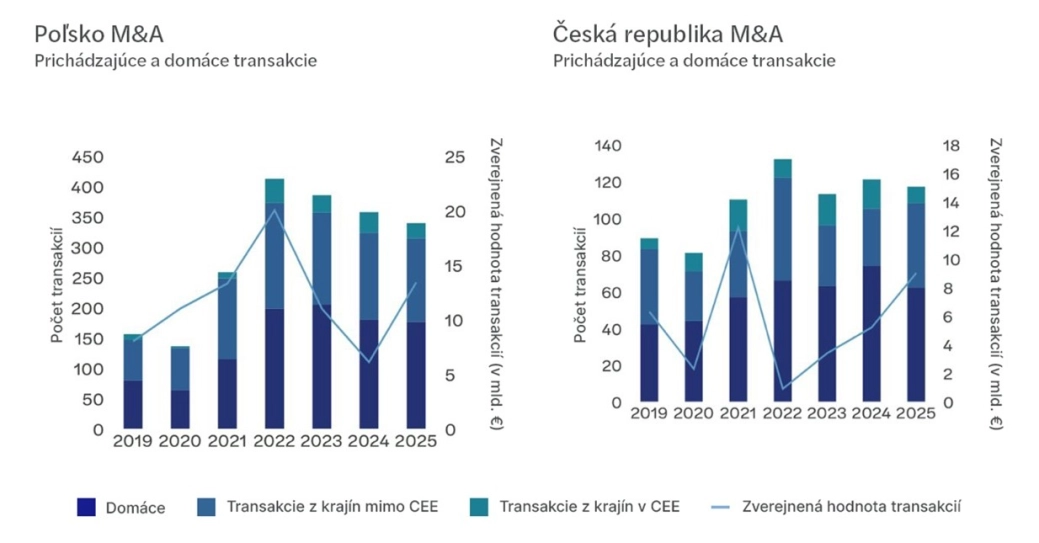
Austria ranked second in terms of the number of M&A transactions completed, though it was overtaken in total value by the Czech Republic. Czechia recorded 117 transactions, with their value rising by 73% year-on-year to just under 9 billion euros. The Czech Republic also saw the second-largest transaction in Europe - American firm GTCR acquired pharmaceutical company Zentiva for more than 4 billion euros. Other dominant sectors in Czechia were technology and real estate.
Local players are also active in the Central and Eastern European region
The strongest sectors for mergers and acquisitions across the monitored region in 2025 were financial services, healthcare and pharmaceuticals, telecommunications, and technology. Financial services alone accounted for nearly 12 billion euros in transaction value, driven largely by the ongoing consolidation of the banking sector.
"We have recently observed growing interest among investors from Central and Eastern European countries in conducting transactions within their own region. Their share of the total M&A transaction value reached 21% last year, the highest level recorded to date in our monitoring," explains S. Svíba.
In addition to domestic investors, German investors remain highly active across Central and Eastern Europe. "However, we have experience with bidders from across Western Europe, particularly French companies," notes Svíba.
The future of our M&A market will also be shaped by family businesses' readiness for change
"The topic of generational succession in business is already resonating in Slovakia. When it comes to family succession, the question arises as to whether the next generation has the capability and the desire to run the business. For the M&A market in 2026, therefore, what will matter is not only whether capital is available on the investor side, but also how many companies will be genuinely ready to take such a step," concludes S. Svíba.
Contact us

Samuel Svíba Senior Manager, Financial advisory - Bratislava

Investing in CEE: Inbound M&A report 2025/2026
Large-cap transactions were the defining theme of CEE dealmaking in 2025, despite severe geopolitical headwinds. With record intraregional investment and ever-improving economic fundamentals, the regional M&A activity in the past year indicates continued growth in 2026.
Explore more