


[Seminar Recap] Demystifying Purchase Price Allocation (PPA): Best Practices for Investors and Corporates
2 April 2026
Purchase Price Allocation (PPA) is a mandatory exercise required for business combination accounting under IFRS 3 and VAS 11 triggered by every M&A transaction. It requires acquirers to allocate the purchase price to the fair values of all assets acquired and liabilities assumed, including intangible assets not previously recognized on the Target's balance sheet. With Vietnam recording over 3,200 transactions totaling nearly USD 36 billion between 2014 and H1 2025, getting PPA right has never been more integral for investors and corporates operating in the market.
At our recent seminar on Demystifying Purchase Price Allocation: Best Practices for Investors and Corporates, held at our Ho Chi Minh office on 1 April, our Financial Advisory expert Hai Hoang walked attendees through the critical decisions that determine whether a deal's true value is properly captured, or quietly lost in translation.
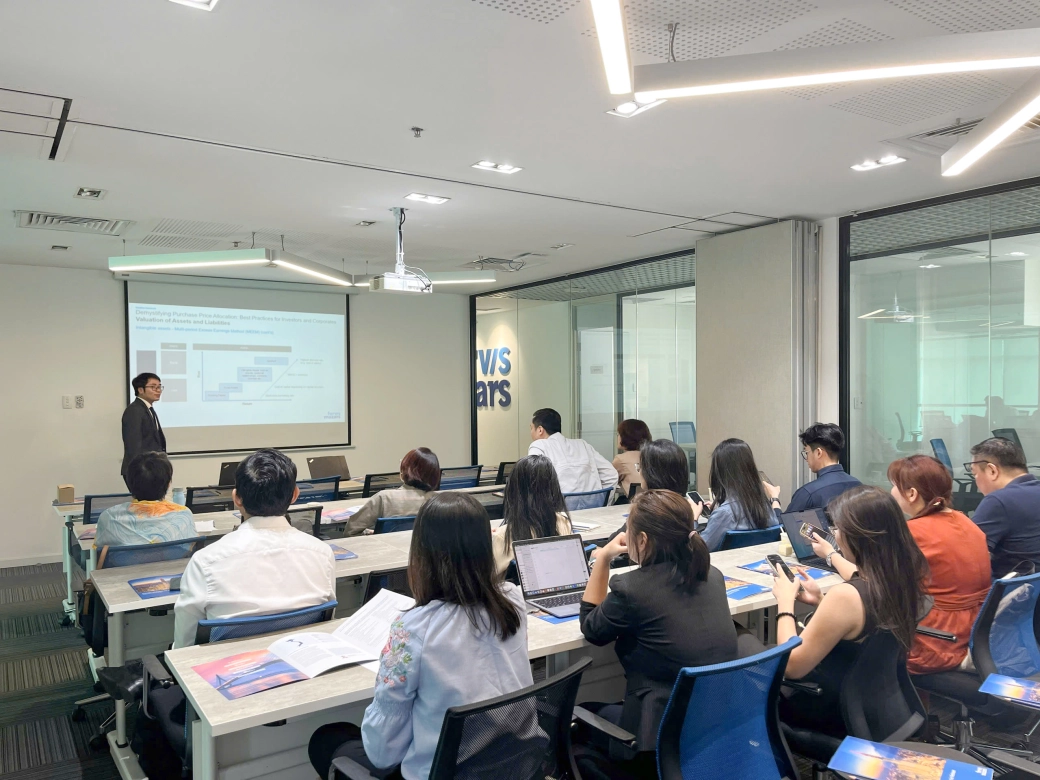
1. Why PPA Matters?
1.1 Accurate financial reporting Ensures the buyer's balance sheet reflects the fair value of everything acquired, not just the purchase price, providing a true financial picture. | 1.2 Strategic & management decisions Informs future choices on operations, upgrades, and growth by clarifying the value of assets like customer relationships, brand names, and technology. |
1.3 Tax planning Determines correct depreciation and amortization for tax purposes, impacting future tax liabilities. | 1.4 Regulatory compliance Mandated by accounting standards for business combinations, ensuring adherence and transparency. |
1.5 Goodwill management Identifies and allocates the residual amount (goodwill) to intangible assets and requires annual impairment testing, crucial for long-term financial health. | 1.6 Unlocking value Helps identify hidden value and potential leakages during integration, maximizing the acquisition's benefits. |
2. Goodwill vs. Bargain Purchase - Are Gains Sustainable?
When the purchase price exceeds the fair value of identifiable net assets, the residual is recognized as goodwill. When the reverse is true, the buyer pays less than the fair value of what is acquired, the difference is recorded as a gain from a bargain purchase (sometimes called 'badwill').
Goodwill: What Does It Represent? Goodwill captures value that cannot be separately identified like assembled workforce, brand reputation, geographic presence, customer service capability, growth expectations, and synergies. It is not amortized under IFRS but is subject to annual impairment testing. In practice, the size of goodwill depends on both the quality of intangible asset identification and management's preference. Some acquirers prefer a larger goodwill figure (avoiding annual amortization charges); others prefer more recognized identifiable intangibles (providing a predictable amortization profile rather than uncertain goodwill impairment events).
Vietnam case: As of Jun 25, VIC recorded VND4.5 trillion goodwill on its balance sheet (VND9 trillion historical cost). | Bargain Purchase: Proceed With Caution A bargain purchase gain can be a legitimate outcome, typically in distressed sales, forced divestitures, or where the seller is under time or liquidity pressure. However, it should be treated with skepticism rather than celebration. In most cases, a negative goodwill result is a signal that:
Vietnam case: In 2022, KBC recorded VND2.2tr other income from bargain purchase of Ho Chi Minh - Da Nang after increasing ownership to 48%, accounting for 129% profit before tax of the same year. |
3. A Structured Valuation Framework for PPA
| Step 1 | Fair Value of Purchase Consideration | Determine the total consideration transferred. Cash requires no fair value adjustment. Deferred consideration must be discounted to present value using the buyer's borrowing rate. Contingent consideration (e.g., earn-outs) is modelled using probability-weighted scenarios or Monte Carlo simulation. Consideration shares in private targets require a separate valuation. |
| Step 2 | Identify Assets & Liabilities for Fair Value Adjustment | Review the target's balance sheet systematically across four categories: Working capital (receivables, inventory, payables) Fixed assets (land, buildings, plant & equipment, leases) Financial liabilities (short- and long-term debt, deferred revenue) Non-operating assets (investments, minority stakes) |
| Step 3 | Intangible Asset Identification | Intangibles are recognised under IFRS 3 if they meet separability or contractual-legal criteria. Common types include brands, customer relationships, technology, and licences. Identification of intangible depends on understanding the buyer’s rationale for the transactions. |
| Step 4 | Fair Value of Intangible Assets | Relief from Royalty (RFR): values hypothetical avoided royalty payments from ownership of the assets. Multi-Period Excess Earnings Method (MEEM): values intangibles by discounting cash flows of the valued assets after contributory asset charges from other assets. Cost: values assets based on replacement cost, adjusted for obsolescence. With-and-without: values assets by comparing two business scenarios. |
| Step 5 | Determine Goodwill | Goodwill is the residual: purchase consideration plus non-controlling interest less than the fair value of identifiable net assets. Existing goodwill on the target balance sheet must be zeroed. The result whether positive goodwill or a bargain purchase gain, must be interrogated for reasonableness before finalization. |
| Step 6 | Perform Cross-checks | WACC should align with WARA and the deal’s IRR. If IRR exceeds WACC, projections may include buyer-specific synergies; if IRR is below WACC, the buyer may have overpaid or the projections too conservative. Benchmarking against comparable PPA transactions adds credibility to results. |
4. Common Pitfalls and Best Practices
Common Pitfalls That Impact PPA Outcomes
| Best Practices for Effective PPA
|
Is your business preparing for an M&A transaction? Contact the Financial Advisory team at Forvis Mazars today for advice on Purchase Price Allocation (PPA) and asset valuation.
Contact us

Hai Hoang Thanh Director, Financial advisory - Ho Chi Minh City

Company formation ahead of IRC
Draft Law on Investment allows foreign investors to form an FIE before obtaining an IRC: current rules, proposed changes and open issues on ERC and DICA in Vietnam.

12 Dec 2025
IFRS Transition
Vietnam's IFRS and VFRS roadmap is entering a pivotal stage. Learn what determines a successful IFRS conversion and why it's a strategic opportunity, not just compliance.

2 Feb 2026
Investing in Vietnam’s Healthcare
What foreign investors need to know about Vietnam's healthcare market, demand drivers, legal risks, scalable models, and AI-enabled care.

15 Oct 2026
Vietnam Construction Law 2026 Updates
The Government has issued six key decrees implementing the new construction law framework, all effective from 1 July 2026. These decrees form the core implementing framework of Vietnam’s new construction regime and introduce substantial changes affecting the development, procurement, execution and management of construction projects. The six decrees are Decree No. 206/2026/ND-CP, Decree No. 207/2026/ND-CP,...

9 Oct 2026
AI Adoption in Vietnam
Vietnam has elevated AI within a broader industrial and digital capability agenda through Decision 1131/QD-TTg (11 strategic technology groups and 35 strategic technology products) and enacted its first standalone Law on Artificial Intelligence (Law No. 134/2025/QH15) on 10 December 2025, effective 1 March 2026, introducing a risk-based classification concept (high/medium/low). This article summarizes...