
AI Adoption in Vietnam: AI Law, Strategy & Key Risks
Download Full PDF below

Vietnam is prioritizing the digital economy to drive its economic growth, positioning itself as a leading player in SEA. According to MIC (now the MST), Vietnam's digital economy is growing 20% annually, and is estimated to contribute 18.3% to GDP in 2024. By 2030, the digital economy is projected to contribute 30%–35% of GDP, with Vietnam aiming to enter the top 30 globally in digital economy contribution, up from 41st today.
| By 2023 - A high-growth digital economy | By 2045 - A leading innovation hub |
|
|
 |
 |
Decision 1131/QD-TTg publishes the list of strategic technologies and strategic technology products, with an official count of 11 groups and 35 products. The AI-related group includes Vietnamese LLMs, virtual assistants, domain-specific AI, analytical AI, digital twins, and metaverse categories, indicating an intent to prioritize both foundational AI capability and applied AI products.
The same strategic list includes enabling layers such as cloud computing and large-scale data centers, robotics/automation, semiconductor chips (including AI chips), and next-generation mobile networks, which together suggest an integrated approach to industrial digital capability rather than "AI in isolation."
The AI Law regulates research, development, provision, deployment, and use of AI systems in Vietnam, and applies to both domestic and foreign organizations/individuals engaged in AI activities in Vietnam, with exclusions for AI activities exclusively serving national defense/security/cipher purposes. The law defines key lifecycle roles (developer, provider, deployer, user), which is relevant for allocating responsibilities across AI development and deployment chains.
Practitioner summaries describe the AI Law as adopting a risk-based approach, typically classifying AI systems into high-risk, medium-risk, and low-risk categories based on their potential impact on human rights, safety and security, sector of application, scope and scale of users and impact, with increasing obligations for higher-risk systems (e.g., documentation, transparency, safety/oversight expectations).
Following the AI Law, on 30 June 2026, the Prime Minister issued Decision 33/2026/QD-TTg, effective 15 August 2026, establishing the list of high-risk AI systems. The list covers AI systems in six sectors: education, healthcare, banking, transport, ethnic affairs and religion, and judicial proceedings, and sets sector-specific criteria for determining risk levels.
The responsibility for classifying AI systems primarily rests with the provider and deployer (in case where modifications, integration, or changes in functionality create new or higher risks). This risk-based framing is consistent with Vietnam's stated objectives of enabling AI development while setting baseline safeguards.
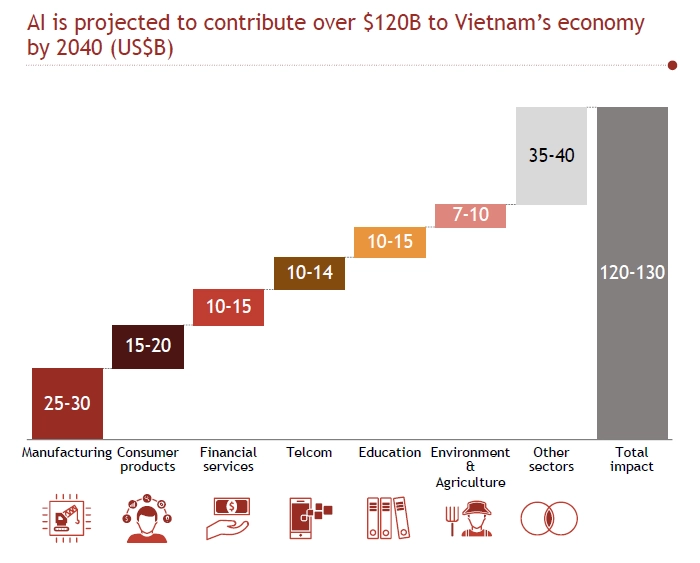
According to BCG, AI is expected to significantly boost Vietnam's economy, especially in the manufacturing sector, which alone could see an impact of USD25–30b, followed by consumer products, financial services, telecom, and education. Many of these sectors have lagged in digitalization due to the challenge of processing large volumes of unstructured data and relying on outdated legacy IT systems. The new generation of AI, driven by large language models (LLMs), is tailor-made for these vertical markets.
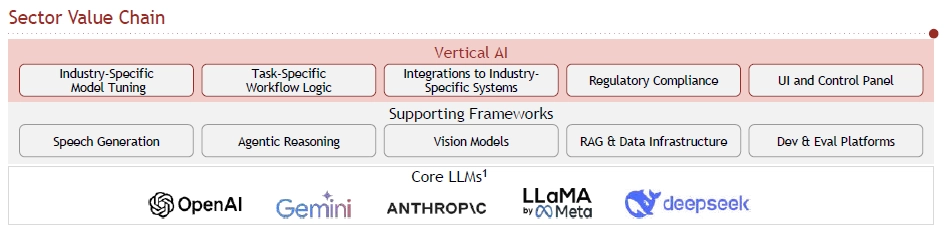
Success in Vertical AI will be defined by its ability to tailor cutting-edge tools to the unique demands of each industry, transforming powerful yet generic AI into specialized, deployment-ready solutions that deliver tangible value.
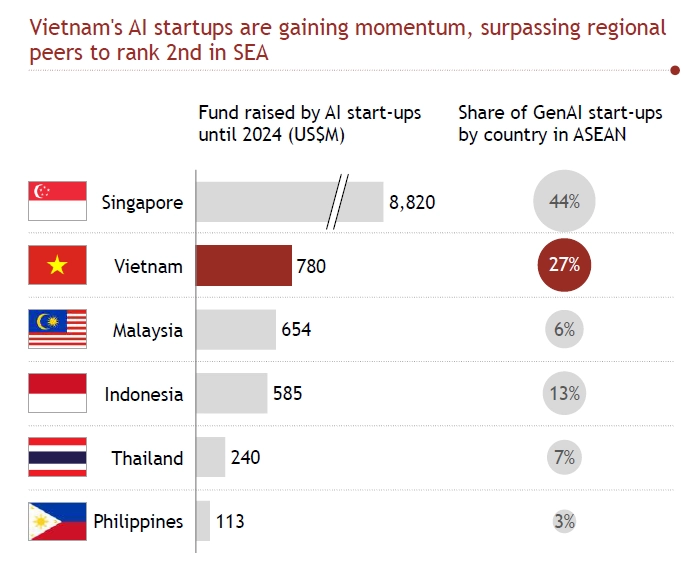
Vietnam currently ranks 45th out of 195 countries in the Government AI Readiness Index report by Oxford Insights (UK), surpassing the global average and maintaining its position regionally at 5th in Southeast Asia.
AI has gradually expanded across industries in Vietnam since 2019, including banking, insurance, consumer finance, retail, healthcare, consumer packaged goods (CPG) and manufacturing. In the banking industry, one of the leading sectors in AI adoption, AI is primarily used for facial recognition, electronic know-your-customer (eKYC), optical character recognition (OCR), and call or voice bots deployed in contact centers, collections and credit card activation.
Late 2023 and early 2024 marked a turning point for AI in Vietnam, driven by the rapid rise of the ChatGPT phenomenon. Some large companies have started piloting GenAI, mainly for internal purposes such as document and knowledge navigation, HR tasks like automated CV scanning and profiling, staff training, and IT support through code copilots. External-facing use cases are still largely focused on GenAI-powered chatbots and voice bots.
Deploy GenAI/AI in everyday tasks to realize 10% to 20% productivity potential; reshape critical functions for 30% to 50% enhancement in efficiency and effectiveness; invent new GenAI/AI business models to build a long-term competitive advantage.
AI adoption in Vietnam surged in 2024, with 47,000 new enterprises implementing AI, bringing total adoption to nearly 170,000 firms, accounting for around 18% of all enterprises nationwide, and a year-on-year growth rate of approximately 39% in AI adoption according to a study by Amazon Web Services in 2025. AI solution provision is concentrated primarily in the IT sector (31%), followed by finance and banking (22%), education (17%), and healthcare and e-commerce (15%).
According to the Vietnam Artificial Intelligence Annual Report 2025 by the Institute of Information Technology, Vietnam National University, based on a survey of nearly 500 enterprises and organizations conducted from July 2025, the most significant challenge facing AI solution providers is the shortage of high-quality talent (45%), while 23% struggle with data and computing infrastructure constraints.
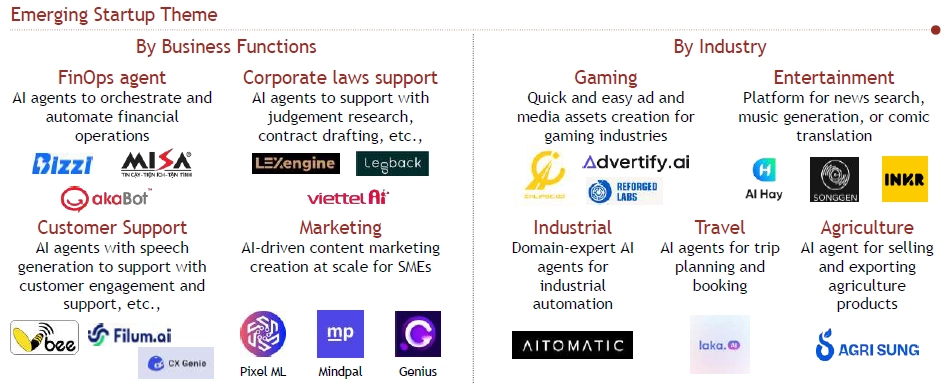
Vietnam's AI market is segmented between well-resourced technology conglomerates (FPT, Viettel, VNPT, and Vingroup), which lead in infrastructure and R&D but often keep applications within their own ecosystems, and emerging companies focused on specialized solutions.
Several Vietnamese players have gained global recognition: Abivin won the 2019 Startup World Cup for AI-powered logistics optimization, VinAI publishes in leading international journals, and NVIDIA's acquisition of VinBrain validated Vietnam's healthcare AI capabilities. Access for SMEs and the public sector remains limited.
| No | AI developers | Main products | AI Application Profile |
| 1 | CMC Corporation | C-OCR, CATI-VLM model, government AI services | CATI-VLM model achieved top 12 global ranking in 2025 Robust Reading Competition. C-OCR processes thousands of official documents daily for government services. |
| 2 | FPT Software | AI Center, FPT.AI platform, chatbots, NLP, computer vision | Vietnam’s largest IT services company with $7.7 billion market cap and $2.47 billion revenue in 2024. Developing $200M “AI Factory” using NVIDIA H100/H200 chips, targeting 6,000 AI engineers by 2028. |
| 3 | VNG Corporation (Zalo AI) | Zalo messaging, KilM LLM, GreenNode AI Cloud | Vietnam’s first tech unicorn valued at $3 billion with 2,000+ employees including 300+ AI specialists. Zalo processes nearly 2 billion messages daily, with 20% of users utilizing AI features. |
| 4 | Cinnamon AI | Intelligent Document Processing (IDP), knowledge mining, OCR | Global enterprise AI startup with strong Vietnamese presence. Specializes in document intelligence for business process automation across finance and logistics sectors. |
| 5 | Viettel AI | Cyberbot Platform, AI Robot Platform, Digital Twin, facial recognition | Military-backed telecommunications conglomerate’s AI division. Developing five core product lines covering chatbots, robotics, analytics, and digital twin technologies. Targets Asia-Pacific leadership by 2030. |
| 6 | VNPT AI | VNPT BioID, computer vision, ASR, video analytics | State-owned telecommunications provider’s AI arm. BioID platform serves banking and securities sectors with high-speed biometric processing. Integrating NVIDIA DeepStream SDK for real-time video analytics. |
| 7 | VinBrain | AI-powered medical diagnostics, X-ray analysis, pathology imaging | Healthcare AI startup with solutions deployed in 182+ hospitals. NVIDIA announced acquisition in December 2024 to accelerate healthcare AI innovation. |
| No | AI deployers | Main products | AI Application Profile |
| 1 | Vietcombank | Commercial banking | Largest Vietnamese bank by assets. Deploys AI for customer service automation, fraud prevention, credit risk assessment, and personalized banking experiences. |
| 2 | Vingroup | Conglomerate (real estate, retail, automotive) | Launched VinVentures fund with $150M AUM focused on AI and semiconductor startups. Integrates AI across VinFast automotive, VinMart retail, and VinHomes real estate. |
| 3 | MoMo | Digital payments, e-wallet | Vietnam’s fintech unicorn using AI for fraud detection, credit scoring, and personalized financial services. 30+ million users leveraging AI-driven payment recommendations. |
| 4 | Tiki Corporation | E-commerce platform | Uses AI recommendation engines analyzing 50M+ searches monthly, computer vision for product categorization, and robotics processing 50,000 orders daily. 800 distribution hubs nationwide. |
| 5 | Trusting Social | Alternative credit scoring | FinTech startup using AI and machine learning to analyze non-traditional data for credit decisions, helping underbanked populations access financial services. |
| 6 | Shopee Vietnam | E-commerce marketplace | Employs machine learning for personalized shopping, resulting in 20% increase in customer retention. AI-powered inventory and demand forecasting systems. |
| 7 | ELSA Speak | English pronunciation AI coaching | Serves 50 million users worldwide with AI speech recognition technology achieving 95% accuracy. Raised $60M total funding, representing Vietnam’s EdTech success. |
| 8 | Be Group | Ride-hailing, delivery platform | Applies AI across its ride-hailing platform to improve real-time route optimization, demand forecasting, and driver-passenger matching, enabling trip allocation and pricing decisions within seconds |
For boards and management teams, the principal risks associated with GenAI and AI adoption in Vietnam extend beyond model performance. They arise from strategic readiness, implementation capability, technology infrastructure, and the evolving legal and governance environment. These risks should be assessed across the AI lifecycle and calibrated to the nature, scale, and potential impact of each use case.
Taken together, these risks argue for a portfolio-based approach: prioritize use cases by value and risk, establish accountable governance, strengthen data and infrastructure foundations, and scale only where controls and operating readiness are proportionate to the intended deployment.
Contact our Legal and Financial Advisory teams to discuss how Vietnam's AI framework applies to your organization's AI strategy in Vietnam.
Download Full PDF below



The Government has issued six key decrees implementing the new construction law framework, all effective from 1 July 2026. These decrees form the core implementing framework of Vietnam’s new construction regime and introduce substantial changes affecting the development, procurement, execution and management of construction projects. The six decrees are Decree No. 206/2026/ND-CP, Decree No. 207/2026/ND-CP,...

Vietnam has elevated AI within a broader industrial and digital capability agenda through Decision 1131/QD-TTg (11 strategic technology groups and 35 strategic technology products) and enacted its first standalone Law on Artificial Intelligence (Law No. 134/2025/QH15) on 10 December 2025, effective 1 March 2026, introducing a risk-based classification concept (high/medium/low). This article summarizes...

This guide sets out how venture capital (VC) firms and crypto funds should approach digital asset valuation as Vietnam moves toward a licensed, onshore digital asset market. It covers the principal categories of digital assets, from cryptocurrencies to stablecoins, the valuation methodologies suited to each, and the Quantity Theory of Money (QTM) as a strategic framework for analyzing tokenomics.

On 27 October 2025, the Ministry of Finance officially issued Circular 99/2025/TT-BTC ("Circular 99") providing guidance on the corporate accounting regime. The Circular has been effective since 1 January 2026 and applies to financial years beginning on or after that date. Vietnamese enterprises should now ensure that their accounting policies, systems and reporting processes reflect the new requirements.

Vietnam's International Financial Center is now backed by enacted law. See the legal stack, tax incentives, and how HCMC and Da Nang compare to global IFC hubs.
This website uses cookies.
Some of these cookies are necessary, while others help us analyse our traffic, serve advertising and deliver customised experiences for you.
For more information on the cookies we use, please refer to our Privacy Policy.
This website cannot function properly without these cookies.
Analytical cookies help us enhance our website by collecting information on its usage.
We use marketing cookies to increase the relevancy of our advertising campaigns.