

Budget 2027: What was left unsaid
Much has already been said and written about Budget 2027. As with the budgets presented by successive finance ministers over the years, it has inevitably been welcomed by some and criticised by others.
There are certainly a number of measures which merit recognition. The extension of the tax bands for parents is welcome, while the introduction of a reduced 25% tax rate for businesses with a turnover of less than €1 million that elect to retain and reinvest their profits is particularly noteworthy.
Yet, it is perhaps precisely on this important measure that more could have been done.
Rather than establishing a single €1 million turnover threshold, consideration could have been given to introducing a wider, progressive framework. Such an approach could help ensure that the measure does not unintentionally create a disincentive for businesses approaching the threshold to grow beyond it.
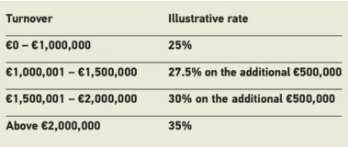
One possibility would be for the applicable tax rate to increase progressively as businesses move through different turnover bands, eventually reaching the standard 35% rate.
By way of illustration, a framework such as one presented in the shaded box on the right could perhaps be considered. This would preserve the incentive intended for smaller businesses while creating a smoother transition as those businesses expand.
Another question left largely unanswered is why the measure should be available to companies but not to self-employed individuals. Admittedly, extending such a system to the self-employed may present additional administrative challenges. Nevertheless, it is worth considering whether the underlying policy objective could be achieved in a manner that provides comparable incentives irrespective of whether a business operates through a company or as a self-employed activity.
The budget also brought forward ideas which are physiologically harsh for third-country nationals and will certainly constitute a financial cost to their employers. This is a sensitive area, and any debate must be particularly balanced.
From my own experience, Malta has already lost experienced and valuable third-country national employees to larger European jurisdictions that offer more attractive personal tax arrangements for skilled professionals. If Malta wishes to remain competitive in attracting and retaining talent, this is an issue that deserves serious consideration.
Regrettably, the budget speech did not address this. On the contrary, the budget prompted some members of the public to revive arguments about third-country nationals that should have long been consigned to the attic of history.
There are also longstanding challenges which the budget could perhaps have addressed more directly. Malta continues to face pressures relating to infrastructure, traffic congestion and the environment. These are not merely peripheral issues. They increasingly influence the quality of life enjoyed by those who live and work here and, ultimately, Malta’s attractiveness as a place in which to invest, establish a business and build a career.
Moreover, it failed to outline any initiatives to help employers recruit internationally while allowing employees to work remotely from their country of origin. This option is quickly spreading across the globe but Malta risks falling behind.
Perhaps of even greater concern is what the budget might have done to encourage Malta’s younger generation to build its future on the island. Increasingly, young Maltese people look beyond our shores when considering where to live, work and establish their careers. That should not automatically be interpreted as a lack of attachment to Malta or a lack of patriotism. Rather, it should prompt a more fundamental question: are we giving younger generations sufficiently compelling economic and social reasons to see their future here?
Financial incentives can certainly form part of the answer, but retention cannot ultimately depend on one-off bonuses alone. Taxation, career opportunities, housing affordability, infrastructure, the environment and overall quality of life all form part of the proposition that Malta offers its younger generation.
And this, perhaps, brings us back to the central point.
A budget should understandably be judged on the measures it contains. But it is equally legitimate to consider the issues it leaves unresolved.
As I reflect on Budget 2027, therefore, it is not only what was said that warrants discussion. Perhaps it is the unsaid that speaks the loudest.
Paul Giglio is a tax and assurance partner at Forvis Mazars in Malta, where he manages a diverse portfolio of local and international clients across the insurance, iGaming, asset management and manufacturing sectors.
This article was first published on The Business Picture on November 1, 2026 and written by Paul Giglio, Tax & Assurance Partner, Forvis Mazars Malta.
Want to know more?