
Vendor Due Diligence: Value Creation Tool or Additional Cost?
Download full PDF below.

When Vendor Due Diligence (VDD) comes up, sellers often ask a perfectly reasonable question: "Why should I pay to help buyers do their job?" After all, buyers will appoint their own advisers and conduct their own due diligence before completing a transaction. As a result, a separate review commissioned and paid for by the seller can feel like an unnecessary additional transaction cost.
However, the issue is not just the cost involved, but also how much transaction value could be lost if important issues are only identified at a late stage. If VDD is treated merely as a report-writing exercise, it can become an expensive box to tick. When conducted at the right time and with the right focus, however, it gives sellers an opportunity to identify and address weaknesses, present a clearer picture of the business and strengthen the basis for valuation before negotiations begin.
Vendor Due Diligence (VDD) is a due diligence review commissioned and paid for by the seller before a sale process is launched. It looks at the business the way a buyer would, covering sustainable earnings, normalised working capital, cash generation, and related-party and tax matters, and can provide all bidders with a credible, common fact base.
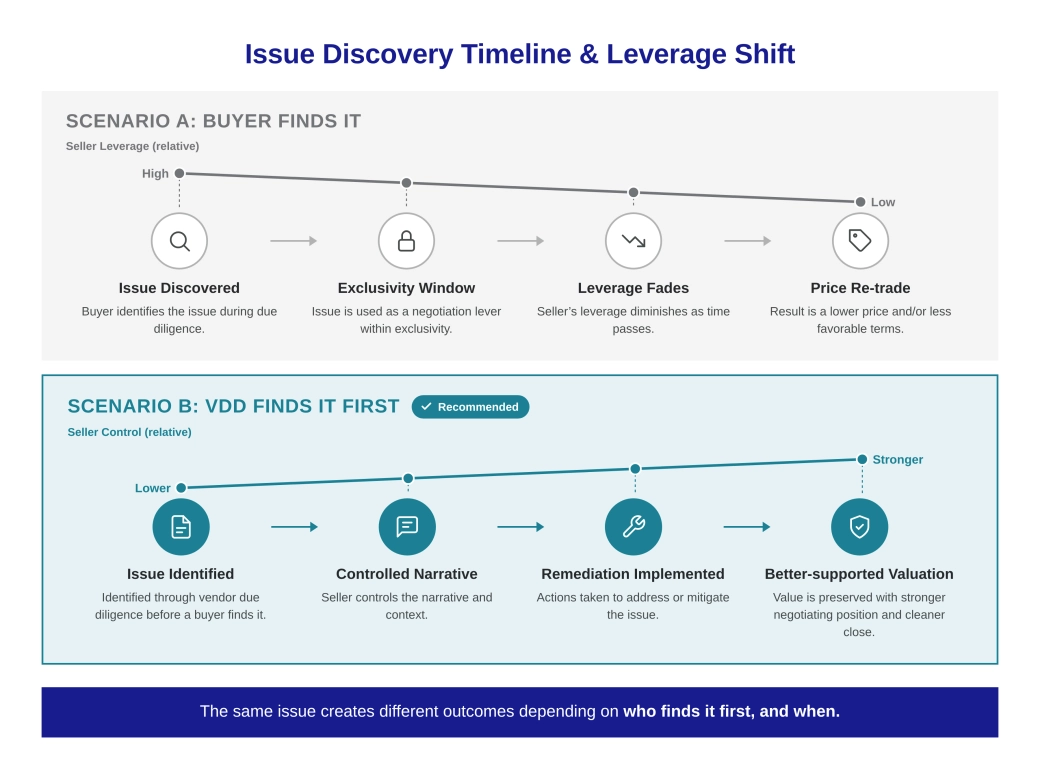
Sellers know their businesses better than any bidder. What they cannot always predict is how buyers will interrogate the numbers. Each bidder approaches diligence differently, and issues may only emerge after exclusivity, when the seller's leverage is starting to fade and the cost of a surprise is at its highest.
Buyers are not simply acquiring reported earnings; they are buying confidence in those earnings. Buyers tend to protect themselves if:
That may mean a lower valuation, tighter deal protections or a late-stage re-trade.
Vendor Due Diligence changes who gets to see those issues first. Management has a chance to understand and address them before they become bargaining chips in a buyer's hands.
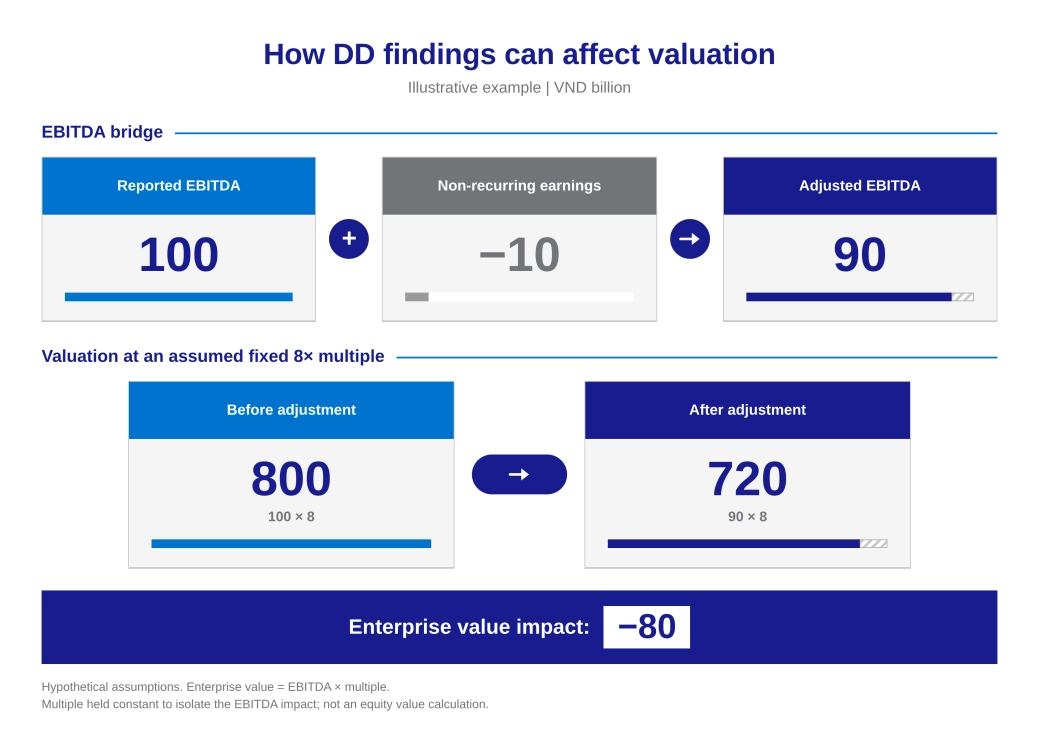
Take a company reporting EBITDA of VND 100 billion. A buyer will want to know:
These are not simply accounting questions. They shape how much of the reported earnings a buyer is prepared to pay for.
That is why a good VDD should not begin with "What will the report say?" The more useful question is: "What can we still change before the buyer sees the business?" The answer might involve:
Or simply giving management a clearer, more consistent explanation of performance
While VDD helps identify and assess matters that could affect a transaction, addressing these findings typically requires action by management. Its greatest value therefore comes when it forms part of a broader transaction-readiness process, allowing sufficient time for improvements before approaching buyers.
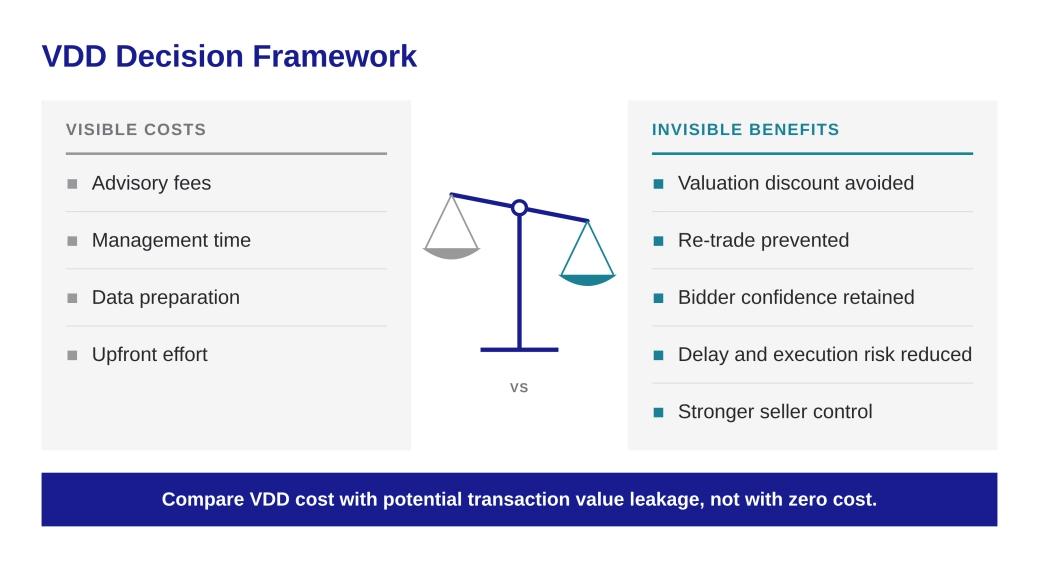
Fewer surprises during exclusivity: Issues are identified while the seller still has time and strategic options, rather than when the buyer has maximum leverage.
The difficulty is that many of these benefits are invisible: the discount that was never taken, the bidder who stayed engaged, the re-trade that did not happen and the delay that was avoided. Comparing a visible advisory fee with an invisible benefit can therefore be misleading.
A fairer comparison is the cost of VDD against the transaction value that could otherwise be lost.
If VDD is commissioned only because "the market expects it", built around a generic template and judged by the length of the final report, it can become exactly the extra cost sellers worry about.
Not every company needs a full institutional-grade VDD. A fact book provides a structured summary of key business and financial information, while a targeted readiness review focuses on selected financial issues or transaction risks that may require attention before approaching buyers.
For a smaller bilateral process, a relatively straightforward business or a buyer already known to the seller, a structured fact book or targeted readiness review may do the job. Equally, a smaller transaction can still justify full VDD when the group structure, related-party history, accounting records or tax position are complicated. The table below is best read as a guide rather than a checklist.
| Factor | Leans toward full VDD | Leans toward a fact book or targeted review |
| Buyer field | Competitive process with multiple bidders | Single buyer or a small, known buyer group |
| Business complexity | Multiple entities, restructurings or related-party history | Simple structure and clean reporting history |
| Known issues | Material matters requiring analysis, framing or remediation | Limited complexity and few expected diligence issues |
| Timeline | Sufficient lead time before launch | Near-term, buyer-driven process with little remediation time |
| Reliance needs | Institutional buyers likely to seek formal reliance | Buyer relationship or process does not require formal reliance |
| Management bandwidth | Team can support a structured external workstream | Capacity is limited and effort must be tightly prioritised |
There is no single deciding factor. The practical question is how much value the seller could lose if an important issue is discovered during exclusivity, and how likely that is to happen.
At its best, VDD strengthens valuation credibility, makes execution more predictable and gives the seller greater control. At its worst, it is too broad, too late and too generic, an exercise detached from the realities of the deal. What separates the two is usually not the label on the report, but the timing, the scope and what management does with the findings.
A seller can uncover issues before the process begins, when there is still time to respond, or let bidders uncover them later, when every answer becomes part of the negotiation.
Every M&A transaction comes with its own due diligence requirements and level of complexity. Forvis Mazars' Financial Advisory team can help businesses assess their transaction readiness and identify the right approach, whether that involves a full vendor due diligence (VDD), a structured fact book or a targeted readiness review.
Contact us to discuss the approach that best fits your transaction plans in Vietnam.
Download full PDF below.



On 18 August 2026, the Ministry of Finance issued Circular No. 118/2026/TT-BTC on the eligible entities, scope, and manner of applying International Accounting Standards (*) in Viet Nam. Circular 118 establishes an election for eligible members of the International Financial Center in Viet Nam (the IFC), not a general mandate to apply International Financial Reporting Standards (IFRS) for all Vietnamese...

When vendor due diligence strengthens valuation credibility, transaction readiness and seller control, and when a lighter approach is enough.

The Government has issued six key decrees implementing the new construction law framework, all effective from 1 July 2026. These decrees form the core implementing framework of Vietnam’s new construction regime and introduce substantial changes affecting the development, procurement, execution and management of construction projects. The six decrees are Decree No. 206/2026/ND-CP, Decree No. 207/2026/ND-CP,...

Vietnam has elevated AI within a broader industrial and digital capability agenda through Decision 1131/QD-TTg (11 strategic technology groups and 35 strategic technology products) and enacted its first standalone Law on Artificial Intelligence (Law No. 134/2025/QH15) on 10 December 2025, effective 1 March 2026, introducing a risk-based classification concept (high/medium/low). This article summarizes...

This guide sets out how venture capital (VC) firms and crypto funds should approach digital asset valuation as Vietnam moves toward a licensed, onshore digital asset market. It covers the principal categories of digital assets, from cryptocurrencies to stablecoins, the valuation methodologies suited to each, and the Quantity Theory of Money (QTM) as a strategic framework for analyzing tokenomics.
This website uses cookies.
Some of these cookies are necessary, while others help us analyse our traffic, serve advertising and deliver customised experiences for you.
For more information on the cookies we use, please refer to our Privacy Policy.
This website cannot function properly without these cookies.
Analytical cookies help us enhance our website by collecting information on its usage.
We use marketing cookies to increase the relevancy of our advertising campaigns.