
16 Oct 2026
Preparing for 2027: HR compliance year-end review
Is it time for an HR compliance health check?

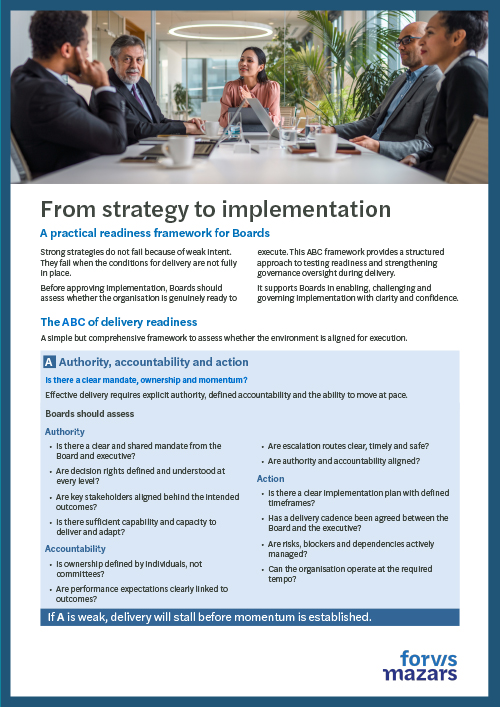
Before approving implementation, Boards should assess whether the organisation is genuinely ready to execute. This ABC framework provides a structured approach to testing readiness and strengthening governance oversight during delivery.
It supports Boards in enabling, challenging and governing implementation with clarity and confidence.
A simple but comprehensive framework to assess whether the environment is aligned for execution.
Is there a clear mandate, ownership and momentum?
Effective delivery requires explicit authority, defined accountability and the ability to move at pace.
Boards should assess:
Authority
Accountability
Action
If A is weak, delivery will stall before momentum is established.
Is there clarity of purpose, value and investment?
Delivery depends on a shared understanding of why the strategy matters and what success looks like.
Boards should assess:
Benefits
Brief
Budget
If B lacks clarity, alignment will weaken under delivery pressure.
Are the human and behavioural conditions in place?
Implementation success is shaped as much by culture and trust as by process and funding.
Boards should assess:
Co-creation
Communications
Culture
If C is misaligned, even well-funded strategies will struggle.
The ABC framework enables Boards to:
Implementation is not an operational detail. It is a governance responsibility.
The question is not only “Is this strategy sound?”
It is “Are we ready to deliver it?”
Is it time for an HR compliance health check?

Following a thematic review, the Central Bank of Ireland (CBI) has published results which highlight how MiFID firms manage liquidity risk.

Since its publication in 2013, BCBS 239 has become a fundamental component of the regulatory framework for effective risk data aggregation and reporting within the banking sector.


Providing an independent perspective to help boards identify improvements and reach their full potential.

Helping you create a resilient framework and culture that keeps you a step ahead of uncertainty

Providing challenge to, and assurance on, organisational form and function

Business in Ireland today face enormous pressures and challenges, requiring flexibility and agility in how organisations are structured, how people work and how we lead.

Creating the foundation for your people to deliver at their best

Driving excellence in service delivery through innovation and partnership
This website uses cookies.
Some of these cookies are necessary, while others help us analyse our traffic, serve advertising and deliver customised experiences for you.
For more information on the cookies we use, please refer to our Privacy Policy.
This website cannot function properly without these cookies.
Analytical cookies help us enhance our website by collecting information on its usage.
We use marketing cookies to increase the relevancy of our advertising campaigns.