

Global mobility and HR news in Switzerland: social security, pillar 3a and work permits
Our newsletter provides you with concise information on HR and Global Mobility news and developments in the areas of tax, social security, payroll, labour law and immigration
Social Security
The reform of European social security coordination adopted at the end of September 2026 leaves national systems unchanged while introducing stricter requirements for assessing cross border activities.
New rules for secondments and cross border work
The reform of European social security coordination introduces important changes for companies with employees working across borders. While national social security systems remain separate, the European rules continue to determine which system applies to a person carrying out cross border activities and how benefit entitlements are coordinated between the countries involved.
The reform focuses in particular on secondments, short term assignments, business travel, cross border home working and activities in several countries. For companies, this means stricter requirements for the prior assessment, classification and documentation of such assignments abroad.
After the Council of the EU formally adopted the revised rules on 28 September 2026, the Presidents of the European Parliament and the Council signed the amendments to Regulations (EC) No 883/2004 and No 987/2009 on 7 October 2026. This brought the legislative process to a close after almost ten years of negotiations.
In brief: The reform introduces targeted simplifications for clearly defined short term assignments. At the same time, the requirements for assessing, classifying, reporting and documenting cross border activities are increasing.
Who is affected by the reform?
The changes do not only affect traditional secondments. The new rules are particularly relevant for companies whose employees regularly:
- Travel on business within Europe
- Work abroad on short term projects
- Work from home across borders
- Work in several countries
- Work within international matrix organisations
- Are employed as cross border commuters
- Use workations or other temporary remote working arrangements.
The duration of an assignment abroad is not the only decisive factor. The purpose of the trip, the activity actually performed, the employers involved and the existing social security arrangements are equally important.
The main changes at a glance
New conditions for secondments
- In future, before a secondment, employees should generally have been subject to the social security system of the sending country for at least three months.
- After a secondment of 24 months, an interruption of at least two months is generally required before a new secondment can take place.
Prior notification with targeted exceptions
- Secondments must generally be notified in advance.
- Exceptions apply in particular to business travel and work assignments lasting no more than three consecutive days within a period of 30 consecutive days.
- This exception does not apply to the construction sector.
- The precise distinction between a business trip, a short-term work assignment and a secondment will therefore become particularly important.
Greater focus on work in several countries and cross border working models
The revised provisions for activities in several countries may also cover cross border home working and other flexible working arrangements. These must continue to be assessed under the applicable coordination rules and where relevant, specific agreements.
What HR and Global Mobility teams should prepare now
| Area for action | What companies should consider |
| Assessment of assignments abroad | Cross border activities should be assessed and correctly classified before the assignment abroad. |
| A1 reporting processes | Existing processes and decision criteria should be reviewed against the new categories and exceptions. |
| Home working and activities in several countries | Cross border working models and activities in several countries continue to require careful social security assessment. |
| Documentation and data quality | Purpose of travel, activity, duration of assignment, place of work and other relevant information should be recorded and documented in a structured manner. |
| Policies and internal processes | Review and where necessary, update business travel, remote working and assignment policies as well as the related approval and escalation processes. |
| Awareness and training | Raise awareness among employees and managers of the social security implications of business travel, international project assignments, home working abroad and other cross border activities. |
| Responsibilities | Responsibilities between HR, Global Mobility, Payroll, Tax and Legal should be clearly defined and existing travel, remote working and assignment processes reviewed. |
| Controls and exchange of information between authorities | The increased exchange of information between authorities raises the requirements for consistency across social security documents, A1 certificates, payroll systems and travel processes. |
The amending regulation enters into force on the first day of the month following its publication in the Official Journal of the European Union. However, the main new provisions on the applicable social security rules for secondments and cross border activities will only apply 24 months after entry into force. Until then, the existing rules generally continue to apply.
Special note for Swiss companies
For Swiss companies, it is particularly important that the new EU provisions do not automatically apply to relations between Switzerland and the EU from the date they enter into force in the EU. As a rule, they must first be incorporated into Annex II of the Agreement on the Free Movement of Persons. Until this happens, the rules currently applicable between Switzerland and the EU remain decisive.
Conclusion
The reform increases the requirements for early assessment of cross border employee assignments. Companies should review in particular their processes for secondments, business travel, short-term work assignments, activities in several countries and cross border home working.
Swiss companies must also monitor the planned incorporation of the new rules into the Agreement on the Free Movement of Persons and continue to apply the rules currently applicable to Switzerland until then.
Social security figures 2027: The main changes at a glance
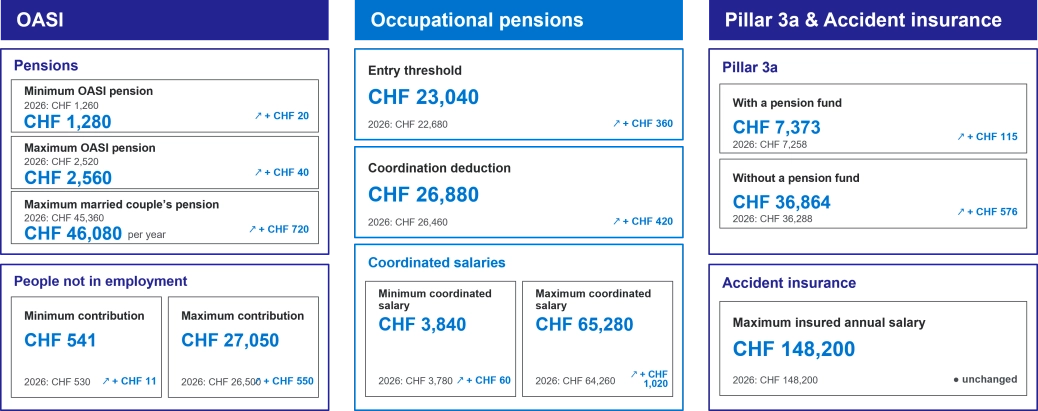
Various changes to Swiss social security and occupational pensions will take effect on 1 January 2027. The increase in OASI pensions will also result in adjustments to several thresholds in the second and third pillars.
For employers, the new occupational pension thresholds and the higher maximum pillar 3a contributions are particularly relevant.
Overview of the main figures for 2027
What does this mean for companies?
Employers should enter the new OASI and occupational pension figures in their payroll, HR and pension systems from 1 January 2027 and check whether there are any effects on insurance coverage, coordinated salary, contributions or benefits.
Conclusion
Overall, the adjustments for 2027 are moderate, but they may affect insurance coverage, coordinated salary, contribution levels and the maximum tax deductible contributions to pillar 3a. Companies should ensure that the new thresholds are correctly reflected in payroll, HR and pension systems from 1 January 2027.
International social security: CJEU ruling changes the calculation of the 25% threshold
Working days outside Switzerland and the EU/EEA can now affect an employee’s social security affiliation.
Internationally mobile employees frequently work across Switzerland, the EU/EEA and third countries. A recent judgment of the Court of Justice of the European Union (CJEU) provides important clarification on how activities in third countries must be taken into account when determining the applicable social security system.
In its judgment of 11 December 2025 in Case C 743/23, the CJEU held that, when assessing whether employees perform a “substantial part” of their activity in their country of residence, all relevant employment activities must be taken into account. This includes activities in third countries outside the EU/EEA and Switzerland.
The 25% threshold
Under Regulation (EC) No 883/2004 and its implementing Regulation (EC) No 987/2009, which apply in relations between Switzerland and the EU, determining the competent social security system for employees who work in several countries depends, among other factors, on whether they perform a substantial part of their activity in their country of residence.
Working time and/or remuneration are relevant criteria. A proportion below 25% indicates that a substantial part of the activity is not performed in the country of residence.
What has changed?
Before the judgment, the general understanding was that only activities carried out within the EU/EEA and Switzerland were taken into account when assessing the 25% threshold. The CJEU has now clarified that working time in third countries must also be included in the overall calculation.
The case illustrates the potential impact. It concerned an employee resident in Germany who was employed by a Swiss employer and performed around 16% of his activity in Germany, 16% in Switzerland and 68% in third countries. Before the judgment, the situation would have been assessed solely on the basis of the working time in Germany and Switzerland, regardless of the time worked in third countries. This would have led to the conclusion that 50% of the working time taken into account for the calculation was performed in Germany and therefore in the country of residence, meaning that German social security rules would have applied.
When the employee’s worldwide activity was taken into account, the activity carried out in Germany represented only around 16% and was therefore below the 25% threshold in the country of residence. The CJEU therefore concluded that Swiss social security rules applied under the general principle of lex loci laboris, meaning the law of the place of work.
Potential impact for employers and internationally mobile employees
The judgment may have practical implications for employees who live in an EU Member State, are employed in Switzerland and regularly work internationally. This applies in particular where a substantial proportion of their activity is carried out outside Switzerland and the EU/EEA.
Existing social security affiliations may therefore need to be reviewed where previous calculations of the 25% threshold excluded working days in third countries. Depending on the individual working pattern, applying the Court’s approach may result in a different social security system being competent.
However, the judgment does not mean that the European coordination rules themselves create social security rights or exemptions in third countries. Local social security rules and applicable bilateral agreements must still be considered separately.
Recommended next steps
Swiss employers and internationally mobile employees should review cross border working patterns in particular where employees:
- Live in an EU/EEA Member State but are employed in Switzerland
- Regularly carry out activities in third countries
- Have a working pattern that places them close to the 25% threshold in their country of residence
Accurate recording of working days worldwide will therefore become particularly important when assessing the applicable social security rules.
Forvis Mazars supports employers and internationally mobile employees in reviewing existing social security affiliations, assessing the impact of the judgment and determining whether reassessment of the applicable social security rules may be appropriate.
Immigration: Switzerland and India strengthen professional mobility
Switzerland and India concluded two agreements on migration and professional mobility on 5 October 2026. The “Migration and Mobility Partnership” strengthens cooperation in areas including education, science, the labour market and legal mobility. A separate agreement allows young nationals of both countries to undertake training or further education stays in the other country.
For internationally active companies, this may create new opportunities for developing young professionals. As the requirements, age limits, duration of stay, procedures and entry into force have not yet been published, specific assignments should only be planned once the implementing provisions are available.
Our recommendation: Companies planning employee exchanges between Switzerland and India should monitor the implementation of the agreement and assess whether it creates new opportunities for their talent and Global Mobility programmes.
Immigration: 2027 quotas, new maximum numbers for work permits expected
Each year, the Federal Council sets the maximum numbers for the admission of workers from third countries. The quotas for 2027 had not yet been published at the editorial deadline. Their announcement is therefore expected to be particularly relevant for internationally active Swiss companies in the coming weeks.
For 2026, a total of 8'500 permits are available for qualified workers from third countries, comprising 4'500 B residence permits and 4'000 L short stay permits. There are also separate quotas of 3'500 permits for service providers from EU/EFTA countries and 3'500 permits for workers from the United Kingdom. These maximum numbers remained unchanged from 2025.
What does this mean for companies? Companies planning to recruit specialists and managers from third countries in 2027 or longer-term cross border assignments should monitor the forthcoming decision closely. The level and distribution of the quotas provide an important framework for the admission of third country nationals to the Swiss labour market. The State Secretariat for Migration notes that their admission is limited in number and that the overall economic interest, personal requirements and other statutory admission criteria must in particular be met.
Our tip: Plan international recruitment and employee assignments for 2027 at an early stage and take the new quotas into account as soon as they are published.
Editorial status: 17 October 2026. The maximum numbers for 2027 had not yet been published at the time of editing.
Author: Gordana Muggler
Want to know more?