



AI at scale: from experimentation to real business value
17 June 2026
The fiscal environment of 2026 has brought AI hype to its peak, bringing with it far higher expectations for value-driven delivery. What was once difficult to quantify is now starting to take shape. As organisations have prioritised use cases and learned from early integration efforts, the first credible wave of ROI reports has now emerged, making it impossible for leaders to justify ongoing investment without evaluating impact.
This marks a clear shift. Organisations can no longer rely on speculative investment or scattergun implementation approaches. There was a time when momentum alone, fuelled by this escalating trend and a persuasive transformation pitch, was enough to secure budget and goodwill. Now, Investors and shareholders are equipped – and willing – to draw a much sharper distinction between AI hype and AI value.
“The questions being asked in boardrooms have shifted; it is no longer enough to say that AI is being explored or piloted. Stakeholders want to see what it has actually delivered.” - Guillaume Devaux, Partner, Head of Technology, Media, Telecommunications, Forvis Mazars Group
|
AI workforce efficiencies and business transformation have had a significant impact, but it still hasn’t reached its full potential for some organisations, often despite enthusiastic and successful implementation. Pilots have proliferated, but few have scaled into habitual change to ways of working or something that materially changes the way a business operates and performs.
- 95of C-suite leaders confirmed at the start of the year that AI is having an impact on their organisation*
- 80of leaders have restructured teams in the last 2 years to implement AI*
- 72confirmed geopolitical developments in the past 6 months have accelerated their AI plans**
* C-suite barometer: outlook 2026
**C-suite barometer: 2026 mid-year insights
To move from AI hype to AI value, organisations and their leaders must move from “capability talk”, which is focused more on deployment milestones and deliverables, to “performance talk”, which focuses squarely on the business value AI is generating.
ROI from AI is an essential step change. The shift from experimentation to measurement is what will ultimately unlock scale and turn any early gains into sustained competitive advantage. The impact for organisations unable to will impact, not just their bottom line and market position, but any justification for future investment.
The AI ROI gap
Every year, we conduct research to understand the priorities and issues at the heart of our clients’ businesses. Our C-suite barometer gathers the views of thousands of executives from all over the world, giving us valuable insight into the trends and transformations impacting businesses.
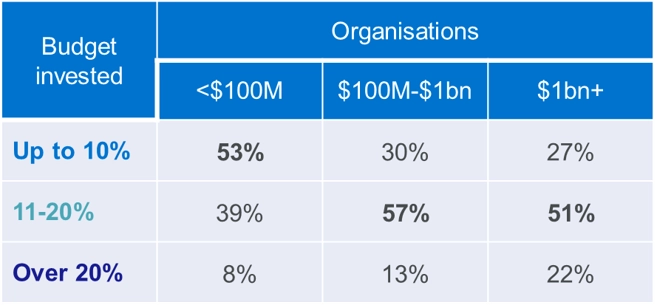
Six months on from our initial 2026 outlook, fresh findings from our mid-year insights reinforce the confidence leaders have in AI’s potential and now reveal initial returns from AI investments. However, you can’t really value the overall returns without considering the scale of investment. Now, the proportion of budget invested in AI rises steeply with revenue, as you would expect, but what we have found is 15% of organisations have invested more than a fifth of their budget in AI, and 35% have spent less than 10%. To what extent of ROI should leaders, their businesses (and their investors and stakeholders) be expecting?
- 96of C-suite leaders confirmed AI has made their teams more productive*
- 63C-suite leaders report up to 10% returns on their AI investments, with a fifth seeing higher gains**
- 33Claim their business is fully equipped and ready to adapt its strategy in response to the pace of future AI developments*
“AI success is not a purely technical challenge, it’s an organisational one. The organisations seeing real ROI are those that start from business problems and build the capabilities to scale AI across the enterprise.” - Tobias Schuster, Senior Manager, AI Solutions Lead, Forvis Mazars in Germany |
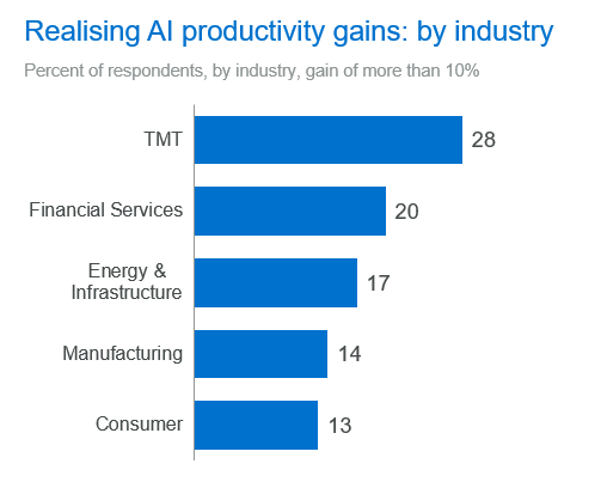
For most organisations, lack of ROI from AI investment tends to result from four critical components:
- Lack of strategy – Too often, the motivation has been simply to use AI, often based on pressures from investors or competition, rather than to solve a defined business problem. Implementation has followed the technology rather than the need.
- Poor use case definition – Organisations have leaned heavily on horizontal use cases instead of vertical ones, chosen the wrong tool for the job or set the wrong metrics and expectations for the use case. Often, all three misalignments are at play.
- Weak governance – Poor data quality and poorly defined boundaries or classifications have hampered even the most well-resourced efforts. Even huge tech companies like Google are still working through these challenges, showing the importance of right-size governance by design.
- Inadequate change management – A lack of workforce buy-in, weak leadership and insufficient enablement have prevented adoption from taking root in many organisations.
None of this is to suggest that organisations should stall in their AI ambitions. The pace of innovation is not slowing; rather, it is accelerating exponentially. Those who do not embrace the transformational potential of AI are likely to be left behind. But the ROI picture is showing that implementation must be approached strategically and proportionally. Being strategic about use case evaluation and definition – along with laying strong foundations in data and governance – will allow organisations to move quickly and generate real value as the technology continues to evolve.
How to use AI to generate real business value
AI reflects such a fundamental shift in operating models and priorities, touching so many different parts of the business, that it cannot be approached as a bolt-on technology. This means a solid foundation of data and governance is required, as is clarity around the business problem the technology is actually helping to solve.
“The most successful organisations are those that either already had the right foundations in data and governance before attempting to implement AI use cases, or those that have used AI as the impetus for a wider digital transformation, establishing those foundations before attempting to implement AI at scale.” – Michael Fried, Principal, Forvis Mazars US
|
In any use case, AI should be treated as a potential tool – albeit a very powerful one – for solving a strategic problem, rather than an end in itself. It is not a silver bullet, and approaching AI implementation with the sole priority of finding a way to leverage it is unlikely to yield real value and is likely to result in disproportionate, ineffective “solutions”. AI is one tool in a vast toolkit of technologies to leverage for any given business problem. The key lies in knowing when to reach for it, versus when something else will better solve the business problem at hand.
However, simply identifying a business problem AI can solve is not enough. Effective, value-generating implementations require clarity of purpose, proportionality of response and a relentless focus on outcomes that matter.
Part 1 – Use case clarity
The first question any organisation should ask is whether there are multiple business problems with overlapping inefficiencies, data sets or requirements that a single solution could help solve. Treating use cases in isolation often leads to duplicated effort and fragmented results. Looking across the business for related problems can reveal opportunities for a more coherent and higher-value implementation.
Horizontal vs vertical use cases
This is where the distinction between horizontal and vertical implementations becomes important. This terminology comes from the IT world, with the concepts of “scaling out” (adding more lanes to a busy highway) vs “scaling up” (replacing existing vehicles with faster, more efficient ones).
When applied to AI implementations, horizontal use cases often take the shape of general AI assistants aimed at increasing the productivity of individuals in the workforce. Not only is it hard to quantify, but employees are likely to make up for productivity gains in other ways when there are no clear, quantifiable metrics attached to their AI usage. An hour saved that is not redirected to a measurable outcome isn’t really a saving at all.
Horizontal use cases are inherently broad and difficult to measure, and alone they’re unlikely to be worth the investment in measurable business value generated.
Vertical use cases, on the other hand, are more capable AI implementations that automate previously manual tasks, whether tedious, data-heavy or both, or help orchestrate end-to-end business processes. Vertical implementations, tied to specific functions and outcomes, are easier to measure and easier to defend, even when a larger up-front investment is required.
Valuable use cases for AI implementation are those that address real business problems and present with quantifiable success metrics.
Once a business problem and corresponding vertical use case has been identified, these 3 questions will help leaders determine how (and if) AI can be used to generate business value:
1. Is AI the right tool for the job?
AI is an extreme solution and should be proportionate to the business value of the problem it is solving. Leaders should resist the urge to crack a nut with a sledgehammer; if a rules-based automation, a process redesign or a better-built dashboard will do the job just as effectively, that is usually a better answer than AI implementation. Environmental concerns and data quality and availability should also be weighed at this stage, before any commitment is made.
Indeed, sustainability concerns belong at the scoping stage rather than as an afterthought. Quantifying an AI footprint is difficult, even with your own GPUs, and AI is established to be environmentally damaging – this is especially true for agentic AI systems. It is important to consider sustainability ambitions, goals and compliance early, because there may be equally effective (or nearly as effective) solutions that are less environmentally taxing. Non-AI solutions can often get you most of the way there without the same sustainability (or even monetary) cost.
2. What type of AI is best suited to this work?
If AI is the right tool, the next question is what type. The benefits and challenges vary significantly across chat interfaces, retrieval-augmented generation, agentic systems and multi-agent architectures.
Task-level AI is often a waste of potential; one use case's leveraging of AI can frequently enable another, and thinking in terms of capability ecosystems rather than isolated tasks tends to yield better returns. In this way, one implementation (or coordinated implementation) can help address multiple business problems, or a single business problem with multiple contributing factors across different areas of the business.
“The organisations getting real value from AI aren't thinking task by task – they're thinking in capability ecosystems. One well-designed implementation can address several business problems at once, but only if you're willing to step back from the immediate use case and look at the wider operating model.” – Laurent Inard, Partner, Head of Research & Development, Forvis Mazars in France
|
Established LLMs (versus proprietary models) are the most common design choice; they will usually be more robust and efficient and will be kept up to date with the right capabilities. They do, however, come with risks and requirements that must be considered, including heightened third party risk management (TPRM) considerations. Borrowed models do not reduce the maturity required for governance and oversight; if anything, they increase it
3. What are the right success metrics for this use case?
One of the biggest hurdles for organisations in moving from “capability talk” to “performance talk” is defining the wrong success metrics for implementation. Every use case’s KPIs should be tied back to the strategic problem being solved and demonstrate real business value in their articulation. Quantifiable value like reduced turnaround time, improved exception rates and shortened value generation cycles will always be better than productivity, milestone or vague “efficiency” metrics.
4. Is this use case operating effectively without AI?
Even if a use case isn’t performing against the relevant success metrics, in most instances, it should be operational without AI. If the process is poorly defined or ineffectual as is, adding AI will only exacerbate those failings, not solve them.
Corporate tax: a use case primed for AI valueOrganisations are seeing clear short-term cash tax savings thanks to AI-enhanced processes and analysis, delivering clear ROI on the relevant AI implementations. This is because corporate tax is often ideally suited to AI implementation thanks to its strong operational and governance foundations:
The key to successful AI implementation is, as always, the quality and standardisation of data and processes. Decentralised corporate tax can get value from AI too, but centralised operations and data mean a clearer path to AI value. AI implementations have been particularly successful for data-heavy and repetitive use cases such as:
|
Part 2 – Governance and data readiness
Governance is too often treated as the brake on AI implementation, when in fact it is the accelerator. Governance without gridlock is achieved by defining governance strategies early. Addressing governance, compliance and risk at the start, even as early as use case evaluation, helps prevent what is often called "pilot purgatory": the state in which a project stalls just before launch, because these considerations have been introduced too late, yet have thrown up valid concerns that require redesign.
The guiding principle here is right-size governance. Safeguards and accountability must be aligned specifically to the nature, scale and criticality of each individual AI use case and the business impact it has. Proportionate controls require organisations to determine what category of risk a use case introduces and apply controls that are proportionate to that risk. A customer-facing decision-making system warrants a very different control environment than an internal summarisation tool.
“Organisations tie themselves up in knots because they don’t have right-size governance in place. They’re governing every use case the same way, regardless of the risk profile or the opportunity for value. This is when governance becomes a blocker to value generation.”
|
Maturity alignment also matters: ambitions should be aligned to the organisation's current readiness across data integration, architecture and workforce skills, not to where leadership wishes the organisation were. If ambitions and maturity don’t align in reality, that signals the need for deep transformation prior to implementation.
Establishing a workflow contract
To move from ambition to action, a "workflow contract" should be established for each use case. This contract sets out five key elements:
- Workflow boundary – identifying exactly where the process starts and ends
- Outcome metric – defining the specific, measurable change expected
- Decision boundary – explicitly stating what the AI can do autonomously, versus what requires human review
- Data boundary – specifying which data the system is permitted to use, and what is prohibited
- Project owner – assigning a specific leader who is accountable for adoption and results
Data readiness underpins all of this. Leaders must align their ambitions with the reality of their maturity along a practical maturity continuum, or their AI implementations are likely to fail. At best, premature or misaligned implementations will generate little to no value, even if “successfully” implemented.
Security and compliance by design
Security and compliance sit alongside governance and require similar discipline. The state of AI regulation in 2026 is more developed than it was even a year ago, with overlapping regional frameworks now placing concrete obligations on organisations deploying some kinds of AI.
Compliance is a core consideration of AI implementations, but like other forms of governance, it should be applied in a right-size manner. It should be an extension of business strategy and risk management. The same applies to cybersecurity: measures should be risk-based and proportionate to the data, processes, people and systems involved.
Both compliance and security should be embedded into the AI lifecycle from the beginning, during scoping and design, rather than as a final review gate. Repeatable governance approaches help here. Organisations should establish repeatable answers to common foundational questions for new use cases, including a standard data classification approach, standardised logging and retention patterns for audit expectations and, crucially, a clear "kill button" or fallback procedure for when quality drops or models behave inappropriately.
A clear exit strategy is essential. Organisations should ask themselves, how will they know when AI quality has dropped? What is the process for disabling the AI and ensuring continuity of the underlying process? Who has ownership and decision-making authority for this? These are questions that need answers before deployment, not after an incident.
“Even more so than other technology, AI transformation requires accepting failure and being able to learn, recover and iterate quickly. Strong data and governance foundations enable this kind of resilience. Without them, every setback becomes a crisis.” – Florence Sardas, Partner, Chief Transformation Officer, Forvis Mazars Group |
Part 3 – Change management
A successful move from AI pilot to scaled implementation begins with clearly defined scope and timelines for both stages, each with its own appropriate success metrics. A pilot that succeeds against scale metrics is a pilot that has been judged on the wrong terms, and the same is true in reverse. But further than that, workforce enablement – and encouragement, as we will see – is the biggest challenge of scaling a solid, vertical AI use case.
Workforce implications, and the fear factor
The most strategic organisations seeing the greatest AI value are finding ways to embrace efficiency gains through better leveraging of their existing workforce, not by replacing it with AI tooling. However, that simple fact does little to assuage workers’ fears of being replaced by AI, especially when that message is not being shared internally.
Realistically, employees will not adopt AI tooling – or at least not to its fullest extent – if they believe it will replace them. They must be assured that AI will help with workforce efficiency, but in the service of growth goals moving forward rather than headcount reduction. The AI-empowered path forward must be clear to everyone, especially those being asked to use it.
“Part of AI change management is offering a clear vision for how employees can be upskilled, reskilled or repurposed within their existing area. Without that vision, adoption will be passive at best and resistant at worst.” – Ali-Sultan Kirgizbaev, Head of Data & AI Centre of Excellence, Forvis Mazars Group
|
Generating buy-in at the pilot stage
Successfully moving from pilot to scale, especially where user adoption is required, relies on demonstrable, highly visible impacts. Results that show up in finance dashboards or weekly operations reviews help earn the permission required for broader transformation.
Education is crucial throughout this transition. Employees must understand the benefits, boundaries and expectations around AI. The cybersecurity overlap deserves particular attention; employees should be well educated on the cybersecurity concerns around AI and data privacy, especially where AI chatbots and external tools are involved.
Users and use case owners should also understand the ESG implications of their work. This understanding will help keep usage focused on critical and valuable processes and will encourage them to use lower-impact solutions first where these are available.
Finally, the workforce should understand how new use cases are evaluated and governed, and this process should be highly visible. With repeatable governance in place, workers and leaders can bring forward new use cases for efficient and effective evaluation focused on improving business outcomes rather than chasing shiny objects.
Leadership sets the tone
Organisation leadership must set a strong example, both for AI enthusiasm and for day-to-day usage. The expectation is set from the top, and leadership defines the tone for how people across the organisation view the AI imperative. A leadership team that uses AI tools, talks openly about its capabilities and limitations and rewards thoughtful experimentation will see a very different adoption curve from one that ignores or rebukes AI in their own roles, delegating its use downward.
So, how can leaders in different areas of the business enable real, tangible business value generation through AI?
“Organisations that succeed will not necessarily implement more quickly. They will implement more coherently, with clearer priorities and stronger execution discipline, and this is how they will generate real business value and enable unprecedented scaling.” – Florence Sardas, Partner, Chief Transformation Officer, Forvis Mazars Group
|
The CEOFocus: define where value should be created The main risk isn’t doing too little – it’s doing too much without delivering impact.
| The CFOFocus: ensure value is measured and realised Treating AI like a traditional IT investment is a mistake. Value is progressive, linked to adoption, and uneven across use cases.
| The CIO & CTOFocus: make value scalable and sustainable Chasing the latest AI trend without strong foundations will increase fragility rather than value.
|
Pivoting from AI hype to AI value
For organisations who have either delayed AI implementation or seen little value return from their use cases, how can they pivot quickly, establishing the right foundation without losing ground?
The good news is that, while true transformation takes time, there are ways to pivot current AI endeavours effectively:
- Take stock – build an inventory of existing AI use cases and prioritise them based on the potential to solve real business problems
- Assign new success metrics – use those business problems to define new success metrics for existing use cases, effectively moving from “capability talk” to “performance talk”
- Create exit plans – exit strategies are the easiest part of governance to retrofit, so define them for all use cases, and initiate them for use cases no longer performing in light of their new success metrics
- Lay foundations alongside existing use cases – hastily implemented use cases should not necessarily dictate governance strategies, but their successes and failures can help inform strategic efforts
- Build a pipeline – reprioritise AI use cases, both new and existing, into a pipeline – both bottom-up and top-down – based on what will solve real business problems within the organisation. Ensure this pipeline has clear evaluation criteria (assessing things like effort, impact, risk, data availability, technical infrastructure and skills) that can be applied to any new use cases.
“Ignore the headlines. Look at your organisation and build a central strategy based on delivering real value instead of serving whoever is yelling the loudest. This will enable you to build the business case for new use cases and establish the right foundation for your organisation’s goals, leading to tangible value generation, as well as more resilience and confidence as AI continues to evolve.” – Michael Fried, Principal, Forvis Mazars US |
Want to know more?

Ali-Sultan Kirgizbaev

Sofia Ihsan AI Consulting Leader - Manchester

Laurent Inard Partner - Paris

Tobias Schuster Senior Manager - Düsseldorf
