
Location-specific climate risk analysis: understanding specific hazards and developing appropriate solutions
Extreme weather events are on the rise worldwide – posing a threat not only to human lives and the environment, but also to business: production facilities are damaged, supply chains disrupted and working conditions become more difficult. At the same time, pressure is mounting on companies to transition to net-zero.
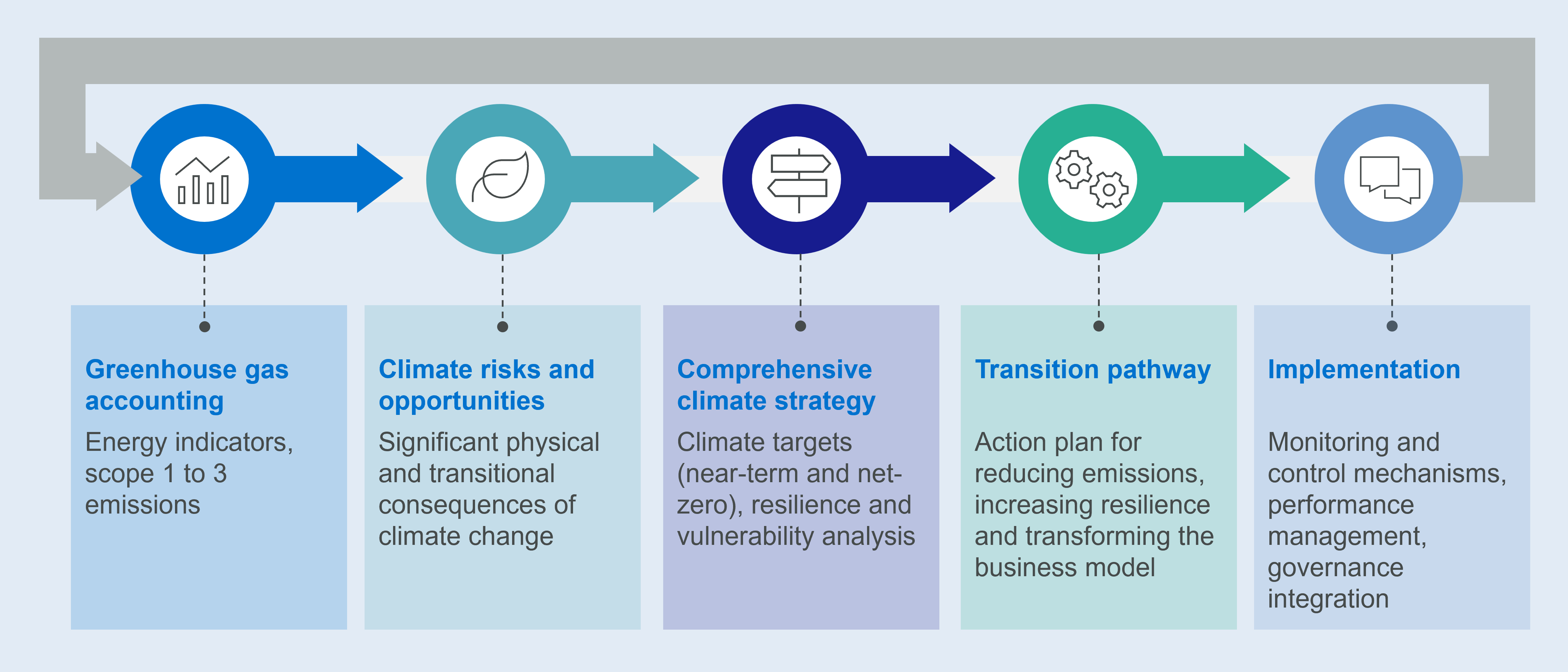
We use company- and location-specific climate risk analysis to identify your key physical and transitional climate risks and opportunities. We base our analyses on individual screening and modelling of climate scenarios using climate projections provided by our long-standing partner Munich Re’s Location Risk Intelligence platform, as well as primary data from the Intergovernmental Panel on Climate Change (IPCC). The climate risks, once identified, are then assessed and financially quantified using vulnerability and resilience analysis. Based on this, we prepare adaptation strategies and measures to efficiently manage climate-related risks. The analysis provides transparent and reliable data for internal strategic management decisions, for meeting regulatory requirements from CSRD and the EU taxonomy, and for communication in TCFD reports and with investors and banks.
Climate strategy and greenhouse gas accounting: the path to net-zero
Many companies need to record their greenhouse gas emissions comprehensively, communicate them credibly and reduce them strategically: those who fail to implement a climate strategy now risk not only violating ESG regulations, but also damaging their reputation and putting themselves at a competitive disadvantage.
Our experienced team supports you in greenhouse gas accounting in accordance with the GHG Protocol and ESRS E1 (climate change) – fully covering scopes 1, 2 and 3 – and creates a solid and transparent data base for identifying effective levers for emission reduction. Building on this, we work with our clients to develop science-based reduction targets (near-term and net-zero) that are compliant with the Science Based Targets initiative (SBTi), and work together to develop appropriate measures. Using the CSRD transition plan, we anchor key figures in a comprehensive climate strategy. In addition to the core metrics, the transition plan includes the development of monitoring and governance processes. With a comprehensive climate strategy, you not only meet stakeholder requirements, but also gain competitive advantages with a sustainable transition of your business model.
Biodiversity: recognising the ecosystem activities critical to success
Biodiversity is a current focus for national and international legislators. It is also growing in importance for companies, as potential shortages of key ecological resources threaten entire business models. Our experts determine whether biodiversity is one of your company’s material topics and to what extent you need to disclose information and address it strategically. We assess material risks and opportunities and analyse their impact on your company. To achieve this, we also consider your company’s dependence on critical ecosystem features such as soil fertility, water availability and coastal safety. We use this information to derive key areas for action, define tailored biodiversity KPIs, provide support in setting targets, develop a concrete roadmap and transfer the results into your ESG ratings and rankings.
This ensures compliance with frameworks such as ESRS E4 (biodiversity and ecosystems), Science Based Targets for Nature (SBTN) or Taskforce on Nature-related Financial Disclosures (TNFD) and contributes to maintaining the economic foundations of your company in the long-term.
Development and significance of a comprehensive climate protection concept
Climate management is not a self-contained process. Each step builds on previous ones and involves specific tasks. At the end, the cylce of evaluation, strategy development and implementation begins anew.
If you would like to learn more about climate & nature, please feel free to contact our experts.
Contact

Moritz Sckaer Partner - Cologne

Philipp Killius Partner - Hamburg

Marc Böhlhoff Partner - Cologne

ESG strategy & transformation
The future viability of a company largely depends on how well its management succeeds in firmly anchoring ESG issues in its overall strategy and culture. This requires a holistic approach, as well as bespoke solutions tailored to the individual business.

ESG technology & AI
Many companies face the challenge of capturing high-quality ESG data along the entire value chain – often with limited resources, high complexity and low availability. A key success factor is the targeted development of a powerful ESG data architecture, as the basis for CSRD reporting, voluntary ESG ratings, strategic sustainability management, customer enquiries and performance management, among...

ESG reporting & communication
Today, it is essential for companies to credibly communicate sustainability while remaining in compliance with ever more regulatory requirements. Legal obligations intensify the pressure on the one hand, while on the other, investors, ESG rating providers, customers and employees increasingly demand transparent, reliable information on environmental, social and governance issues.

Der richtige Umgang mit dem Rahmenwerk der TNFD
Die Hälfte der weltweiten Wirtschaftsleistung – rund 41 Billionen € / 44 Billionen $ – wird von der Umwelt beeinflusst. Dennoch berücksichtigen die meisten Unternehmen, Investoren und Kreditgeber die naturbezogenen Risiken und Chancen bisher nur unzureichend.

Our climate risk analysis solution
What are the biggest economic risks posed by climate change? And how can companies identify all the potential risks in time? Our experts will help you to conduct a climate risk analysis to determine your company’s climate risks and to take possible countermeasures.

The risks of climate change
Companies face a variety of risks due to climate change – physical as well as transitory. Physical risks include, for example, more frequent extreme weather events, rising sea levels, and higher average temperatures. Transitory risks, also known as transition risks, result from the shift toward a low-carbon economy or changes in consumer behaviour. These risks make it ever more important for companies...

Our solutions for climate change strategy
A responsible climate change strategy and the pursuit of sustainability are no longer optional for companies, but rather regulatory and economic necessities. Decisive action and the right strategies are needed to remain successful in the market moving forward.

Our solutions for the TCFD recommendations
By making their business activities and their environmental impacts transparent, companies put themselves ahead of the competition and can thereby strengthen the trust of customers, business partners, and investors. This has a lasting positive effect on the company’s development and also on its reputation as an employer. The recommendations of the Task Force on Climate-related Financial Disclosures...

Navigating the revised CSRD
Practical guidance on the simplified EU sustainability reporting requirements for organisations within and outside the European Union.