

Why do MSMEs need to work on a sustainable model?
MSMEs are at a crossroads where adapting sustainable practices is no longer just a trend but an essential factor for their survival and growth.
Micro, small, and medium enterprises (MSMEs) are the backbone of India's economy. With over 6.3 crore units across the nation[1], MSMEs contribute significantly to employment, innovation, and economic growth. However, in a rapidly changing world, where environmental concerns and sustainable development are at the forefront of global agendas, MSMEs must play a key role in shaping a sustainable future for India. The shift toward sustainable economic practices is no longer just an option for these businesses—it’s a pressing need.
Sustainability - a critical adaption agenda for MSMEs
India, being a leading nation in the fight against climate change, has been actively developing a reporting framework for companies. In this light, a comprehensive Business Responsibility and Sustainability Report (BRSR) framework was developed and made mandatory from the financial year 2022-23 for the top 1000 listed companies based on their market capitalization. Alongside top-listed companies, SEBI has been urging listed small and medium enterprises and other unlisted companies to voluntarily report on sustainable practices through BRSR Lite, which is a simpler version compared to BRSR Comprehensive.
Studies conducted worldwide have revealed that small and medium-sized enterprises (SMEs) still have a long way to go in fully embracing environmental sustainability. While there has been some progress, SMEs have not fully integrated environmental, social, and governance (ESG) reporting and standards into their operations. To help MSMEs, the government has launched various schemes to align them to best practices. For example, the MSME-Sustainable (ZED) Certification scheme was announced in April 2022. This certification program aims to assist enterprises in enhancing their quality and productivity. To provide even greater support to SMEs, amendments known as ZED 2.0 were implemented in September 2024.
These amendments include the addition of new parameters such as Energy Management and Measurement & Analysis, which are intended to strengthen SMEs. Furthermore, financial assistance for multiple testing and certifications has been introduced to offer comprehensive support to SMEs. Overall, ZED 2.0 represents a significant evolution of the scheme, enabling SMEs to achieve positive and impactful changes. ZED certified MSMEs are eligible for handholding and technology up gradation support (a critical element in our journey to being sustainable) up to Rs. 2 lakh and Rs. 3 lakh respectively.[2]
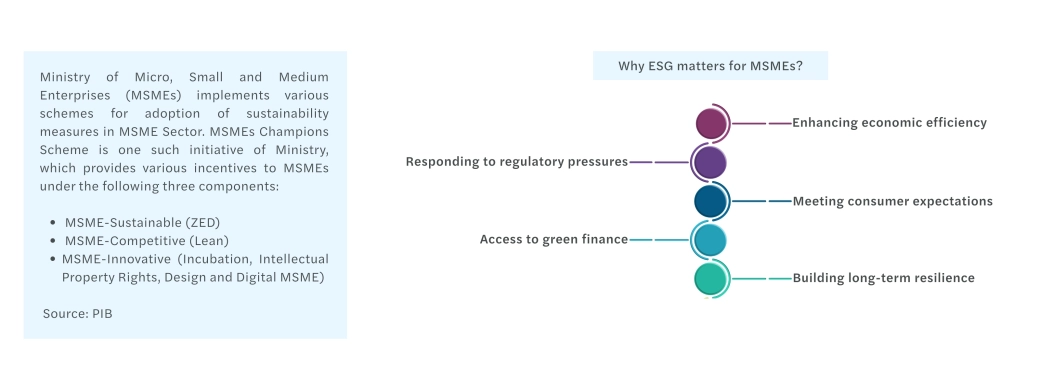
MSMEs are at a crossroads where adapting sustainable practices is no longer just a trend but an essential factor for their survival and growth. MSMEs need to be shown the merits of adapting ESG. Here are the key reasons why:
1. Enhancing economic efficiency: By adapting sustainable practices, such as energy-efficient technologies, waste reduction, and water conservation, MSMEs can significantly lower costs and boost their bottom lines. This is particularly crucial for businesses with limited capital and operational budgets.
2. Responding to regulatory pressures: With governments worldwide tightening environmental regulations, India is leading the crusade against the climate change. Laws related to carbon emissions, waste management, and sustainable production are becoming stricter. MSMEs that fail to adopt environmentally friendly practices may face hefty fines, loss of market access, or operational shutdowns due to non-compliance.
3. Meeting consumer expectations: The demand for eco-friendly products and services is on the rise, especially among younger, environmentally conscious consumers. MSMEs that incorporate sustainability into their offerings not only align with this growing trend but also create new opportunities in niche markets that prioritize sustainable living.
4. Access to green finance: Financial institutions and investors are increasingly focusing on businesses that prioritize sustainability. Whether it’s through green bonds, sustainability-linked loans, or ESG criteria, MSMEs that adopt green practices may find it easier to access funding and capital from investors and financial institutions that are prioritizing sustainability.
5. Building long-term resilience: By embracing sustainable practices, MSMEs can enhance their resilience against environmental shocks, such as resource scarcity, climate change impacts, and supply chain disruptions. Sustainable businesses are more adaptable and can better weather economic and environmental uncertainties.
MSMEs, which contribute approximately over 28 percent to nations GDP, must look at seizing every opportunity to embrace and advance on the sustainability agenda because there is no time to waste!
Rising awareness among MSMEs
Thankfully, there is a rising awareness among MSMEs towards sustainability. The SPeX (also known as the 'Green Pulse Indicator') for July-September 2024, which evaluates the perception of sustainability among MSMEs across three key dimensions: willingness, awareness, and implementation, revealed a 30% jump in willingness during July - September 2024 followed by awareness, which saw a 4% increase to 62; while implementation dropped 15% to 41 compared to the previous quarter. Both the willingness and awareness dimension increased, and implementation fell from the last year quarter.[3]
What is next for us?
The vulnerabilities faced by MSME units will continue to present challenges. These challenges include a lack of financial assistance, limited support for technical upgrades, and difficulties in meeting regulatory compliance. It is crucial to address these obstacles as they contribute to a larger problem.
Of the 6.30 crore units in the country, a significant share of these units is involved in manufacturing and producing goods across sectors. Manufacturing being a focus area of the government tends to add to the overall emissions and waste production. Hence, it is critical for MSMEs too to incorporate risk assessments through a robust sustainability plan. This way, organisations can prepare themselves better against extreme future weather events and future policy updates.
One effective solution is for MSMEs to establish partnerships with larger corporations, industry groups, or non-governmental organizations (NGOs). By doing so, they can gain access to valuable resources, knowledge, and technology. Collaborative efforts enable small businesses to share costs, implement sustainable practices on a larger scale, and benefit from collective action.
A particular focus should be placed on supporting women-led units. According to the Udyam Registration Portal (URP) of the Ministry of MSME, Government of India, women-owned MSMEs account for 20.5% of all registered MSMEs. This presents a significant opportunity for the industry. While progress is being made in addressing the specific needs of women-led businesses,
If MSMEs strive to develop resilience in the face of challenges, they can become an essential pillar of support for various industries, including manufacturing. However, achieving sustainability requires a long-term commitment rather than short-term planning.
Get in touch