

Investing in Thailand: Opportunities, regulatory challenges and the importance of getting the deal structure right
22 October 2026
Thailand continues to be one of the important investment destinations in Southeast Asia, supported by its strategic location, established manufacturing base, infrastructure, and government incentives for foreign investors. The country also offers opportunities for strategic and financial investors looking to enter the market through acquisitions, joint ventures, or greenfield investments.
However, from my experience in advising on M&A transactions across Southeast Asia, a successful investment is not simply about identifying an attractive business or agreeing on the right valuation. Investors also need to understand the regulatory environment, foreign ownership restrictions, taxation, investment incentives, and operational challenges that may directly impact the profitability and long-term value of their investments.
In recent years, cross-border transactions have become increasingly complex. While investors continue to show interest in Thailand, the gap between announced and completed M&A transactions highlights the importance of proper transaction planning, due diligence, and deal structuring.
Thailand's M&A market: Strong interest, but execution remains challenging
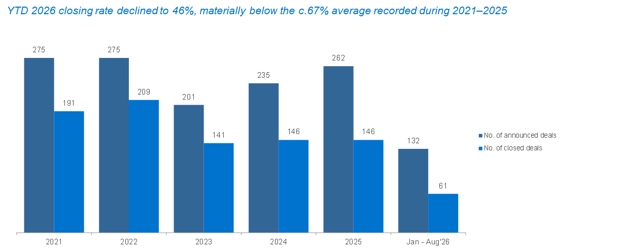
Thailand's M&A market continues to attract both domestic and international investors, although transaction completion remains challenging. Based on S&P Capital IQ data and Forvis Mazars' analysis, Thailand recorded 132 announced M&A transactions during January to August 2026, of which 61 were recorded as completed, representing a closing ratio of approximately 46%. This compares with an average ratio of approximately 67% during 2021–2025.
Source: CapitalIQ, Forvis Mazars’ analysis
Note: these numbers are indicative and based on only available information in public sources
Now, this does not necessarily mean that all the remaining transactions failed. Some transactions may still be under negotiation or waiting for completion. However, it does tell us something important.
Announcing a transaction and successfully completing a transaction are two different things. From my experience, a transaction can face difficulties at different stages. Sometimes the buyer and seller cannot agree on valuation. Sometimes the financial due diligence identifies issues that were not considered when the initial offer was made. And sometimes regulatory approvals, foreign ownership restrictions, or tax considerations create additional complexity.
Therefore, one of the most important factors in a successful M&A transaction is to identify the potential execution risks as early as possible.
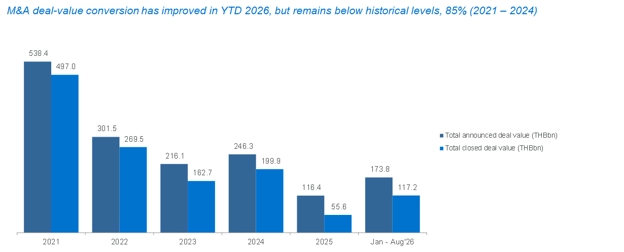
In terms of transaction value, approximately THB 117.2 billion announced transactions and THB 78.5 billion of completed transactions were recorded during the same period, representing a deal-value conversion ratio of approximately 67%.
Source: CapitalIQ, Forvis Mazars’ analysis
Note: these numbers are indicative and based on only available information in public sources
It suggests that although the number of transactions being completed remains relatively low compared with announced transactions, some larger transactions are progressing towards completion. Of course, we should remember that Thailand's M&A market is also influenced by a relatively small number of large transactions, particularly in sectors such as telecommunications. For investors, the important message is that market activity alone does not determine transaction success. Even in an active M&A market, execution discipline remains extremely important.
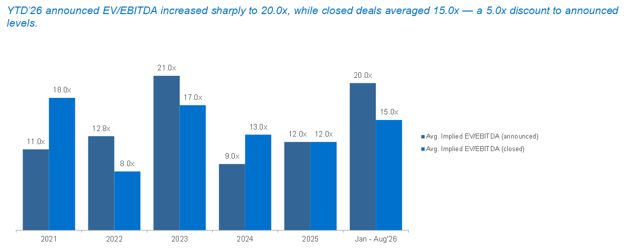
Another interesting observation is the difference between announced and completed transaction valuation multiples. During January to August 2026, the average announced EV/EBITDA multiple was approximately 20.0x, compared with 15.0x for completed transactions.
Source: CapitalIQ, Forvis Mazars’ analysis
Note: these numbers are indicative and based on only available information in public sources
Now, I would not interpret this as meaning that every transaction receives a valuation discount of five times EBITDA. The difference can also be influenced by the types of businesses, industries, and transaction sizes included in the data. However, it highlights one important issue that we frequently observe during M&A negotiations.
Sellers often focus on the future potential of their businesses, while buyers focus on sustainable earnings, cash flow, and potential risks. A seller may expect a premium valuation based on the growth potential, customer relationships, market position, or synergies that a strategic buyer could achieve.
However, a buyer will normally assess historical financial performance, future capital expenditure, working capital requirements, and any regulatory or tax exposure.
This is where valuation gaps can arise.
Therefore, it is important for both buyers and sellers to understand what is driving the valuation and whether those expectations can be supported by financial and commercial evidence.
In my view, a transaction does not fail only because of valuation differences. Foreign ownership restrictions, regulatory approvals, tax exposures, commercial arrangements, and financial due diligence findings can materially influence the final purchase price and, in certain situations, the feasibility of the transaction itself.
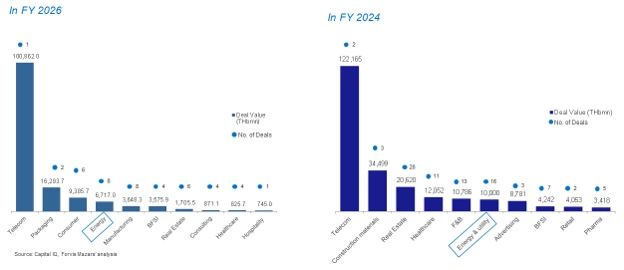
M&A activity is becoming more diversified, although transaction value remains driven by a handful of large telecom deals – selected industries are dominated by foreign investors
Source: CapitalIQ, Forvis Mazars’ analysis
Note: these numbers are indicative and based on only available information in public sources
Looking at the sector breakdown, we can see that Thailand's M&A market is becoming increasingly diversified. Historically, large transactions in telecommunications and certain infrastructure-related industries have significantly influenced the overall deal value.
However, we are also seeing transaction activity across packaging, consumer products, energy, manufacturing, financial services, healthcare, and other sectors.
From my perspective, this presents opportunities for different types of investors. Strategic investors may focus on acquiring businesses that provide market access, technology, customer relationships, or operational synergies. Financial investors, including private equity funds, may focus more on businesses with stable cash flow, scalable operations, and potential for value creation.
For mid-market companies, Thailand continues to offer interesting acquisition opportunities, particularly where shareholders are considering succession planning, business expansion, or bringing in strategic partners.
However, investors should assess each industry independently because regulatory restrictions, operating risks, and valuation expectations can be quite different
Government incentives are creating new investment opportunities
The Thailand Board of Investment (BOI), through its Investment Promotion Strategy 2023–2027, continues to support investment in strategic industries that can strengthen the country's competitiveness and attract foreign capital.
The government's strategic priorities include the Bio-Circular-Green (BCG) economy, electric vehicles and automotive, semiconductors and advanced electronics, digital and creative industries, and regional headquarters and international business centres.
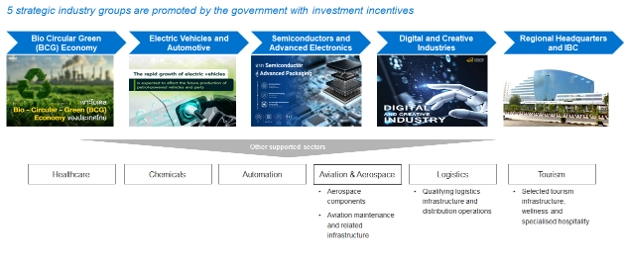
Other eligible activities include selected investments in healthcare, specialty chemicals, industrial automation, aerospace, logistics, tourism and advanced manufacturing.
From an investor's perspective, these sectors are particularly interesting because government support can improve the economics of eligible investment projects. For example, a manufacturing business investing in advanced machinery or technology may qualify for specific investment incentives.
Similarly, investment in renewable energy, digital infrastructure, or certain high-value manufacturing activities may benefit from BOI promotion, depending on the nature of the project.
However, I would like to highlight one important point - Just because a company operates in a promoted industry does not automatically mean that the company is entitled to BOI incentives.
The incentives depend on the specific business activity, investment conditions, and approval granted by the BOI. Therefore, investors should assess eligibility before making their investment decisions.
Depending on the promoted activity and conditions, investors may be eligible for corporate income tax exemptions ranging from 3 to 13 years, exemptions from certain import duties, and non-tax incentives such as permission for foreign ownership, land ownership for promoted operations, and facilitation of foreign specialists and skilled employees.
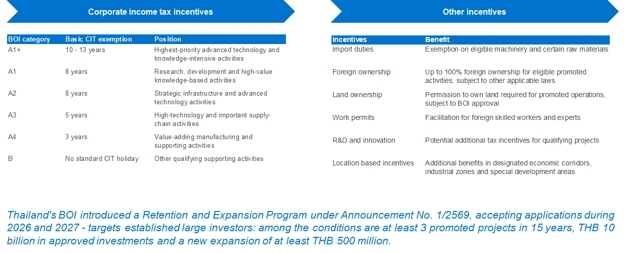
These incentives can have a significant impact on investment returns, particularly for capital-intensive projects.
These incentives can create significant economic benefits for investors. For example, a corporate income tax exemption could materially improve the cash flows during the initial years of a capital-intensive project.
This becomes particularly relevant when investors are comparing Thailand with other potential investment destinations in Southeast Asia. However, the value of the incentive depends on the company's ability to generate qualifying taxable profits during the exemption period.
If the business is making losses or does not generate sufficient taxable income, the actual benefit may be lower than initially expected. Also, certain incentives have investment-linked limits and conditions.
Therefore, when valuing an investment opportunity, it is important to calculate the actual present value of the available tax benefits rather than assuming the maximum advertised incentive will apply.
The BOI has also introduced measures to encourage existing large investors to expand their operations in Thailand. This creates opportunities not only for new investors but also for companies already operating in the country.
What makes cross-border M&A in Thailand difficult?
Now, let us discuss the challenges of acquiring a business in Thailand. In our experience, transaction risks rarely arise from one issue alone.
They generally come from the interaction of regulatory, commercial, financial, and tax matters. I normally look at these risks from four perspectives.
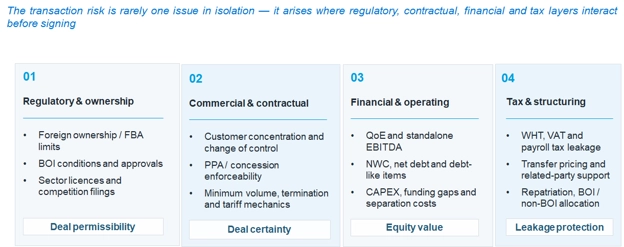
First, regulatory and ownership risks. Can a foreign investor legally acquire the business? Are there foreign ownership restrictions? Does the company require BOI approvals or other sector-specific licenses?
Second, commercial and contractual risks. Are the major customer contracts transferable? Are there changes in control provisions? Are the company's revenues dependent on a few customers or specific contracts?
Third, financial and operational risks. Does the reported EBITDA represent sustainable profitability? Are there significant working capital requirements, shareholder loans, or future capital expenditure commitments?
And fourth, tax and transaction structuring risks. Are there withholding tax, transfer pricing, VAT, or other tax exposures? What is the most efficient structure to acquire the business and repatriate future profits?
These four areas are interconnected.
For example, a regulatory issue may affect the future revenue of the business, which in turn affects the financial forecasts and ultimately the valuation. Therefore, regulatory and financial due diligence should not be treated as completely separate exercises.
Choosing the right investment structure is important
One of the first decisions for foreign investors is determining the appropriate structure for entering the Thai market. The four commonly considered approaches are a representative office, foreign branch, Thai limited company, and BOI-promoted Thai company.
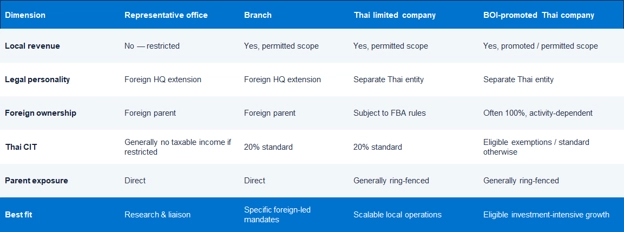
A representative office is generally suitable for market research, liaison, and certain non-revenue-generating support activities. It is not intended for conducting ordinary commercial trading activities in Thailand.
A foreign branch may be appropriate for specific activities carried out directly by an overseas company. However, the branch is not a separate legal entity, and the foreign head office remains directly exposed to the branch's obligations.
A Thai limited company provides a separate legal entity and is generally a more suitable structure for businesses seeking to establish long-term commercial operations. Nevertheless, the proposed activities must comply with Thailand's Foreign Business Act and any applicable sector-specific regulations.
A BOI-promoted Thai company may offer greater economic benefits where the proposed activities qualify for investment promotion, including corporate income tax incentives and, in certain cases, the ability to operate with 100% foreign ownership.
In selecting the appropriate structure, investors should not consider only the initial incorporation costs. They should also evaluate the impact on taxation, capital requirements, foreign ownership, financing flexibility, dividend repatriation, operational requirements, and future exit options.
The most suitable investment structure is not necessarily the one with the lowest initial cost, but the one that supports long-term profitability, operational flexibility, and a commercially feasible exit.
Tax efficiency and profit repatriation should be considered from the beginning
Thailand's standard corporate income tax rate is generally 20%, while dividend payments to overseas shareholders are generally subject to 10% withholding tax, subject to applicable exemptions and treaty provisions.
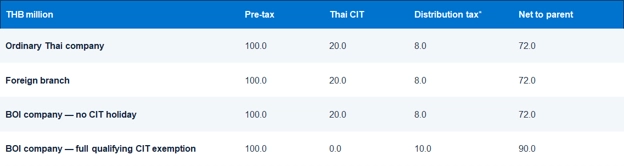
Consequently, the tax structure can materially impact on the actual return received by foreign shareholders. Investors should assess the appropriate combination of equity and debt financing, intercompany funding, management and service fees, intellectual property arrangements, and dividend repatriation.
For example, shareholder loans may provide greater flexibility for funding and repayment. However, investors need to consider interest deductibility, transfer pricing, withholding tax, foreign exchange exposure, and other applicable requirements.
Similarly, management fees or other related-party service charges should be supported by commercial substance, appropriate agreements, evidence of services provided, and arm's-length pricing.
From an investment perspective, tax optimisation should not focus only on reducing the tax liability in Thailand. Investors should consider the overall after-tax return at the shareholder level, taking into account overseas taxation, available tax credits, withholding taxes, and compliance costs.
For BOI-promoted companies, separate monitoring of qualifying and non-qualifying income is particularly important to avoid unexpected tax exposures.
Regulatory challenges can directly impact transaction value
Foreign investors considering acquisitions in Thailand need to assess several regulatory and commercial considerations before committing to a transaction. The Foreign Business Act is one of the key regulations affecting foreign ownership and the ability of foreign-owned businesses to undertake certain activities.
Depending on the industry, additional approvals may be required from relevant authorities, particularly in regulated sectors such as energy, telecommunications, healthcare, financial services, and other licensed activities. Change-of-control provisions in customer contracts, concessions, financing arrangements, and operating licences may also require specific attention.
While these matters are often considered legal or regulatory issues, they can have direct financial implications. For example, if the target company requires additional regulatory approval to continue certain operations following an acquisition, this may delay completion, increase transaction costs, or affect the future revenue-generating capacity of the business.
Therefore, it is important to assess regulatory feasibility at an early stage of the transaction, preferably before submitting a binding offer.
Due diligence: Understanding the difference between reported profitability and sustainable cash flow
Financial due diligence is an important element of an acquisition process, particularly when acquiring privately held or family-owned businesses. From our experience in reviewing businesses across the energy, logistics, manufacturing, and service sectors, the reported EBITDA does not always represent the sustainable earnings or cash-generating capacity of a business.
In renewable energy transactions, for example, a project may have long-term power purchase agreements, but investors still need to assess whether the contractual terms are enforceable, whether the necessary regulatory approvals are in place, and whether the expected revenue is supported by actual electricity generation and customer demand.
Furthermore, renewable energy businesses often require significant maintenance and replacement capital expenditure over the investment period. These cash outflows may not be fully reflected in reported EBITDA, but they can materially impact on the future free cash flow and equity value.
Similarly, in logistics transactions, customer concentration, dependence on subcontractors, and project-based revenue can influence the sustainability of historical margins. Another area that we frequently assess is the standalone cost structure of the target business.
A company operating within a larger corporate group may receive accounting, HR, treasury, management, or operational support from related parties without being charged the full cost of those services. Following an acquisition, the investor may need to incur additional expenditure to replace these functions. Without appropriate normalization, historical profitability may therefore overstate the earnings that a new shareholder can reasonably expect.
In addition, working capital, shareholder loans, related-party balances, committed capital expenditure, and tax liabilities can materially affect the bridge between enterprise value and the final equity purchase price.
These matters reinforce an important consideration: a company can report positive EBITDA while still requiring substantial funding to support its operations and future growth.
Converting due diligence findings into transaction protection
Identifying issues during due diligence is only the first part of the process. The next step is to determine how these findings should be reflected in the valuation, transaction structure, and sale and purchase agreement (SPA).
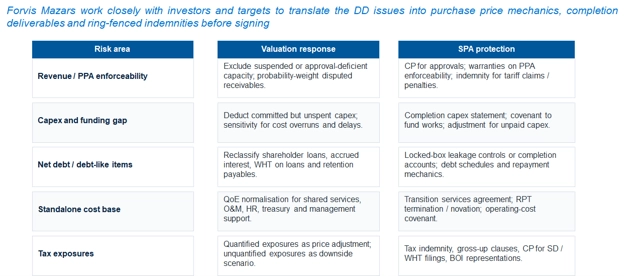
For example, a significant outstanding shareholder loan may need to be treated as a debt-like item when determining the equity purchase price.
Similarly, committed but unspent capital expenditure may require an adjustment to the valuation or specific funding obligations under SPA. Where the target relies on services provided by the existing shareholders or group companies, a transitional services agreement may be required to support operational continuity after completion. Identified tax exposures may require specific indemnities, while outstanding regulatory approvals or customer consents may be included as conditions precedent to completion.
The objective is not to eliminate every risk, which may not be commercially feasible, but to ensure that material risks are properly understood, quantified where possible, and allocated between the buyer and seller. This also helps reduce uncertainty during negotiations and improves the likelihood of completing the transaction.
Managing foreign employees, data protection and operational readiness
In addition to financial and regulatory structuring, investors need to prepare for the practical requirements of operating a business in Thailand. Foreign employees generally require appropriate immigration status and work authorization. While BOI-promoted businesses may benefit from facilitated procedures for bringing in foreign specialists, approvals remain subject to the relevant project and role-specific conditions.
Another important consideration is Thailand's Personal Data Protection Act (PDPA), which affects how businesses collect, use, disclose and protect personal information. Companies expanding their digital operations or using regional shared service centres should carefully assess employee data, customer information, cloud arrangements, and cross-border data transfers.
These are not simply administrative compliance matters. Failure to address them can result in operational disruption, unexpected costs, and regulatory exposure. It is therefore advisable to incorporate immigration, employment compliance, cybersecurity, and data protection into the initial investment planning process rather than addressing them only after the business becomes operational.
Conclusion
Thailand continues to offer attractive opportunities for foreign investors, supported by its established industrial base, strategic geographical location, government incentives, and a diversified range of businesses available for investment. However, the growing complexity of cross-border transactions reinforces the need for a more integrated investment approach.
In my view, investors should focus on three important questions before entering the Thai market or pursuing an acquisition. First, is the proposed investment structure legally and commercially feasible, considering foreign ownership restrictions, BOI incentives, taxation, and operational requirements?
Second, does the business generate sustainable cash flow, after considering working capital requirements, capital expenditure, related-party arrangements, and potential tax exposures?
Third, are the identified transaction risks appropriately reflected in the valuation and transaction documentation, so that investors have sufficient protection and a clear understanding of their post-acquisition obligations?
Addressing these matters at an early stage can help investors avoid unnecessary transaction delays, reduce the risk of value leakage, and improve the probability of successful deal completion. Ultimately, a successful investment is not only about acquiring the right business at the right price. It is also about choosing the right structure, understanding the underlying risks, and ensuring that the expected investment returns can be achieved over the long term.
Source and references
2. Thailand Board of Investment – Eligible Activities and Investment Incentives
3. Thailand BOI – Investment Promotion Announcements
4. Department of Business Development – Foreign Business Act B.E. 2542 (1999)
5. Thailand Revenue Department – Corporate Income Tax – Standard corporate income tax, withholding tax and relevant tax treatment. The Revenue Department (English Site)
6. Forvis Mazars' Financial Advisory transaction experience and analysis (2026) – Sector-specific financial due diligence observations, including renewable energy and logistics, together with transaction protection mechanisms.
Want to know more?

Financial advisory
We provide support for the critical moments that define the success of your business.