

If you can't pay the most, how do you compete for talent?
27 October 2026
Why understanding your Employee Value Proposition may matter more than simply adding another benefit.
For many businesses, particularly SMEs, there is a simple reality when competing for good people: somebody else can probably afford to pay more.
The obvious response is to look again at salaries and benefits. Are we paying enough? Should we increase annual leave, improve medical insurance, increase our provident fund contribution or pay a bigger bonus?
Sometimes the answer will be yes. We should not fall into the trap of pretending that money does not matter. It does. If you are paying significantly below the market for the skills and experience you need, you probably have a problem. Similarly, if your benefits are well below what employees would reasonably expect, telling people that you have a great culture is unlikely to make that problem disappear.
But continually trying to compete by adding another benefit or increasing salaries can become an expensive battle, and one that many businesses will never win. So, if you can't pay the most, perhaps the more important question is: what else makes someone choose to work for you — and, just as importantly, what makes them stay?
This is where Employee Value Proposition, or EVP, becomes important.
What exactly is an EVP?
Many of you will have heard the term EVP. It has become part of the standard language of HR and recruitment, but I am not convinced it is always particularly well understood, including within HR itself.
For a lot of organisations, developing an EVP seems to become largely a branding and advertising exercise. There are workshops, discussions about purpose and culture, perhaps some employee testimonials and photographs, and eventually a series of attractive statements appear on the careers website, LinkedIn and recruitment materials telling prospective candidates what a wonderful place the organisation is to work.
There is nothing wrong with communicating the positive aspects of working for your organisation, but that is really employer branding. It should be the output of understanding your EVP, not the starting point.
At its heart, an EVP is much more fundamental. It is the overall proposition between an organisation and its employees. If I choose to give this organisation my time, skills, experience, effort and commitment, what do I receive in return?
That clearly includes salary and benefits, but it also includes what I experience while I am there, how I am managed, the opportunities I have, whether I am listened to and what working for the organisation might do for my future career.
In reality, every organisation already has an EVP, whether it has deliberately developed one or not. The more important question is whether it understands what that EVP actually is.
Start with the reality, not the advertising
I have seen plenty of EVP exercises that seem to start with the question, “What do we want candidates to think about us?” For me, that is starting at the wrong end of the process.
Before deciding what you want to tell people, you need to understand what it is actually like to work for your organisation. That means talking to employees and managers, looking at why people join and why they leave, understanding what frustrates people and, just as importantly, why some employees have chosen to stay for many years.
It also means being prepared to hear things you may not particularly like. There will probably be things that are genuinely good and that employees value, perhaps including things management has never really considered important. There will be things that could be improved. And there may be things employees would like to change that, for perfectly legitimate business reasons, simply are not going to change.
That is not necessarily a problem. A credible EVP should not pretend that every aspect of working for an organisation is wonderful. It should provide a realistic picture of what the organisation offers, what differentiates it and what kind of employment experience people can reasonably expect.
More importantly, understanding where the organisation is less strong allows management to decide what it could realistically improve and where it might create value in other ways.
What do people actually want?
There are obviously many things people consider when choosing a job. Location is an obvious example. Someone may think a company is an excellent employer but simply not be prepared to spend three hours travelling to and from work every day. Industry, company reputation, working hours, the nature of the job and someone's personal circumstances can all influence a decision.
Not everything therefore fits neatly into an EVP framework. However, when we look specifically at the employment relationship, I think much of what people value can be considered through three fairly simple questions:
What do I get? What do I experience? And what can I become?
Within those three questions, there are six areas worth examining.
What do I get?
Reward is the most obvious. Am I being rewarded fairly for what I contribute? This includes base salary, bonuses, incentives, allowances, insurance, provident fund, leave and the other tangible parts of compensation and benefits. Employees will also make judgements about fairness: how decisions are made, whether they understand them and how their package compares with the alternatives available to them.
The second area is Flexibility & Security. Does this employment relationship work reasonably well with the rest of my life, and does it provide an appropriate degree of stability and predictability? Depending on the job, that could mean working arrangements and hours, flexibility, predictable schedules, income security or simply confidence that the organisation and my job have a future.
What do I experience?
Management & Trust can be every bit as important as some of the things we traditionally put into a benefits package. What is it actually like to be managed in the organisation? Do managers communicate, listen and provide clear direction? Are employees trusted to do their jobs? Are decisions made reasonably and consistently, and can people raise a concern or challenge something?
A generous benefits package can quickly become less attractive when someone spends every day working for a manager they cannot tolerate.
Then there is Belonging & Recognition. Do I feel part of the organisation and that my contribution is valued? This includes relationships with colleagues, teamwork, inclusion, employee voice and recognition. Recognition does not necessarily require another formal programme or award. Sometimes it is simply about knowing that somebody notices when you have done a good job.
What can I become?
Growth & Opportunity asks a rather different question: will I be better professionally in two or three years because I worked here? That may involve formal training and promotion, but it can also mean mentoring, exposure to new experiences, learning from colleagues, international opportunities or simply being given the chance to do things that develop new skills.
Finally, there is Ownership & Impact. Can I take responsibility, influence what happens and see that my work makes a difference? For many people, the opportunity to have their ideas heard, make decisions and take genuine responsibility can be enormously valuable.
These six areas do not explain every reason somebody chooses one employer over another, nor should we pretend they do. But together they provide a useful way of looking beyond a list of salaries and benefits and thinking about the overall value of working for an organisation.
What might that look like in practice?
The value of looking at an EVP in this way is that an organisation does not necessarily need to be outstanding in every area. In fact, a realistic assessment is unlikely to produce six scores of five.
Consider a growing SME that knows it has some limitations. It cannot pay at the top of the market. Its benefits are relatively modest and, because of the nature of the business, it cannot offer employees very much flexibility.
Its profile might look something like this:
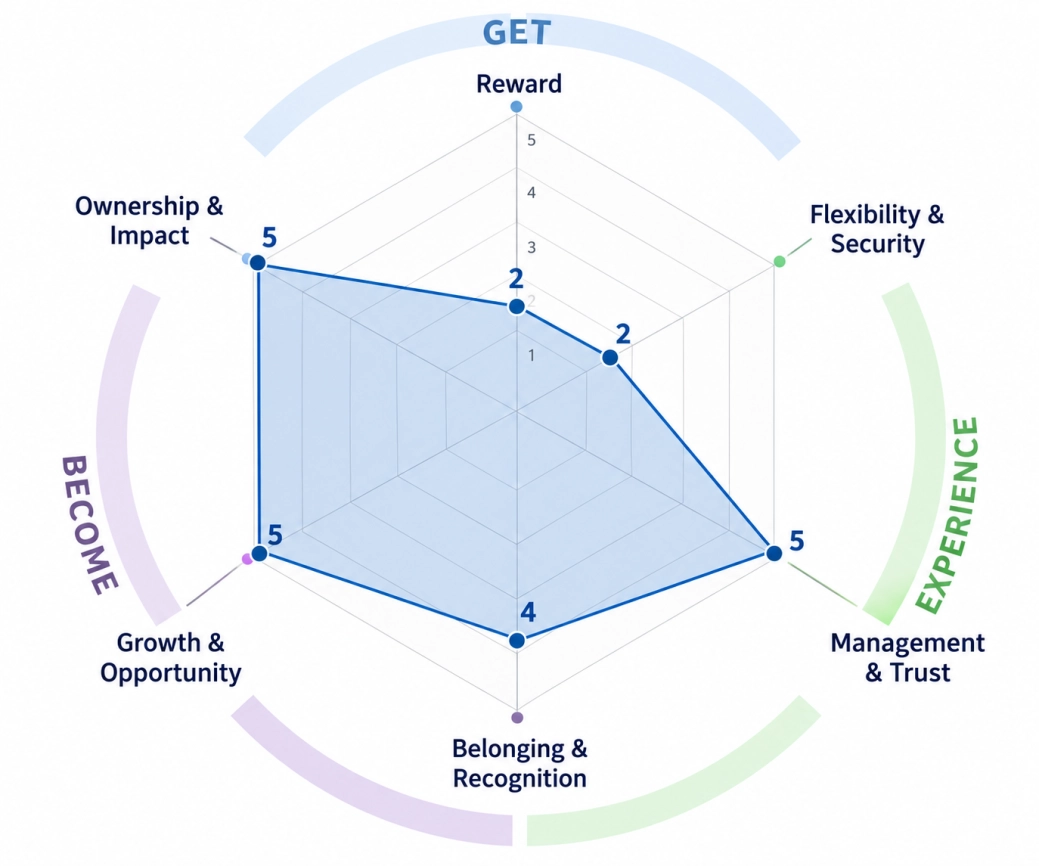
At first sight, the two scores of 2 may look concerning, and they should. The purpose of an EVP review should not be to explain away weaknesses.
Perhaps this company really does need to look at its compensation. Perhaps employees are leaving because they can earn considerably more elsewhere. Equally, perhaps flexibility is constrained by the nature of the work and there is very little the organisation can realistically do about it.
But now look at the other side of the profile.
Employees may have excellent managers who trust them and involve them in decisions. They may work in a close team where people know one another and contribution is recognised. They may be given opportunities to learn quickly, take on responsibilities beyond their formal job description, work directly with senior leaders and see the impact of the decisions they make.
That creates a very different employment proposition.
It does not mean that a score of 5 for Growth & Opportunity somehow cancels out a score of 2 for Reward. If the pay gap becomes too large, people will leave. Nor should an employer tell somebody who is struggling financially that they should be grateful for the excellent development opportunities.
But equally, it would be a mistake to look at this organisation only through the two scores of 2.
For some people, particularly those who value learning, responsibility and the opportunity to have an impact, the overall proposition could still be very attractive. Another employer might pay considerably more but offer narrower jobs, slower progression, less autonomy and several layers of management between the employee and anyone able to make a decision.
Neither proposition is automatically better. Different people will value them differently.
That is really the point of the spider graph. It is not intended to produce an overall EVP score or suggest that every organisation should try to push every dimension towards five. It allows us to see the shape of the employment proposition: where the organisation is strong, where it is weak and where those strengths and weaknesses actually matter.
There is then a second question to ask: how important is each dimension to the people you need to attract and retain?
A score of 2 in something your workforce considers critical is a serious issue. A score of 2 in an area they value less may be manageable, particularly if there are genuine strengths elsewhere.
That is why simply copying another employer's benefits package is unlikely to give you the answer.
Compensation and benefits still matter
There is clearly a point at which compensation and benefits become a threshold issue. If someone is worth around THB 100,000 per month in the employment market and you offer THB 60,000, you are probably going to struggle, regardless of how good the manager is or how interesting the job might be.
But once your overall package reaches a level that people regard as sufficiently fair and credible, the discussion becomes rather different. Is spending another THB 2,000 or 3,000 per month really the thing that will make someone join or stay? Perhaps it is, and we should not assume otherwise. But perhaps greater value could be created through better management, development opportunities, greater employee involvement or improving another part of the employee experience.
This is why I think organisations need to be careful about simply benchmarking benefits and then copying whatever somebody else is offering. Benchmarking certainly has its place, but knowing that another company offers 15 days' annual leave while you offer 12 does not, by itself, tell you why somebody would choose one organisation over the other.
Nor does every improvement necessarily require a large budget. Listening to people better, improving the quality of management, giving employees greater responsibility or providing clearer development opportunities may require effort and management attention, but the answer to every retention problem does not have to be another cash payment or benefit.
Flexible working — and the danger of one-size-fits-all solutions
Flexible working is a particularly good example.
There has been enormous discussion in recent years about hybrid working, working from home and organisations requiring employees to spend more time back in the office. For many office-based employees, flexibility has real value. Avoiding a long commute two or three days a week can make a significant difference to someone's quality of life, and they may value that more highly than a relatively small increase in salary.
But this discussion can become rather office-centric. There are millions of employees for whom working from home is simply not an option. Production employees need to be in the factory. Hotel and restaurant employees need to be where their customers are. Retail employees need to be in stores, and many healthcare employees need to be physically present with patients.
Sometimes there may be other forms of flexibility available, such as more predictable scheduling or some ability to change shifts. But sometimes we simply have to accept that flexibility isn't possible. There is little value pretending otherwise. If your production line requires people to be on site at 7am, that is the reality of the job.
The more useful question then becomes: what else makes someone want to work on your production line rather than the one in the factory down the road?
Perhaps your pay and overtime arrangements are fair and clearly understood. Perhaps you offer greater employment security. Perhaps your supervisors are particularly good at managing people and treating them with respect. Maybe you have a strong record of developing operators into technicians and supervisors, or perhaps employees know that when they suggest a better way of doing something, somebody will actually listen.
This is why one size does not fit all. A benefit that is extremely valuable to one group of employees may be irrelevant or simply impossible for another. Understanding what your people value is far more useful than following the latest trend in employee benefits.
Different people value different things
The same principle applies within an organisation. Someone at the beginning of their career may place considerable value on learning, development and gaining experience quickly. Someone with significant family responsibilities may place greater value on security, predictability or flexibility. A senior professional may care considerably more about autonomy, influence and the ability to make decisions.
Even that is a simplification. Two people of the same age, doing similar jobs and apparently at the same stage of life may value completely different things, and people's priorities change as their lives and careers develop.
The question therefore should not simply be, “What benefits should we offer?” It should be, “What do the people we need to attract and retain actually value?”
For larger organisations, that may mean looking at different employee populations separately. What attracts and retains a software engineer may be quite different from what matters to a production operator, salesperson, accountant or hotel employee. There does not need to be a single answer that works equally well for everyone.
Why people join may not be why they stay
There is also an important difference between attraction and retention.
Before joining, candidates can see the salary, benefits, job title and location. They can look at the company's website and social media, read reviews and listen to what recruiters and interviewers tell them about the culture, career opportunities and working environment.
What they cannot really know is what their manager will be like on a difficult Monday morning, whether people are actually trusted to make decisions, whether senior management listens, or whether all those development opportunities discussed during the interview ever materialise. After six months they have a much better idea.
This is one of the reasons treating EVP primarily as an advertising exercise can be counterproductive. There is little point developing a beautifully presented promise to candidates if the reality employees encounter when they arrive is completely different. Employer branding can help attract people, but retention depends much more on the employment proposition they actually experience.
Smaller businesses may have more to offer than they think
This discussion is particularly relevant to SMEs and mid-sized businesses. A company employing 100 people may simply not be able to match every benefit offered by a multinational employing tens of thousands, and continually trying to do so can become a very expensive exercise.
But smaller organisations do not necessarily need to compete on exactly the same things.
They may be able to give employees much closer access to senior leaders. Jobs can be broader, decisions faster and talented people may be given significant responsibility much earlier in their careers. Employees may be able to see the direct impact of their work in a way that can be much harder inside a very large organisation.
None of this should be used as an excuse for paying people poorly. Compensation still needs to reach a level employees regard as sufficiently fair and credible. If Reward is genuinely sitting at 2, as in our example, the organisation should understand why and consider whether something needs to be done about it.
But it does not necessarily follow that the only answer is to try to turn that 2 into a 5.
Perhaps moving from 2 to 3 is important, while maintaining the things that make Management & Trust, Growth & Opportunity and Ownership & Impact genuine strengths. The aim should be to create a credible overall proposition, not to win every category.
That is potentially a much more realistic strategy for a smaller organisation than attempting to become a miniature version of a multinational.
Before spending more, understand what you already have
When recruitment becomes difficult or turnover increases, increasing salaries or adding another benefit can feel like the obvious response. Sometimes that will be exactly what is required. But before spending more money, it is worth properly understanding the employment proposition you already have.
That means looking at what employees value, where the organisation is genuinely strong and where there may be gaps between management's perception and employees' actual experience. It also means identifying things that could realistically be improved, while accepting that some aspects of the employment relationship are simply part of the reality of the business.
An independent perspective can be particularly useful here.
Forvis Mazars can independently review an organisation's employee offering across the six dimensions of Reward, Flexibility & Security, Management & Trust, Belonging & Recognition, Growth & Opportunity, and Ownership & Impact.
Rather than simply comparing a list of benefits with the market, the review looks at the employment experience from different perspectives, including leadership, HR, managers and employees themselves. The aim is to understand what is already working, where there may be gaps between intention and reality, what employees genuinely value and where change or investment could have the greatest impact.
The spider graph is one way of bringing that information together. It can help an organisation see its EVP as a whole rather than looking at individual policies or benefits in isolation. Combined with an understanding of how important each dimension is to the people the organisation needs, it can also help identify where action should be prioritised.
Importantly, the answer is not necessarily to spend more. An organisation may discover opportunities to strengthen its EVP through better management, clearer career opportunities, greater employee involvement or simply making better use of strengths it already has.
It may also discover that compensation or benefits genuinely are part of the problem. If so, that is important to know too.
Only after understanding this reality does it really make sense to decide how the EVP should be articulated and communicated to existing and prospective employees.
Because if you can't pay the most, the answer isn't to pretend that pay doesn't matter. It is to understand why the people you need would choose to work for you anyway — and why, once they join, they would want to stay.
Want to know more?

HR Advisory & Outsourced HR Services
As organisations grow, workforce challenges become increasingly complex. Leadership capability, workforce planning, employee relations, compliance obligations and organisational structures must evolve alongside the business. Forvis Mazars provides practical HR advisory, outsourced HR support and fractional HR leadership services that help organisations strengthen governance, reduce risk and create...