

Family business 3: Resilience is built, not inherited: Restructuring the family business
13 November 2026
The greatest challenge for a family business may not be passing on ownership, but passing on a structure that can support the next generation’s ambitions.
Many Thai family businesses have grown over generations into diversified groups spanning manufacturing, retail, property and investment. Along the way, their structures have often grown into a complex web of holding companies and cross-shareholdings, each created for a good reason at the time.
That structure may have served the founders well. But it may not support what comes next: raising external capital, expanding regionally, or giving family branches with different priorities room to grow. Three Asian family groups show what a deliberate restructuring can achieve.
Three groups, three challenges
Singha: raising capital without giving up control. In 2014, Singha integrated its property businesses into a listed platform, Singha Estate, through an entire business transfer. Five years later, Singha Estate spun off its hotel arm, S Hotels & Resorts, which raised THB 7,475 million at its IPO. Singha Estate kept 60%. Restructuring does not have to mean selling: a dedicated vehicle lets investors back one business while the family retains control.
Central Retail: getting investor-ready. Before its February 2020 IPO, then the largest in Thailand’s history, the Chirathivat family’s group consolidated its retail operations in Thailand, Vietnam and Italy under Central Retail Corporation and delisted Robinson through a share-swap offer. Investment readiness starts long before investors arrive.
Godrej: keeping the peace by separating. In 2024, India’s Godrej family divided its 127-year-old conglomerate into two groups led by different family branches. A brand agreement lets both keep the Godrej name, and a six-year non-compete keeps them out of each other’s businesses. Sometimes the best way to preserve a legacy is a clean, well-documented separation.
The route matters as much as the destination
The same end structure can carry very different tax costs depending on how you get there. Thailand offers four main tax-relieved routes:
| Route | What happens | Key tax and cost points |
|---|---|---|
| Amalgamation | Companies combine into a new company | Transfer at book value with tax relief; land passes by law, so only a nominal registration fee applies; tax losses are lost |
| New merger (since 2023) | One company absorbs another and survives | Taxed as an entire business transfer; no new company or separate liquidation needed; registration fee treatment for land not yet settled |
| Entire business transfer | Whole business moves to another company; the transferring company dissolves | Relief from corporate income tax, VAT, specific business tax and stamp duty; 2% land registration fee still applies; tax losses are lost |
| Partial business transfer | One business line moves between associated companies | VAT, specific business tax and stamp duty exempt, but not corporate income tax; 2% land registration fee applies |
The difference can be substantial. Consider a family company transferring land bought decades ago for THB 50 million, now worth THB 500 million. Sold outright to a new group company, the immediate cost of tax and registration fees could be around THB 116.5 million. A partial business transfer removes the transaction taxes but not corporate income tax, leaving around THB 100 million. A qualifying entire business transfer removes the taxes, but the 2% land registration fee of around THB 10 million remains. An amalgamation goes further: the land passes to the new company by operation of law, so only a nominal registration fee applies and the immediate cost is close to nil.
The lowest-cost routes have trade-offs. Under an entire business transfer, amalgamation or new merger, the gain is deferred rather than eliminated, tax losses are lost, and the original companies cease to exist. The new merger is taxed like an entire business transfer, but whether land transferred under it attracts the full registration fee or only a nominal fee has not yet been settled in practice.
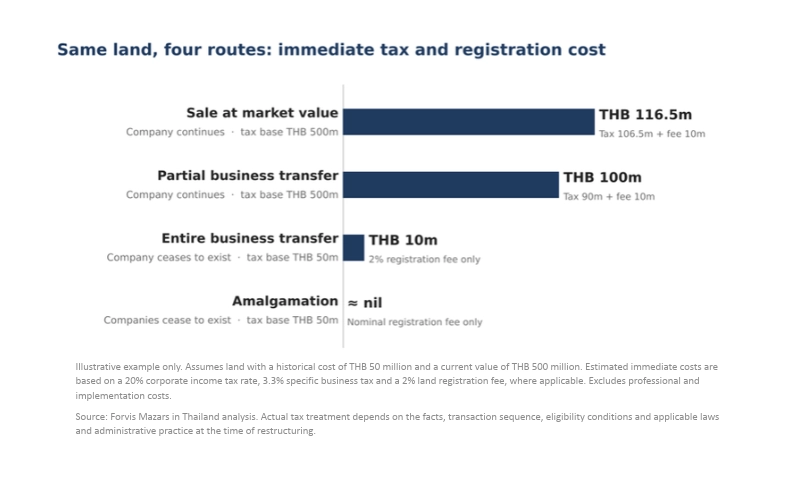
The lesson is simple: tax planning belongs at the start of the commercial discussion, not after the deal is agreed. The choice of route, and the order of the steps, can be worth more than the choice of structure itself.
Five questions for your next family meeting
- Could you explain your group structure to an investor on one slide?
- Which business could attract capital on its own, and is it in its own company?
- Do family branches want different things, and is it better to plan a separation now?
- Which assets have grown most in value, and which route protects their tax base?
- Are your family agreements written to bind the companies, or only the people who signed them?
From planning to execution: how we can help
A restructuring succeeds or fails on the detail, and tax, financial and legal issues rarely arrive one at a time. At Forvis Mazars, our M&A Tax Advisory, Financial Advisory and Legal teams work together as one team from the first conversation to the final filing:
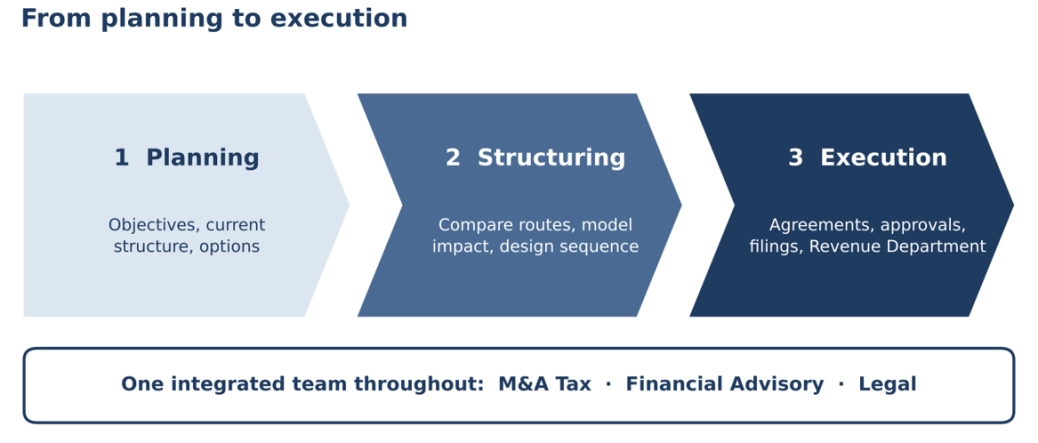
- Planning: understanding the family’s objectives, mapping the current structure and its tax, financial and legal constraints, and identifying the restructuring options available.
- Structuring: comparing routes such as amalgamation, merger, entire and partial business transfers, modelling the tax and financial impact of each, and designing a legally sound and efficient sequence of steps.
- Execution: preparing the transaction and family agreements, managing corporate approvals and registrations, and engaging with the Revenue Department, so that the conditions for tax relief are met.
Supported by our global network, we help families build structures that protect what previous generations created and give the next generation room to take it further.
Is your structure ready for what comes next? Contact our team to start the conversation.
Want to know more?

Parin Supsavaipol Tax Director - Taxation Practice - Bangkok

Family business 1
Family businesses play an important role in a country’s economy as one of the factors supporting sustainable business development. A number of large, successful public companies worldwide started out as family businesses.

Family business 2
This chapter will provide you with a comprehensive overview of the structure, including the holding company, critical considerations, advantages and disadvantages, and our recommendation.

13 Nov 2026
Family business 3
The greatest challenge for a family business may not be passing on ownership, but passing on a structure that can support the next generation’s ambitions.