

Central & Eastern Europe: the rising “Promised Land” for PE funds?
“Private capital isn’t just bouncing back; it’s powering Europe forward." (Eric de Montgolfier, CEO, Invest Europe): Private Equity in CEE region is a growing, dynamic and maturing sector, attracting more and more the attention of financial investors looking for market opportunities and promising returns. Centered mostly until recently on Poland, Czech Republic, Romania and Hungary which often served as primary regional hubs for the PE activity in CEE, the PE investments are currently increasingly focusing on other parts of the region, notably the Adria Subregion.
1. Four main profiles of PE firms active in CEE
Analyzing the Private Equity sector operating in CEE, 4 main types of PE funds can be identified:
- Large international PE funds, mainly from the US and the UK, focusing typically on large transactions with an Enterprise Value above EUR 500 million;
- Pan-European PE funds, mainly coming from Western Europe (UK, France, Germany), generally interested by mid-caps with an EV between EUR 100-500 million;
- CEE-focused PE funds, most often headquartered in Warsaw, Prague, Vienna or in London, dealing with SMEs with EUR 20-100 million EV;
- Purely local PE funds, active only in their country and targeting companies with EUR 5-20 million of EV.
2. PE activity landscape revealing an increased interest for CEE
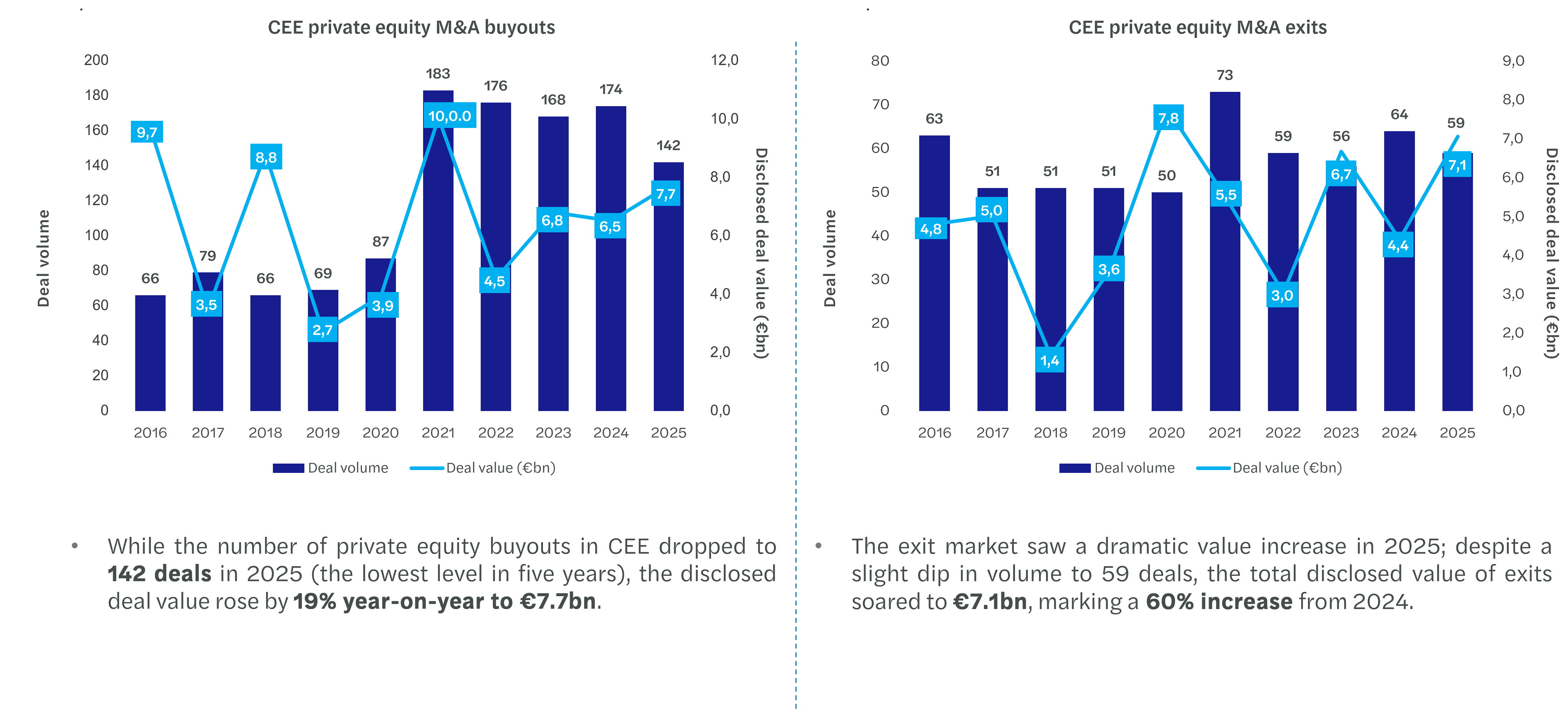
Based on Forvis Mazars’ “Investing in CEE: inbound M&A report 2025/2026” developed in collaboration with Mergermarket market intelligence, Focusing on buyouts, the total value of all PE acquisitions announced in CEE in 2025 surpassed that of 2024, with €7.7bn worth of deals announced (+19% year-on-year) and a total of 142 buy-outs transactions (vs. 174 in 2024). The picture is similar with exits, where deals were fewer in number but considerably higher in value. In volume terms, 59 exits were announced in CEE, down 8% year-on-year, but the total value of these deals was €7.1bn – up 60% from 2024’s total.
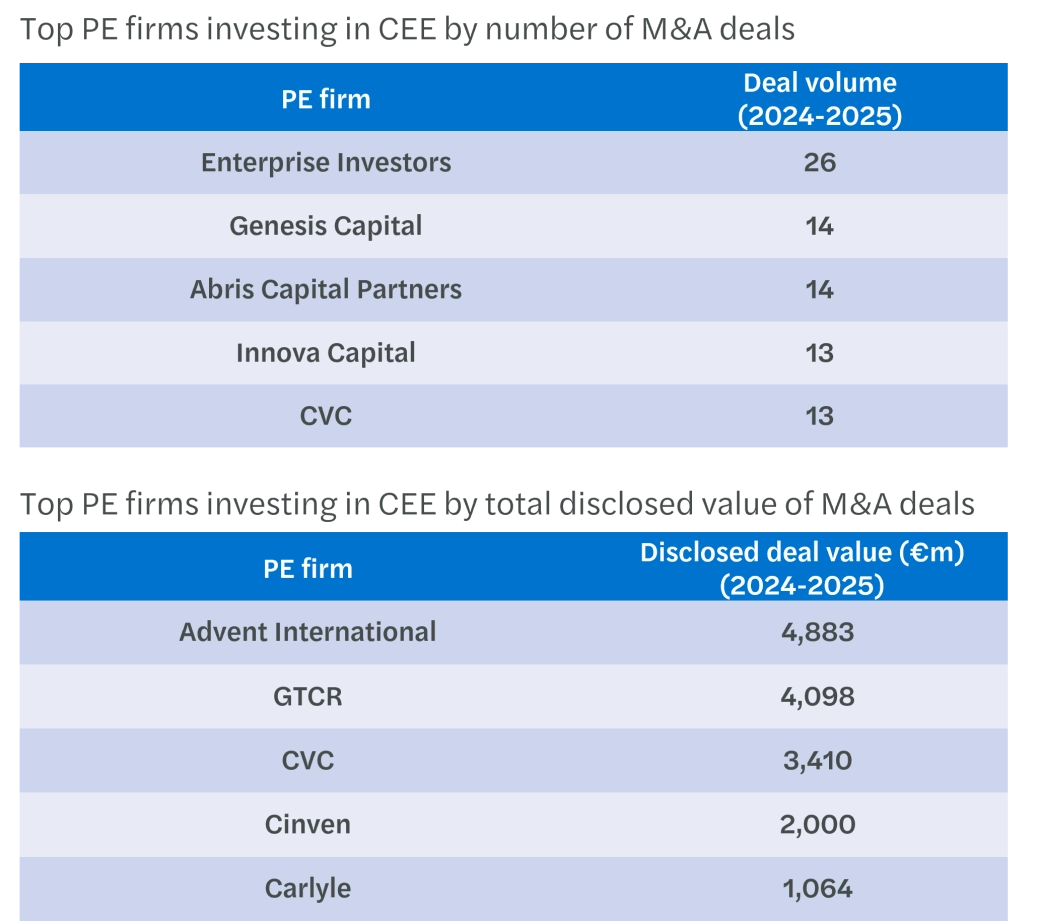
As far as the origin of PE funds investing in CEE during the last 2 years, 4 out of the 5 most active Private Equity funds in terms of deal volume were originally from within the region: Enterprise Investors, Abris Capital, Innova Capital (all three from Poland) and Genesis Capital (from Czech Republic ). As far as total disclosed value are concerned, all the top 5 PEs investing in CEE were leading international funds headquartered in the USA or the UK: Advent, GTCR, CVC, Cinven and Carlyle.
|
 |
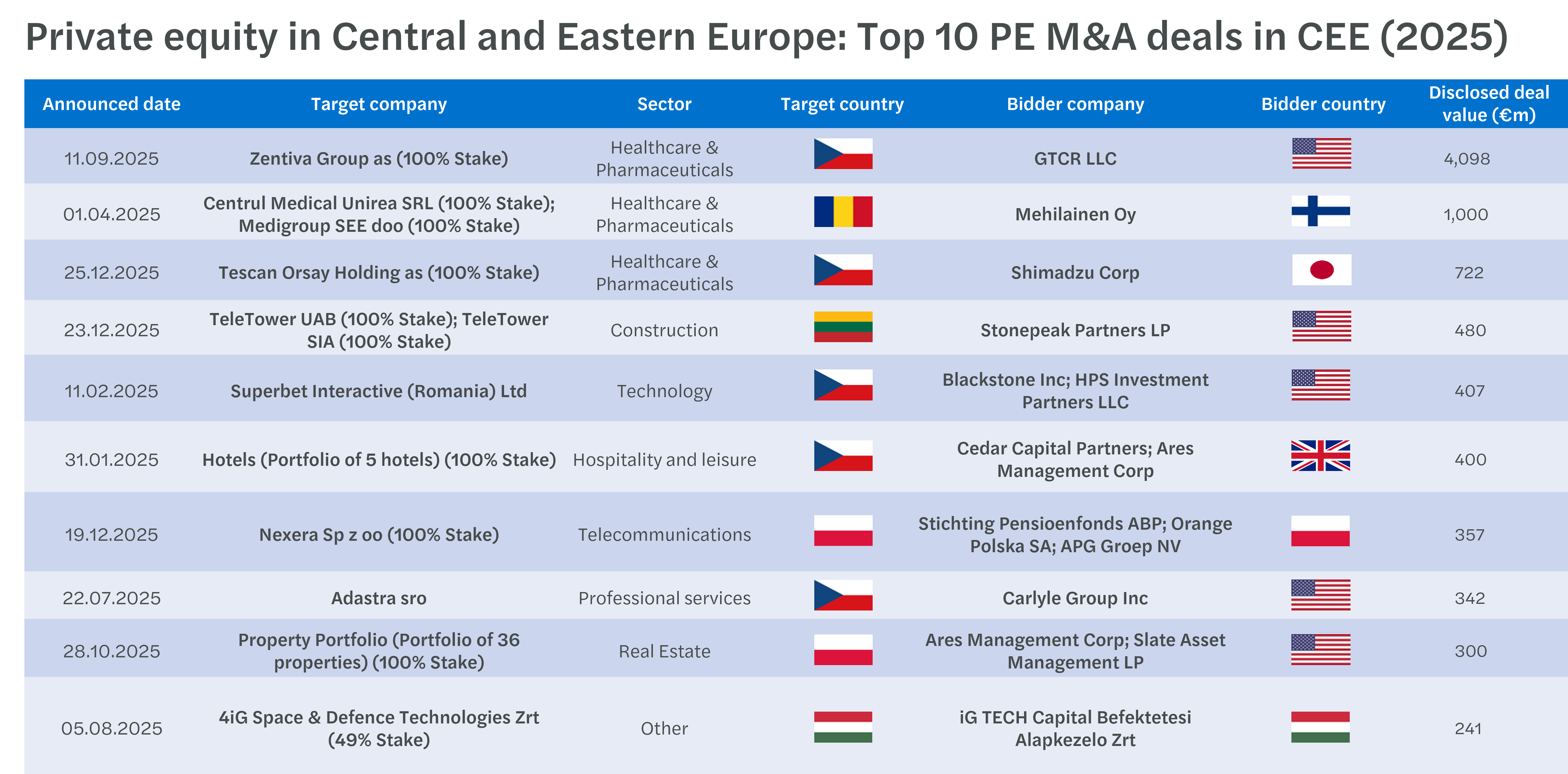
Out of the top 10 M&A deals realized in CEE last year, the vast majority involved a buyer coming from outside the region. The largest PE deal was the €4.1bn purchase of Zentiva Group (Czech Republic) by US-based GTCR, which acquired the Czech pharma group from US-based Advent International. The second largest PE deal saw PE firms MidEuropa Partners and Blue Sea Capital divest Romanian healthcare provider Regina Maria (Centrul Medical Unirea) in a €1bn transaction with Finland-based Mehiläinen.
3. A couple of drivers influence the CEE PE market
Several drivers are pushing the PE activity in Central & Eastern Europe. Among those:
- Relatively easy access to a large consumer market, with most CEE countries being part of the European Union and/or the Eurozone;
- Talent pool: CEE has a highly educated workforce, notably in engineering and IT, still being at a relatively lower costs than in Western Europe;
- Industrial nearshoring: with increase manufacturing and supply chain processes being relocated to CEE from Western Europe or Asia; EU funds often allow to have access to modern production facilities;
- Succession planning: with more than 70% of the companies owned by the first generation and founders, ownership transition is becoming a growing issue for a lot of firms; options such as management buyouts (MBOs) are gaining popularity, where managers find a PE firm to buy a majority stake while they retain a minority share to keep "skin in the game".
- Relatively strong M&A activity and/or market consolidation in selected sectors, including: manufacturing, energy & renewables, telecommunications, technology, healthcare & pharmaceuticals, consumer goods and defense.
4. Existing challenges and growth perspectives for 2026
The growth of PE investment activity in CEE stills faces a slower fundraising pace than Western Europe. Relatively high valuation expectations from company owners might be a hurdle; many SMEs with strong fundamentals are waiting for better market valuations before committing to a sale. In the other hand, international investors might sometimes lack resources in the ground allowing to source deals in CEE, especially in the mid-segment.
While 2026 carries some political and economic challenges (geopolitical tensions worldwide, fiscal pressures, relatively high interest rates), the overall sentiment for the CEE region is one of “calculated optimism”. The CEE PE market is progressively growing, but still only accounts for less than 0.5% of regional GDP based on estimates, suggesting significant room for further penetration compared to Western Europe. Many global PE funds now view CEE as an attractive diversification play that will continue to offer higher development potential and lower entry multiples than the more mature markets. The expected Ukraine Reconstruction will also create interesting opportunities for the private equity ecosystem during the upcoming years.
For more information related to the Private Equity sector and/or CEE M&A market, download our 2026 Global Private Equity Report and/or our Investing in CEE: inbound M&A report 2025/2026
Contact

Pere Mioč Partner, Porezno savjetovanje - Zagreb
