
What is Business Intelligence?
Business Intelligence turns large volumes of company data into strategic insights, providing an integrated and up-to-date view of the performance of companies, investees and investment portfolios. With advanced reporting and analysis tools, investors and management can monitor key KPIs, identify trends and make faster, better-informed decisions.
Before dashboards, data
In many organisations, the information base is not yet ready for management-level reporting. Data sits in different management systems and spreadsheets, master data is not aligned, and the charts of accounts of group companies do not allow for comparison. Growth phases, extraordinary transactions and the integration of new companies, as in buy-and-build strategies, tend to amplify the problem.
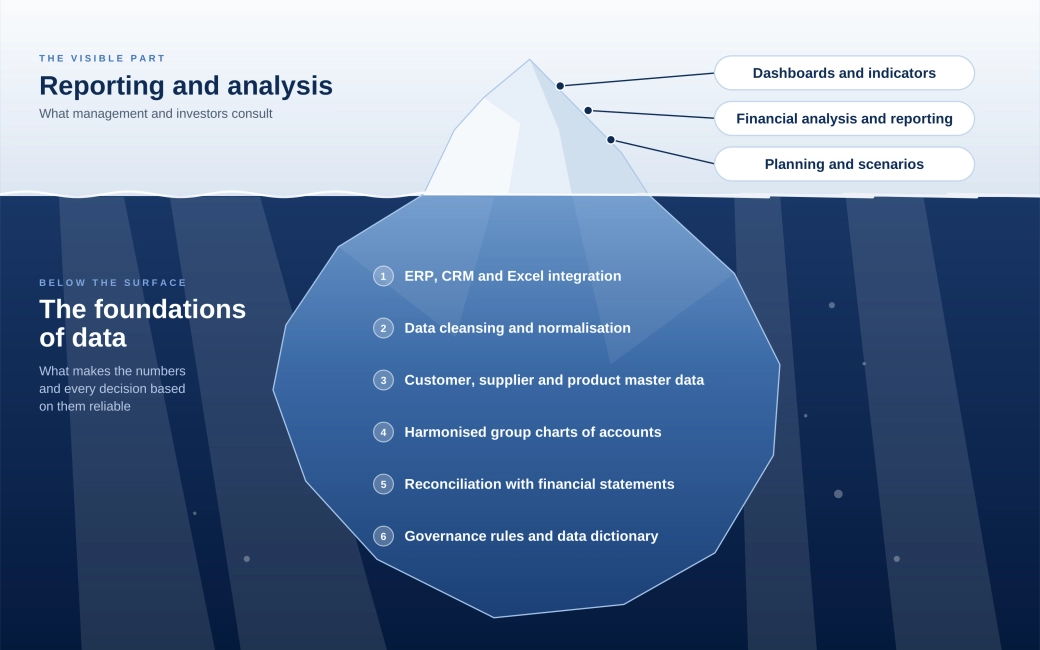
The iceberg principle applies.
Dashboards, indicators and reports are the visible tip; their reliability depends on what lies beneath the surface: the quality, consistency and structure of the source data. Without these foundations, even the most sophisticated tool will return partial or non-comparable figures.
Forvis Mazars works from these foundations and, in acquisition transactions, builds on the evidence already gathered during due diligence.
| Data quality (Cleansing and normalisation) Removal of duplicates, errors and inconsistencies; uniform coding, formats and recording criteria. |
| Master data (Alignment) Alignment of customer, supplier and product master data, a prerequisite for any analysis of profitability and concentration. |
| Charts of accounts (Harmonisation) Mapping of the different companies to a common scheme that is comparable and consolidatable. |
| Reconciliation with financial statements (Reconciliation) Every figure shown is reconciled with the accounting records and official data. |
| Rules and responsibilities (Governance) Shared data dictionary, ownership of sources and recurring quality controls. |
In this way, the information base grows in step with the company. Each new source or new company plugs into an already well-ordered structure, and management and investors have a solid basis on which to ground their assessments.
Performance monitoring
Private Equity |
For private equity funds, these solutions provide consistent monitoring of the entire portfolio: each portfolio company is incorporated into a common model, with KPIs and definitions aligned with those used in due diligence. The value creation plan is monitored over time, from the priorities of the first hundred days to the results for the period. In buy-and-build strategies, add-ons are integrated into an existing structure, and in the run-up to the exit, the data is consistent, reconciled and immediately available for vendor due diligence.
Management, owners and investors need a consolidated and consistent view of the performance of the business, group companies or investees. The solutions developed by Forvis Mazars make it possible to:
- track economic, financial and operational indicators, automatically updated at each period close;
- compare companies, divisions and business units on a uniform basis;
- verify execution against the budget and business plan and, for investors, the value creation plan;
- monitor compliance with financial covenants and manage dialogue with the banking system;
- feed periodic reporting to the board of directors, shareholders, investors and lenders;
- provide the information base for extraordinary transactions, equity raisings and exits.
Due diligence tools, on a continuous basis
Our solutions go beyond presenting accounting data: they regularly reproduce the analyses that underpin a financial due diligence.
| EBITDA bridge (Performance) Reconciliation of actuals, budget and prior year, broken down into volume, price, mix and cost drivers. |
| Profitability by segment (Margins) Margins by product, customer, channel and geographic area, to distinguish the areas that generate value from those that absorb it. |
| Working capital Trends in DSO, DPO and inventory turnover, identifying the levers to improve cash generation. |
| Cash flow and net financial position (Cash) Cash conversion, changes in indebtedness and headroom against covenants. |
| Normalised data and LTM (Normalisation) Indicators adjusted for non-recurring items, consistent with the metrics adopted in valuation. |
From measurement to forecasting
The most significant contribution of Business Intelligence lies in its ability to guide future decisions. Backward-looking reporting tools are complemented by forward-looking analysis tools.
- Rolling forecasts: Continuous revision of estimates in light of actual results and management assumptions.
- Scenario and sensitivity analysis: The effects of alternative assumptions on revenue, margins and financing needs, and their impact on the business plan and covenants.
- 13-week cash flow forecast: Close monitoring of liquidity in the phases that require it.
- Early warning indicators: Automatic alerts when thresholds on indicators, liquidity or covenants are breached, so that action can be taken before issues show up in the results.
- Enterprise value: Analysis of operating performance in light of the main valuation drivers, ahead of extraordinary transactions or an exit.
Where the underlying data allows, models can be integrated with predictive analytics techniques to estimate demand, cost trends and the seasonality of cash flows.
A path to organisational growth
Business Intelligence is also a lever for organisational development. Many companies, in particular SMEs and family businesses, rely on spreadsheets, on knowledge concentrated in a few individuals and on loosely structured closing processes: a constraint on growth that affects access to credit, the ability to attract investors and, ultimately, the value of the company. For a fund, addressing these issues in its portfolio companies is a direct lever for value creation.
Forvis Mazars guides the company through a gradual transition, tailored to its level of maturity and the pace of the organisation.
- In-house skills: Training for management and the finance function, so that data analysis becomes part of day-to-day management.
- Know-how transfer: Reclassifications, indicators and analytical criteria that are shared and documented, for the benefit of the company rather than of individuals.
- Phased evolution: A move from manual processes to automated reporting with no operational disruption, with hands-on support through the first closes.
- Data culture: Management, owners and investors share the same information base, improving the quality of discussion and governance.
From due diligence to management control
In acquisition transactions, due diligence defines the scope of analysis, the reclassifications, the normalisations and the indicators on which the investment decision rests. Forvis Mazars adopts the same definitions as the foundation of the reporting model, ensuring consistency between what was assessed and what is subsequently monitored, with shorter implementation times.
The same methodological rigour is applied to companies that wish to put in place an advanced management control system, regardless of any extraordinary transaction.
Three phases, one point of contact
1. Assessment and model design
Analysis of the organisation, reporting processes and systems in use (ERP, management systems, CRM, spreadsheets) to identify the relevant sources, define the strategic indicators and design a model consistent with governance requirements.
2. Data integration and development
Integration of sources and development in Power BI of analysis models, interactive dashboards, and planning and simulation tools. Access is profiled by company and by role to protect the confidentiality of information.
3. Training and skills transfer
Gradual adoption, with dedicated training, support during period closes and validation of indicators, until the company is fully autonomous and the solution continues to evolve over time.
Company performance and market context
Company performance can thus be read against the competitive landscape, and planning assumptions can be tested against industry dynamics.

Want to know more?

Alessandro Motta Transaction Services & M&A Partner - Milan

Maurizio Galati Financial Advisory Director - Rome

Financial advisory
Building the future of financial services with forward thinking solutions

Deals
Expert advice throughout the life cycle of the deal.

Financing
Secure the financing you need to achieve your goals.

Crisis & disputes
Expert support through your most challenging times

Forensic & Investigation Services
Management and Resolution of Unexpected Critical Events.

Private equity
Our private equity consultancy teams offer agile execution, a deep bench of talent and a flexible approach that blends global perspective with local expertise

Financial Services
Building the future of financial services with forward thinking solutions

Outsourcing
An outsourcing partner that helps you play to your strengths

Audit & Assurance
Independence and rigour that provides confidence and transparency for stakeholders and society.

Tax
Insight and innovation to guide you through today’s evolving global tax landscape.

Consulting
Companies thrive when their people, processes and tools are all aligned behind shared objectives

International Desk
To make the right investment and expansion decisions, businesses need to understand all the forces at play, anticipate new challenges and capture the opportunities.

Legal
Our services are designed to support and guide the growth of your business.

Sustainability
Helping companies place sustainability at the centre of their business


Public & social sector
Driving excellence in service delivery through innovation and partnership

Energy & infrastructure
Tailored solutions to meet global needs and manage resources in a changing environment

Manufacturing
Turning risks into opportunities to help you thrive in an evolving global marketplace

Real estate
A solid foundation for an uncertain property market

Technology, media & telecommunications
Innovative ideas for fast-growing, digitally connected technology, media and telecoms companies

Life sciences
Helping life sciences companies have sustainable growth in an innovative manner to deliver better health outcomes for society