
References
* The PS notes that these may be subject to further change in the subsequent phase of reform.
[1] The FCA’s 12-week rule allows a firm to appoint an individual to perform an SMF on a temporary basis for up to 12 weeks in a consecutive 12-month period, without prior FCA approval, where the absence is temporary or reasonably unforeseen.
[2] SMF7 is the FCA’s Group Entity Senior Manager Function, applying to the individual with overall responsibility for a UK‑authorised firm’s activities carried on from, or through, a group entity.
[3] SMF18 is the Other Overall Responsibility function, applying to the individual with overall responsibility for an area, activity or function of the firm that is not otherwise allocated to an approved SMF.
[4] SMF22 is the Other Local Responsibility function, applying to the individual with local responsibility for a branch’s activities, business areas or management functions where no other SMF applies.
Senior Managers & Certification Regime review Phase 2
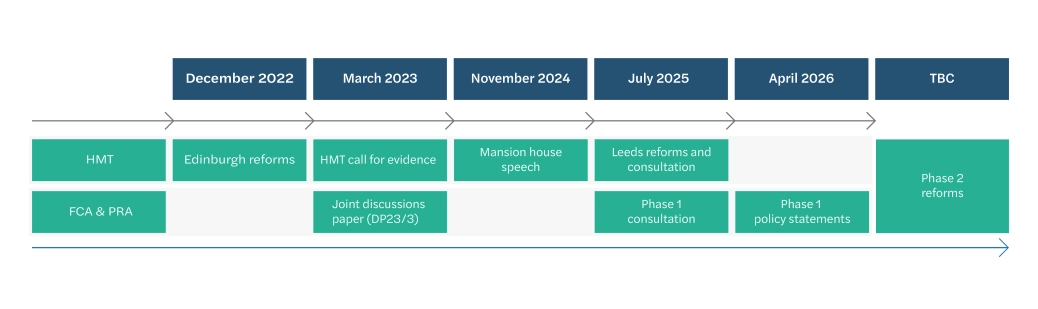
The reform of SM&CR is to be conducted in phases with the second phase focussing on legislative change.
Reforms have already seen improvements made to the SMF approval process, including swifter assessments and enhancements to Form A; but PS26/6 speaks of additional commitments to further enhance the approvals process in Phase 2, including to:
- Further simplify online forms.
- Reduce and consolidate the documents required to support an application.
- Update the wording of questions for further clarity.
The commitment to easing the administrative burden has also been echoed in the ‘Enhancing Financial Services’ bill of the 2026 King’s speech, delivered on 13 May 2026. The bill speaks to easements being “proportionate without compromising on core consumer, prudential and market protections”, and includes the reduction of the overall regulatory burden of SM&CR by 50%.
Alongside this policy statement, the Treasury has published its consultation response, committing to the legislative reform which will underpin Phase 2. The package is anticipated to include:
Legislative change | Impact to regulators |
|---|---|
| The removal of the Certification Regime from primary legislation, including the annual recertification requirement. | Enable the regulators to consider a more proportionate and flexible framework in their rulebooks. |
| Repeal of the prescriptive legislative provisions relating to Statements of Responsibilities. | |
| Reduce the number of senior management functions that require regulator pre-approval. | Increased flexibility to specify when firms may notify regulators of a senior manager’s appointment after assessing their fitness and propriety. |
| Repeal legislative requirements on firms to notify regulators of breaches and to conduct mandatory training. | Regulators will retain the power to make or streamline Conduct Rules and set out appropriate requirements in their rulebooks. |
| Increase the power of the Regulators. | Enable the regulators to specify the time-limits or conditions in which they may accept senior manager applications, the approval of which would not trigger statutory notice requirements. |
| Amend the financial markets infrastructure SM&CR regime legislated in FSMA 2023, to be consistent with the wider SM&CR reforms. | Removes legislative restrictions to consult on further rule changes for SM&CR. |
Following this legislative change, the Regulators will consult on the second phase to consider additional reform.
Key takeaways of PS26/6: Senior Managers & Certification Regime review
PS26/6 represents a measured recalibration rather than a reset of SM&CR. It delivers practical, near-term relief in areas that firms have long identified as inefficient, while reinforcing that individual accountability remains non-negotiable. Firms that proactively update their SM&CR frameworks can realise genuine efficiency gains but should do so with one eye on Phase 2 reforms later in 2026, when more fundamental legislative change is expected.
Get in touch with our financial services experts
|
Key contacts

Jessie Jones Director - Risk and Regulatory Consulting - Leeds

Sarah Ouarbya Partner - Risk and Regulatory Consulting - London

Ruth Forty London

Sign up to hear more from us
Select your interests and receive our latest insights, event invitations, news and more.

Financial services insights
Expert insights surrounding the financial services sector.

Insurance insights
Read our latest insurance insights.