

Authority: autonomy, execution and loss of control
As autonomy, authority and access increase, so does the potential impact of failure. Agents may take irreversible actions or chain tasks in unintended ways before intervention is possible.
These failures are often partial and difficult to detect, with systems behaving correctly in most cases, only diverging in edge cases. Equally, an agent optimising toward a goal may find a shortcut that technically achieves its objective but causes significant collateral damage.
Access: identity and access management and cyber security
Agents may be given broader access than their role requires, with poor separation between agent, system and user identities and weak control over tool permissions. Enterprise practice for distinct, attributable agent identity remains immature, which can make access harder to govern consistently. The result can be excessive privilege, weak segregation of duties and poor control over how permissions are granted, used and reviewed. These weaknesses may also be exploited through cyber-attacks such as prompt injection, which can manipulate an agent into misusing tools or exercising permissions in ways that bypass intended controls. Because agentic systems are often connected to other tools, systems and agents, the impact of a compromise can also propagate more quickly across the environment.
Anchoring: context memory and data integrity
Agentic systems depend heavily on the quality and integrity of the context they use to make decisions, and this creates a distinct set of risks. If that information is wrong, out of date, or has been tampered with, the agent’s decisions will be wrong too and potentially in ways that are hard to spot. In a connected system, one corrupted data source can silently skew decisions across multiple agents and workstreams.
A particular concern is persistent memory, unlike a one-off query, an agent may carry knowledge from past interactions into future ones. If that memory has been manipulated even subtly the agent can behave incorrectly for a long time before anyone notices. There is also a real risk that sensitive data from one customer or case leaks into another, creating both legal exposure and loss of trust.
Accountability: traceability, auditability and accountability
Accountability can become blurred in agentic AI. Actions may pass through multiple agents, systems and third-party tools before anyone notices a failure. Unlike a human decision where responsibility sits with a named person, agentic AI can distribute accountability across layers in a way that makes it genuinely difficult to identify where things went wrong and who should fix them.
The risk is compounded by speed. An agent can take a series of irreversible actions sending communications, approving transactions and modifying records before anyone has observed a problem. Without traceability and a clear audit trail showing what the agent did and why, the ability to investigate, challenge and remediate is severely limited.
This is why agentic AI use cases need a named business owner, supported by right-sized clear oversight responsibilities, effective traceability, defined escalation paths, change control and periodic recertification.
Affordability: resource consumption and cost
Unlike a conventional software transaction, an agentic workflow can loop, retry, call multiple tools and delegate work to sub-agents, with each step adding to overall cost. Resource consumption is driven not only by volume, but also by design choices such as routing, model selection, context size and orchestration complexity.
In addition, without hard limits in place, a single poorly configured agent or a runaway loop can generate very significant charges before an alert.
The cost risk also has a quality dimension. When an agent accumulates excessive context, carrying too much information from previous steps, the quality of its reasoning can degrade, even though the cost of running it is increasing. Spend controls, budget caps and per-agent monitoring are key for organisations deploying agents at scale.
- Agentic AI risksAs AI becomes agentic, governance must move beyond model performance to authority, boundaries, traceability, and intervention.
Agentic AI risks also arise, and increasingly concentrate, through third-party tools, models and vendor-supplied agents operating within organisational workflows. Concentration across a small number of model and cloud providers is itself a systemic concern, requiring vendor governance that covers data protection, model provenance, monitoring, change management and rights to test and audit.
Further, multi-agent designs introduce a distinctive risk profile and errors and hallucinations can cascade between agents with one agent treating another’s output as fact. Emergent behaviour can arise that none of the individual agents would have produced alone. This is increasingly reflected in practical research environments such Emergence World, which are exploring how agent interactions can produce behaviours, dependencies and failure modes that are not obvious when agents are assessed one by one.
Governance of multi-agent systems therefore needs to extend beyond each agent in isolation to the interfaces between them and what one agent is allowed to ask of another, how cross-agent context is validated and how the chain can be stopped if it begins to drift.
Finally, an operational risk to note is deploying agents into processes that are not yet ready for them. Where processes are poorly designed, fragmented or controls are weak, agentic AI can scale those weaknesses rather than resolve them. The same is true of poor data foundations, where low-quality or incomplete data can drive poor decisions at speed and scale.
The challenge is therefore not only technical failure, but the risk of automating inefficiency and control weakness across the organisation.
How existing responsible AI principles can help address agentic AI risks
Responsible AI principles provide the strategic guardrails that help organisations govern AI in a way that is trustworthy, controlled and aligned to their risk appetite.
Agentic AI does not replace these principles. However, it does require them to be applied differently with greater emphasis on autonomy, execution, oversight and operational control.
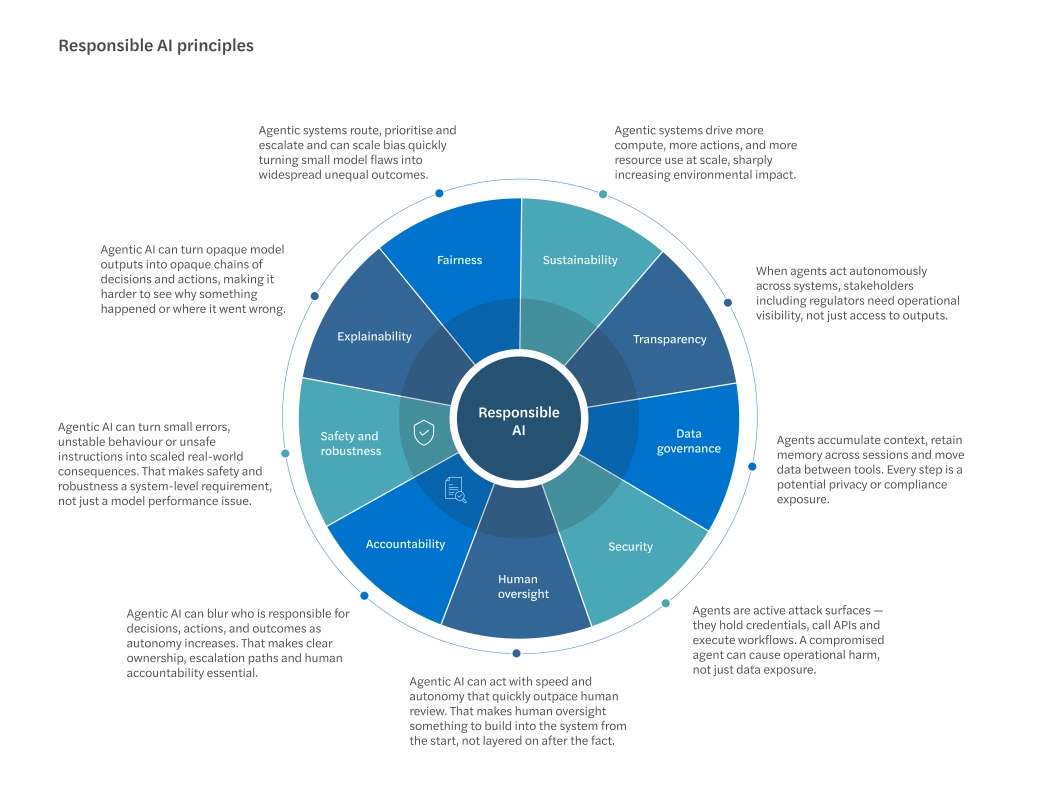
Below are our nine Responsible AI principles with additional considerations for agentic AI.
Accountability
As agents take decisions and actions across systems, accountability must become more explicit, not less. Organisations should be clear who owns the agent, who approved its scope and who is responsible if something goes wrong. Autonomy should be aligned to the system’s role, criticality and potential impact.
Human oversight and control
As agents operate at speed and scale, oversight must shift from approving individual actions to supervising the system. This includes setting boundaries, monitoring behaviour and intervening when needed. Agentic systems must be corrigible in that they can be paused, overridden or shut down reliably when needed.
* Note: Accountability is about who owns the agent and its outcomes and human oversight is about where people review, intervene or stop execution.
Fairness
Fairness in agentic AI extends across the full workflow, not just the final output. Organisations need to ensure decisions are based on relevant factors, applied consistently and do not create unintended bias as actions are routed, prioritised and executed. Small biases at one step can build across a workflow and create meaningful harm at scale.
Transparency
Stakeholders need to understand when agents are being used, what role they perform and what authority they have. Organisations must also be able to reconstruct what the system did, what it relied on and how decisions unfolded. In agentic AI, transparency is what makes oversight, accountability and trust possible.
Explainability
Explainability is not just about outputs but about understanding why an agent took a particular course of action. Organisations should be able to trace how decisions were made and identify the causes of failure where they occur. This is essential for trust, assurance and regulatory defensibility.
Security
Security is one of the most critical guardrails for agentic AI because agents do not just process information; they can use credentials, call tools and take action. That means a security failure can quickly become an operational failure. Many traditional controls are not fit for purpose, as they were designed for human users and static scripts, not for autonomous systems that can discover permissions, improvise and act at machine speed. Incidents such as PocketOS highlight why security for agents must extend beyond legacy access control to include runtime constraints, attributable identity, manipulation resistance and clear control over who can instruct the agent.
Data governance
Agentic systems rely heavily on context and often retain information over time. Organisations need to ensure data is appropriate, controlled and does not leak across users or workflows. Poor or outdated data can influence behaviour long after the original interaction.
Safety and robustness
Once an agent can act in live environments, safety becomes an operational concern. Organisations must ensure agents operate within defined operational boundaries, detect harmful behaviour quickly and have clear escalation and containment mechanisms in place before damage spreads.
Sustainability
Sustainability in agentic AI means ensuring that resource consumption remains proportionate, controlled and justified by the value created. Unlike traditional AI, agentic systems can drive non-linear compute demand through multi-step reasoning, repeated tool use and multi-agent coordination. Organisations therefore need visibility and control over the design choices that shape cost so that inefficient or runaway behaviour does not create unnecessary cost and infrastructure strain. For example:
- model selection - using the right AI engine for the task rather than defaulting to the most expensive one
- routing decisions - deciding which tasks should go to which model
- context size - how much information the system is given to work with at each step.
- Principles to practicePrinciples matter, but trust is earned in production through controls that are visible, testable and enforceable.
Having the right principles is a key part of the solution, but the real challenge is translating them into controls that can manage the governance and risk challenges of agentic AI in live environments.
Our thought leadership, scaling agentic AI, turns these principles into practical actions organisations can take.
Agentic AI governance maturity self-assessment
We have developed an agentic AI governance maturity assessment to help senior leaders judge whether their organisation is ready to put higher-autonomy and impact agents to work with confidence. It translates the twelve operating disciplines, shared in our thought leadership scaling agentic AI into five practical areas for which to assess maturity.
The aim is not to be at the highest maturity level overall but to assess whether your current level is strong enough for the agents you are already deploying or planning next. A low-risk assistant may be workable at a lower level of maturity. An agent acting across live systems or handling sensitive data will require a much higher one. The gap between the maturity you have and the maturity your use cases demand becomes the leadership agenda.
Complete your self-assessment
| Dimension | Level 1 Ad hoc | Level 2 Basic | Level 3 Managed | Level 4 Embedded | Level 5 Leading |
|---|---|---|---|---|---|
| Scope and guardrails | No one has clearly defined what the agent is there to do, what it must not do or where human approval is required. | Some boundaries exist for certain use cases, but they are incomplete, inconsistently applied and not tied clearly to risk. | A standard approach defines the agent’s role, permitted actions, boundaries, escalation points and where human approval is required. | Scope and autonomy limits are risk-tiered, formally owned and approved before go-live and when material changes are made. | Scope, autonomy boundaries and risk classification are actively maintained, monitored and updated as the agent, its environment or its role changes. |
| Identity, data and trust | The agent can access far more than it needs and there are no reliable controls over identity, permissions, source quality, memory or data leakage.
| Some access controls exist and key sources have been identified, but identity, delegation, grounding and retention are only partly understood. | The agent has a distinct identity, access is limited to what is needed, trusted sources are defined and rules exist for retrieval, memory, retention and cross-context data handling. | Identity, access, grounding, retention and information flows are reviewed regularly, with controls to reduce excessive privilege, stale data and cross-context leakage. | Identity, access and information quality are continuously monitored, with automated detection and review of misuse, leakage, drift, anomaly or grounding failure. |
| Testing, live safeguards and assurance | Testing is absent or informal and, once live, there is little to stop the agent acting outside expectations.
| Some testing and safeguards exist, but they are patchy, inconsistent and not clearly linked to risk. | Structured testing covers safety, reliability, misuse and business performance before launch, and key safeguards and approval thresholds are in place before go-live. | Controls operate alongside the agent in production, with ongoing testing, monitoring and triggers for changing risk, behaviour or operating conditions. | Continuous testing, internal challenge, drift detection and live assurance operate in production, and safeguards can be adjusted rapidly as risk or context changes. |
| Accountability and traceability | No one clearly owns the agent and there is no agreed process for escalation, intervention or remediation if something goes wrong. | A project or technical owner is named, but responsibilities are unclear and oversight largely falls away after deployment. | Clear business and operational owners are in place, with defined responsibilities for oversight, approvals, intervention, traceability and change. | Escalation routes, review forums, traceability, governance reporting and incident handling are established, used and understood in practice. | Leadership has a live view of agent ownership, risk and control status across the organisation, supported by governance reporting, a maintained risk register and strong traceability across the estate. |
| Change and lifecycle | Governance stops at launch and the agent is treated largely as set-and-forget. | Some reviews take place, but changes to prompts, models, tools or workflows often go unmanaged. | Structured review, change approval and periodic recertification are part of how the agent is run. | Reviews are triggered by time, incidents and material change, with clear re-approval points and defined retirement steps. | Change, recertification, retirement and evidence retention are tightly managed across the full lifecycle, including dependencies on third parties and connected systems. |
How we can help
We bring together multidisciplinary teams spanning AI, data governance, cyber security, technology risk and legal to help organisations move from AI ambition to controlled, real-world deployment through pragmatic, right-sized governance that builds confidence and trust.

What is agentic AI and why it matters
The hardest question your board will ask about AI in 2026 is “What decisions and actions are we allowing agentic AI to take on our behalf and how do we know it’s under control?” That is a very different question to those we’ve been hearing from boards recently on AI and requires a different kind of governance.

Scaling agentic AI
Agentic AI offers organisations significant opportunities to improve speed, productivity and decision-making but it also introduces a greater governance challenge.

Agentic AI from principles to practice
A C-suite guide to capturing value without losing control.

AI consulting services
Our AI solutions: Prepare with purpose. Govern with confidence.

AI Impact Hub
Artificial intelligence (AI) adoption is accelerating rapidly, driving investment, transforming business operations and facing increasing regulatory scrutiny across industries and global markets.
Key contacts

Sofia Ihsan AI Consulting Leader - Manchester

Matt Lomax Associate Director - Data and Digital Advisory - London

Asam Malik Head of Growth - Large Clients - Newcastle

Simon Withington Partner - Head of Technology Assurance - Newcastle
This website uses cookies.
Some of these cookies are necessary, while others help us analyse our traffic, serve advertising and deliver customised experiences for you.
For more information on the cookies we use, please refer to our Privacy Policy.
This website cannot function properly without these cookies.
Analytical cookies help us enhance our website by collecting information on its usage.
We use marketing cookies to increase the relevancy of our advertising campaigns.