
What changes does the Basel 3.1 framework bring to the banking sector?
Basel 3.1 seeks to make two considerable adjustments to the regulatory landscape. The first will materially alter the composition of capital requirements by making major underlying changes in the calculation of Pillar 1 capital. In particular, this relates to credit, market and operational risk. While the second will make the capital regime more risk sensitive.
The aim of the regulations is to reduce the likelihood of future banking crises by encouraging transparency and more standardised practices, ensuring that banks have a more accurate and comparable assessment of their risk exposure.
Basel 3.1 is likely to have a significant impact on a large number of regulated banks and building societies in the UK. The scale of the changes being proposed, and their materiality, means this will be one of the most significant regulatory challenges facing firms in the medium term.
Who does Basel 3.1 apply to?
The PRA will replicate the scope of application currently in place under the CRR, with a few significant exceptions. The current framework applies to:
- PRA-authorised banks and building societies.
PRA-approved or PRA-designated holding companies and building societies. - Small domestic deposit takers (SDDTs) will be able to join the Strong and Simple Framework, a more proportionate prudential regime for less systemically important banks and building societies.
How will Basel 3.1 be implemented in the UK?
The current state of Basel 3.1 implementation in the UK is progressing steadily. The Financial Conduct Authority (FCA) and the Prudential Regulation Authority (PRA) have been working closely with banks to ensure a smooth transition and adherence to the new regulations.
Basel 3.1 has several impacts on the UK banking sector. One of the key objectives of the framework is to enhance the risk management practices of banks, particularly in relation to capital adequacy. Banks must therefore assess regulatory capital requirements more accurately, to absorb potential losses, reducing the risk of financial instability.
Basel 3.1 introduces stricter rules for measuring and managing risks, including credit, market, and operational risks. This encourages banks to adopt more robust risk management frameworks and processes to improve the sector’s overall resilience.
The implementation of Basel 3.1 also aims to promote transparency and accountability in the banking industry. Banks are required to enhance their reporting and disclosure practices, providing stakeholders with more comprehensive and timely information about their risk profiles and financial positions.
How did we get to Basel 3.1?
The Basel Framework can be traced back to four key instances. These are:
- The Basel Committee on Banking Supervision: The committee, comprising banking supervisors from various countries, responsible for developing and maintaining the Basel Framework.
- Basel I: The first iteration of the Basel Framework introduced in 1988 focused on credit risk and established minimum capital requirements for banks based on their risk-weighted assets.
- Basel II: Introduced in 2004, Basel II expanded on Basel I to introduce additional risk categories, including operational risk and market risk, providing more detailed guidance on how banks should assess and manage these risks.
- Basel III: Basel III, introduced in response to the 2008 financial crisis, further strengthened the regulatory framework by increasing the quality and quantity of regulatory capital banks are required to hold. It also introduced measures to address liquidity risk and leverage ratios.
What is the objective of the proposed changes to the Credit Risk Standardised and Internal Ratings Based (IRB) approaches?
The aim of credit risk proposals is to enhance risk sensitivity and robustness in the standardised approach (SA) and reduce excessive complexity and lack of comparability in firms’ calculations of RWAs through the Internal Ratings Based (IRB) approach.
Proposed changes in the credit risk SA include introduction of new exposure classes and reduction of firms’ reliance on external credit ratings.
Under the IRB approach, the PRA have proposed removing the option to use IRB for certain exposure classes, and restricting the type of internal modelling that can be used for others.
However, there does appear to be a positive for IRB firms, particularly those on the cusp of receiving approval for IRB models. The threshold for approving IRB model applications under the current proposals will change from ‘full compliance’ to ‘material compliance’. This may foreshadow a relaxation in the requirements associated with IRB model approval.
What is the purpose of the proposed Output Floor?
The output floor will perform as a backstop against excessively low risk weights and excessive variability among firms with internal modelling (IM) permissions.
Under the PRA’s revised Output Floor proposals, IM firms, will be required to calculate Risk Weighted Assets as the higher of;
- Total RWAs using all approaches they have the supervisory approval to use, including IM approaches, and
- 72.5% of RWAs calculated using only standardised approaches.
What impact will the final rules have on Operational Risk capital requirements?
The PRA has confirmed in PS1/26 that the new Basel 3.1 Standardised Approach (SA) for operational risk will replace all existing Pillar 1 approaches from I January 2027. The PRA has exercised national discretion to set the Internal Loss Multiplier (ILM) to 1. With the ILM fixed at 1, firm‑specific loss experience no longer affects Pillar 1 requirements. The PRA therefore plans to capture idiosyncratic operational risks through the Pillar 2 framework, which will be reviewed and recalibrated to address risks not reflected in the new Pillar 1 approach.
What are the implications of the final rules for Market Risk?
PS1/26 confirms the PRA’s adoption of the Basel 3.1 market risk framework, replacing existing methods with the FRTB SSA, ASA and IMA to improve risk sensitivity and consistency. The PRA has also tightened and clarified trading/banking book boundaries. Despite industry concerns that the rules are overly conservative, the PRA made no material changes in the final rule. Overall, the final framework aims to deliver a more coherent and comprehensive approach to market risk.
What impact will the final rules have on CVA (Credit Valuation Adjustment) and SA-CCR (Standardised Approach for Counterparty Credit Risk)?
PS1/26 confirms the PRA’s amendments to the scope and calibration of CVA risk and the standardised approach to counterparty credit risk. The new CVA framework introduces three methodologies—the Alternative Approach, the Basic Approach, and the Standardised Approach—designed to improve the risk‑sensitivity and comparability of CVA capital requirements.
The final rules aim to deliver a more comprehensive treatment of CVA risk, better recognition of CVA hedges, closer alignment with industry accounting practices, and new methodologies that reduce reliance on complex modelling.
What is the Basel 3.1 go‑live timeline for the UK?
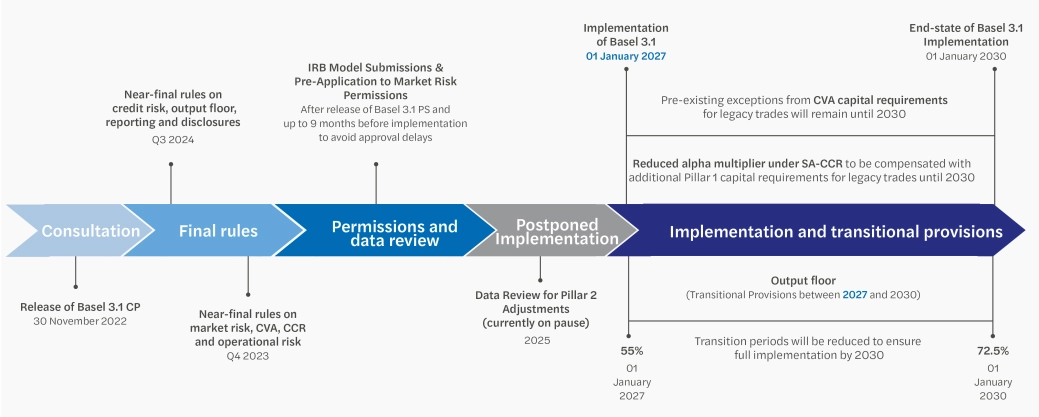
Basel 3.1 will take effect in the UK from 1 January 2027, following the PRA’s decision to delay implementation by one year. From this date, firms must comply with the revised rules across credit risk, market risk, operational risk, CVA, and the Output Floor. The Output Floor will be phased in gradually, starting at 50% in 2027 and rising to 72.5% by 2030, at which point the full end‑state framework becomes mandatory. This timeline aligns the UK more closely with international developments while giving firms additional time to prepare. Output Floor Phase-in (Transition Schedule):
1 Jan 2027: 50%
1 Jan 2028: 55%
1 Jan 2029: 60%
1 Jan 2030: 65%
After 2030: 72.5%
How should risk management frameworks be updated in line with the Basel 3.1 rules?
Risk management teams should revise ICAAP, stress testing methodologies to reflect the new capital framework. Risk appetite statements and limits framework may need adjustment to account for revised capital requirements or changes in risk‑weighted asset calculations. Risk management policies and procedures including model oversight and validation, should be updated to ensure alignment with Basel 3.1 framework.
What should firms do to ensure Basel 3.1 regulatory compliance by 2027?
Firms should confirm that their business portfolio is clearly defined and identify the risk categories most affected by upcoming regulatory changes. This includes assessing specific areas such as credit risk, market risk, operational risk, liquidity risk, and model risk to understand where the most material impacts will fall. They then need to evaluate the data, systems, and governance enhancements required to meet new standards and, by building a structured roadmap and addressing gaps early, ensure they remain fully compliant and strategically prepared for 2027.
What checks should firms be completing to ensure they are Basel 3.1 ready?
As the UK financial sector approaches the implementation of Basel 3.1 on 1 January 2027, firms must prepare for one of the most significant regulatory overhauls in recent years. Basel 3.1 introduces stricter rules on credit risk, market risk, operational risk, and the Output Floor, with the aim of improving consistency, comparability, and resilience across the banking system. The PRA has finalised its rules, and while the phase-in period extends to 2030, full compliance is expected from January 2027.
Basel 3.1 is the UK’s implementation of the final Basel III reforms, covering:
- Credit risk (Standardised and IRB approaches)
- Market risk (FRTB SA, FRTB IMA, FRTB SSA and ASA)
- Operational risk (Standardised approach under Pillar 1 applying Business component Indicator and Internal Loss multiplier)
- Credit Valuation Adjustment (CVA SA BA)
- The Output Floor restricts the advantages firms gain from using internal risk models. The Basel Committee has flagged concerns over inconsistent and incomparable risk weights, suggesting these models may not fully capture aggregate risks.
- Data governance framework, system readiness, data quality controls and reporting framework readiness
- Senior management engagement
- Smaller banks and building societies fall under SDDT (CR SA for Credit risk and market risk and SA credit risk mitigation methods, OR SA for operational risk).

Basel III: The new US proposals
US regulators recently proposed a significant recalibration of their capital framework. As Basel III now plays out differently across the US, UK and EU, this article compares the approaches and assesses the implications for internationally active banks.

Basel 3.1: changes to Pillar 2A
The Prudential Regulation Authority (PRA) published consultation paper CP12/25 in May 2025 as the first phase of a two-stage overhaul of Pillar 2A methodologies, with final rules published in January 2026.

Basel 3.1: Are you ready for the new rules?
The delay in implementation of Basel 3.1 offers banks a valuable window to recalibrate compliance strategies, strengthen system capabilities, and position themselves to navigate the complexities of the new framework with confidence.

Basel 3.1: Final rules key focus
The Prudential Regulation Authority (PRA) has now published the final Basel 3.1 rules in Policy Statement PS1/26, marking the completion of one of the most significant overhauls of the UK capital framework in over a decade.

CP14/24 - Large Exposures Framework
The Prudential Regulation Authority (PRA) has released its Consultation Paper 14/24 (CP14/24), which includes significant proposals to enhance the UK’s large exposures framework.

Operationalisation of Basel 3.1
Firms are expected to have a comprehensive Basel 3.1 implementation plan to support the quality of the upcoming data submissions and to ensure smooth operationalisation of the incoming regulatory regime. We encourage firms to focus on capital impact assessment, data governance and people and transformation priorities. Furthermore, it is imperative firms understand how Basel 3.1 fits within the wider...

Basel 3.1: Key submissions before January 2026
On 12 September 2024, the Prudential Regulation Authority (PRA) released the long-awaited near final rules for Basel 3.1 on Credit Risk, Output Floor, disclosures and regulatory reporting. As firms finalise their implementation plans, there are key submission dates they will need to work towards to ensure they are ready for Day 1 compliance on 1 January 2026.

Basel 3.1 webinar series
Watch back on our Basel 3.1 webinar series, where our experts reflect on the Basel 3.1 final rules for Credit Risk and Output Floor, as well as what firms should prioritise from an operational perspective ahead of the implementation of Basel 3.1. This follows the publication of the Prudential Regulation Authority’s Basel 3.1 Policy Statement (PS9/24) in September.

Bank of England’s Basel 3.1 Policy Statement
The Policy Statement (PS9/24) contains the long-anticipated near-final policy proposals for Credit Risk and Output Floor under the forthcoming Basel 3.1 framework. We have outlined the key points from this Policy Statement for firms.

Basel 3.1 Final Rules – What to look out for
The near-final Basel 3.1 rules on Credit Risk and Output Floor are expected on 12 September 2024. Ahead of this, we think there are several areas of the Bank of England’s proposals firms should be looking out for when the final policy is published. We discuss some of these below.

Expectations ahead of final Basel 3.1 rules
Pending the release of the PRA’s Basel 3.1 final rules, our banking risk experts discuss the proposed changes to credit risk and output floor rules, as well as the near-final rules relating to market risk and operational risk.

Data implications of Basel 3.1
The Prudential Regulation Authority (PRA) continues to emphasise the importance of the reliability and accuracy of regulatory data for banks and building societies. Data risk is named a main priority within the 2024 Dear CEO Letter and through the Transforming Data Collection initiative between the Bank of England and the Financial Conduct Authority.

Basel 3.1 – Near-final rules part 1
Policy statement 17/23 (PS17/23) contains Basel 3.1 near-final policy materials for market risk, credit valuation adjustment (CVA) risk, counterparty credit risk and operational risk.

Basel 3.1 - Bitesize
In this series of short bitesize articles, our Prudential Regulation Consulting team delves into the implications of Basel 3.1 changes on banks.

Basel 3.1 video series
Basel 3.1 is the final set of amendments to the capital regime for banks after the Global Financial Crisis. The Prudential Regulation Authority (PRA) proposed that the implementation date for the changes would be 1 July 2025. In this series, we take a closer look at what firms need to consider before these reforms will be live in the UK.

Credit Risk – Standardised Approach
As part of its near-final rules (PS9/24) the PRA has proposed several changes to the Standardised Approach for credit risk which could have a significant impact on the RWAs for UK banks and building societies.

Credit Risk - Internal Ratings Based
The PRA’s IRB proposals focus on reducing the complexity of the approaches and improving comparability across firms.

Market risk
Under Basel 3.1, the Prudential Regulation Authority has proposed to implement changes to how firms measure market risk. These include an amended version of the preexisting simplified standardised approach (SSA) and two new calculation methodologies – an advanced standardised approach (ASA), and a new internal model approach (IMA).

Removal of the SME support factor
The PRA has confirmed the removal of the CRR SME Supporting factor under the Standardised and IRB approaches their near final rules for Credit Risk. However, an ‘SME Lending Adjustment’ will be introduced to offset the impact on the cost of SME lending. This is with the intention of ensuring that the cost of capital for SME exposures will be net neutral under the Basel 3.1 regime.

Disclosures and Regulatory reporting
Under Basel 3.1, firms are classified based on a range of criteria, such as retail deposits, total assets, derivatives, complexity, or processes.

UK vs EU Basel comparison
Both the UK and the EU are consulting on the next wave of iterations to the Basel reforms. Whilst the focus of these consultations has been relatively broad, the rules around the computation of Pillar 1 Credit Risk RWAs seen the most significant change. This article outlines some of the main differences between the UK and EU approaches on this topic, along with our thoughts on these divergences.

UK vs US - Comparing Basel 3.1 implementations
The US unveiled its take on the BCBS Basel reforms on July 27th, 2023, calling it the “Basel III Endgame” (referred to as Basel 3.1 in the UK). This article outlines the key disparities between the US and UK approaches to implementing these reforms.
National contacts

Gregory Marchat Partner - Group Financial Services Leader - London

Huseyin Sahin Partner - Banking Risk Consulting - London
This website uses cookies.
Some of these cookies are necessary, while others help us analyse our traffic, serve advertising and deliver customised experiences for you.
For more information on the cookies we use, please refer to our Privacy Policy.
This website cannot function properly without these cookies.
Analytical cookies help us enhance our website by collecting information on its usage.
We use marketing cookies to increase the relevancy of our advertising campaigns.