
Latest economic, market and investment news
The latest news and analysis on the changing markets and economic environment.

In 2022, the traditional 60/40 equity-bond portfolio experienced an unusually difficult period. Equities and bonds fell together as inflation rose and central banks increased interest rates, prompting claims that the combination was no longer fit for purpose.
Subsequent performance suggests those claims were premature. From January 2022 to August 2026, an illustrative 60/40 portfolio returned approximately 33.6%¹, driven by global equities which returned approximately 65% and offset a -3.8% decline in global government bonds.
Equities driving the recovery is not itself a problem: they are the portfolio’s main growth engine. The more important question is whether bonds can still provide protection when equities fall.
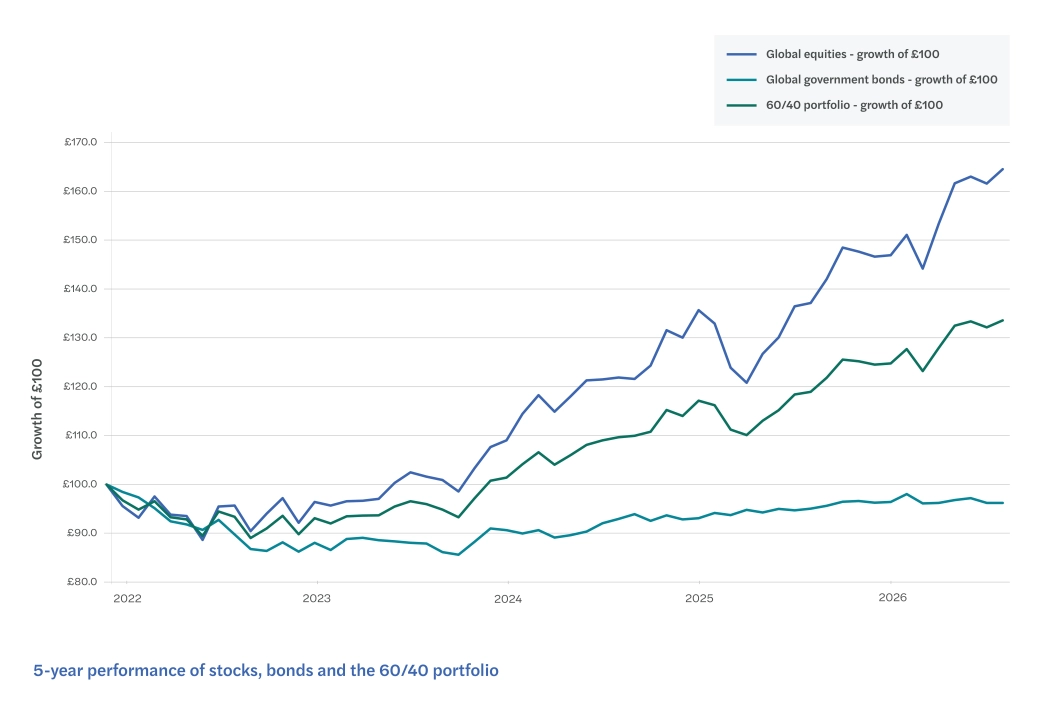
Here we tackle two questions. Were concerns about 60/40 overblown, or have strong equity returns concealed a change beneath the surface? And, if its historical diversification properties have become less dependable, do investors understand the risks they are accepting when they continue to use it as their default portfolio?
The simple 60/40 portfolio was not designed to maximise returns in every environment. Rather, it offered a practical compromise between growth and resilience.
Equities supplied the main source of long-term capital growth, while bonds offered income, liquidity and generally lower volatility. Their combination was particularly valuable because the correlation between their returns was historically low and, at times, negative. Thus, in periods where one declined, this was dampened by the strong performance of the other.
During many growth-led downturns, weaker corporate earnings placed pressure on equities while lower interest-rate expectations supported bond prices. Bonds could therefore cushion losses and provide a relatively resilient asset from which to meet commitments or rebalance into cheaper equities.
The power of 60/40 lay in combining two assets that often responded differently to the same economic news. Its simplicity, liquidity, transparency and relatively modest governance burden strengthened the case.
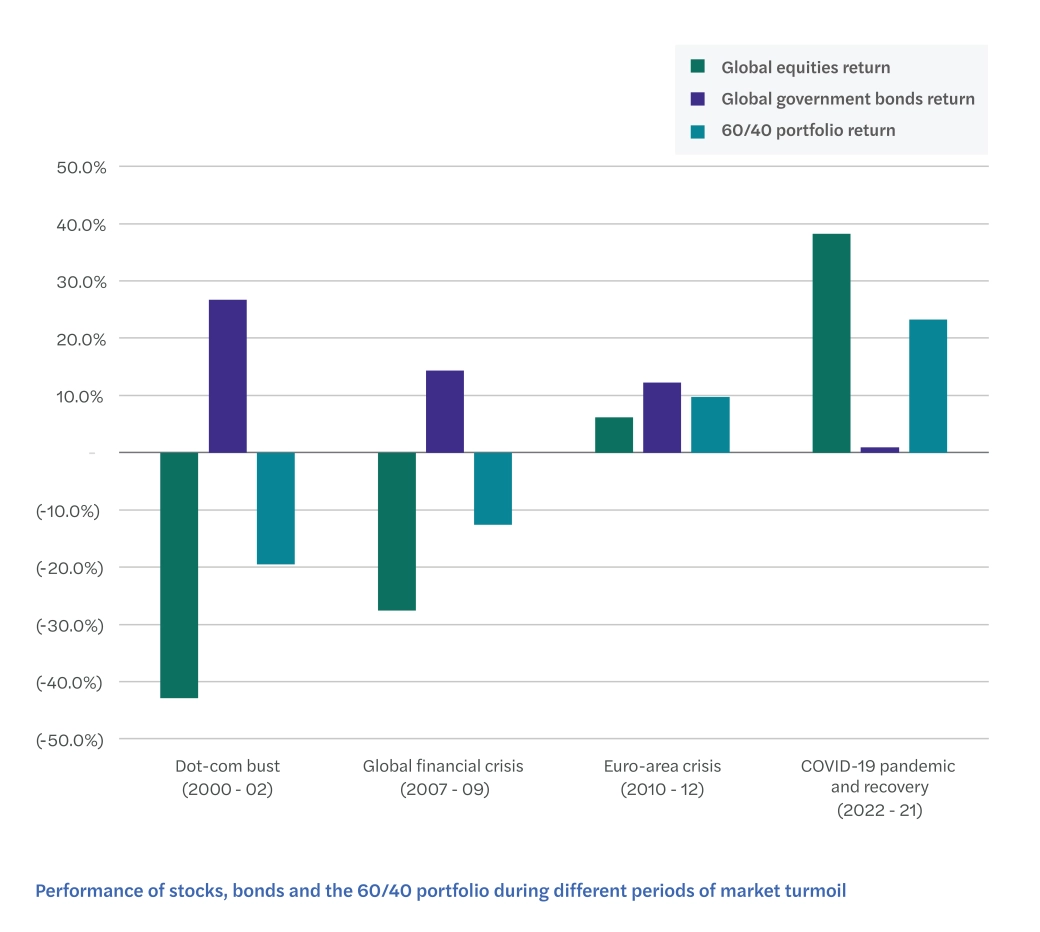
The complication is that correlation, the extent to which two assets move together, is not fixed over time. It changes with the economic environment and with the relative attractions of equities and bonds.
When inflation is low and stable, disappointing growth may hurt equities but support bonds through expectations of lower interest rates. An inflation shock is different. Higher inflation may require higher rates, pushing existing bond prices down. Equities can also suffer as discount rates and borrowing costs rise.
This was the central problem in 2022: the same shock affected both sides of the portfolio. From January 2022 to October 2023, stock-bond correlation was meaningfully positive at +0.62 and both assets declined in 11 of 22 months. By comparison, there was only one month in each of the dot-com bust and global financial crisis periods in our analysis where both assets declined.²
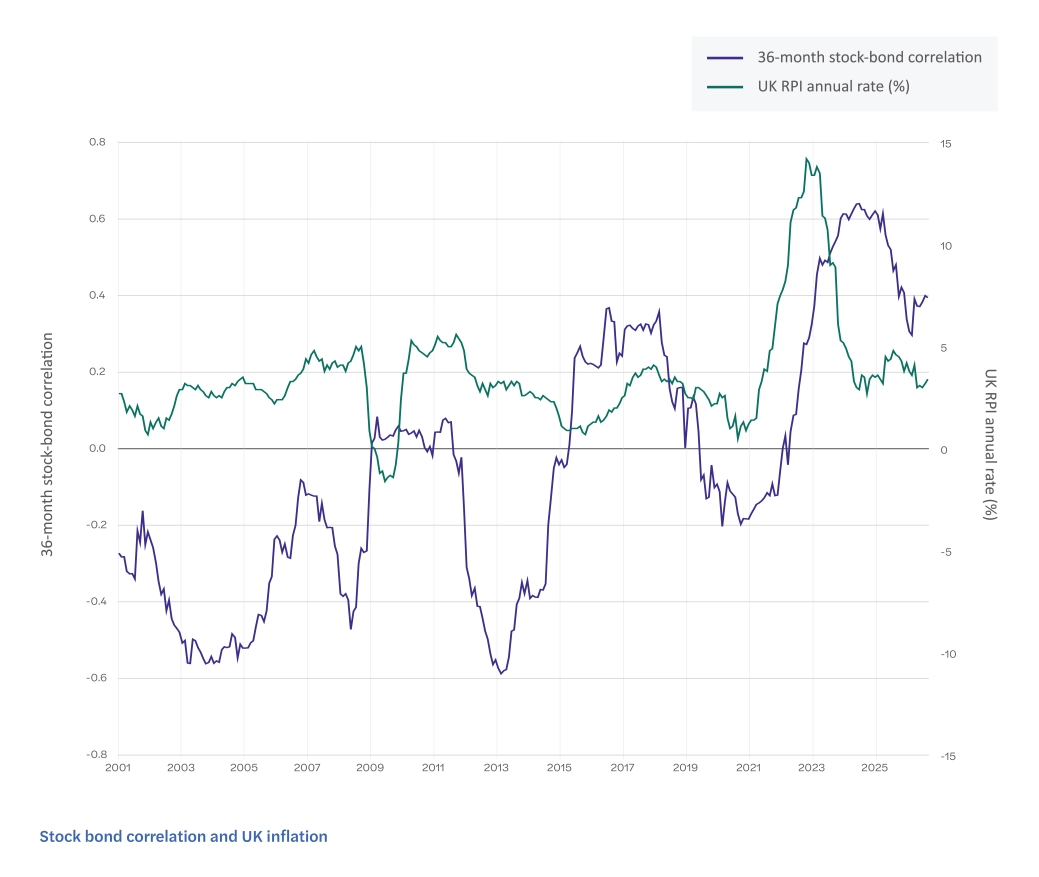
Across the wider period from January 2022 to August 2026, equities rose by approximately 65%, and the 60/40 portfolio returned more than 33%. Against those solid returns, investors may have had little reason to question the relationship between the two assets, however, over the period, stock-bond correlation was positive at +0.53.
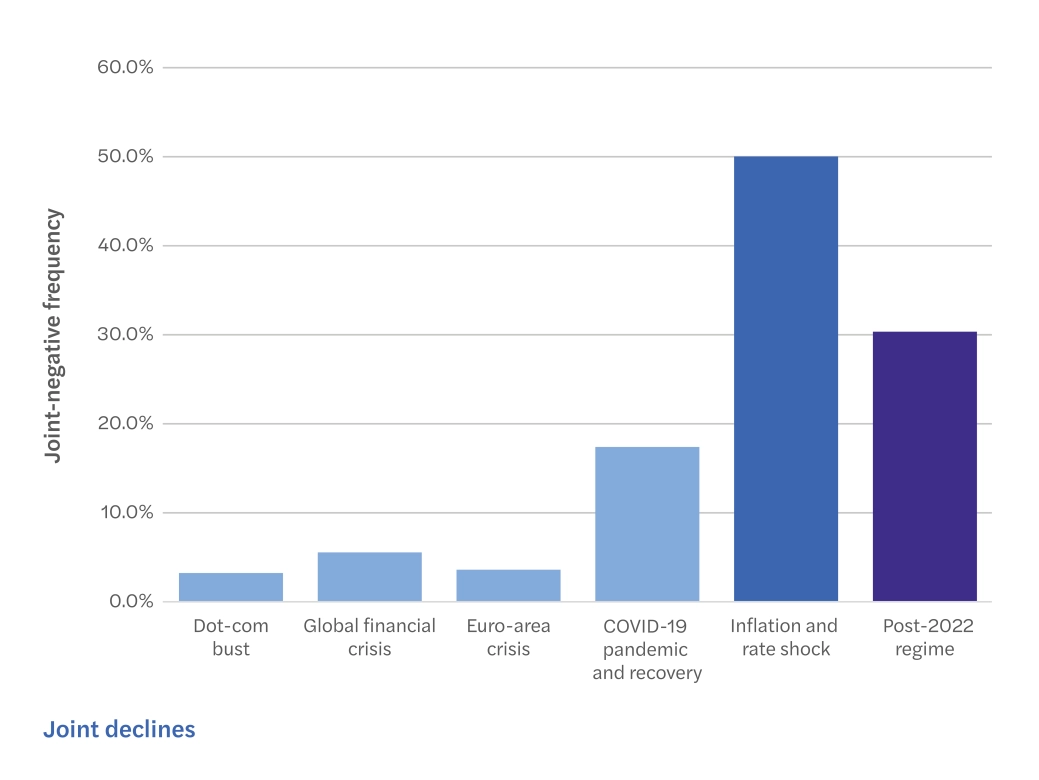
The portfolio’s recovery was therefore heavily dependent on equities. Bonds provided less consistent protection, although strong equity returns left the portfolio comfortably ahead, making the weaker diversification less conspicuous.
Strong equity returns cannot be relied upon to compensate for weak bond performance. If equities weaken while bonds also fall, both parts of the portfolio could come under pressure.
In a prolonged period of drawdown, this is particularly relevant to fiduciaries and organisations that rely on portfolios to fund spending commitments. If both assets are depressed, withdrawals may crystallise losses and reduce the capital available to participate in a recovery.
The evidence does not suggest that 60/40 is dead. However, its strong recent performance does not prove that its historical diversification properties have returned since the inflation shock of 2022. Equities still offer long-term growth, while bonds can provide income, liquidity and contractual cash flows. Nor is greater complexity automatically better: a simple equity-bond portfolio remains liquid, transparent and relatively straightforward to oversee.
Those responsible for asset allocation need to understand the role assigned to each component and assess how the portfolio might behave if equities and bonds both disappointed at the same time. Forecasting the next correlation regime is less important than having a resilient portfolio in place that can weather a storm, wherever it comes from. Investors holding a 60/40 portfolio should be asking what is providing the resilience in their strategy.
Contact our investment experts to discuss your strategy |
¹ The analysis uses broad global equity and hedged global government-bond total-return series in sterling. The illustrative portfolio allocates 60% to equities and 40% to bonds, is rebalanced quarterly and excludes costs and taxes.
² The selected periods are:
Correlations are calculated using monthly returns within each defined period.
The latest news and analysis on the changing markets and economic environment.

Our investment management consulting helps organisations and asset owners make informed investment decisions, navigate complex opportunities and ensure their investment arrangements remain aligned with their objectives.

This website uses cookies.
Some of these cookies are necessary, while others help us analyse our traffic, serve advertising and deliver customised experiences for you.
For more information on the cookies we use, please refer to our Privacy Policy.
This website cannot function properly without these cookies.
Analytical cookies help us enhance our website by collecting information on its usage.
We use marketing cookies to increase the relevancy of our advertising campaigns.