
AI and asset management: from experimentation to everyday advantage
11 September 2026
Tags
Financial services
Technology & digital consulting
Insights
AI is no longer a future consideration for asset managers. As AI enters its Return-On-Investment (ROI) or return-on-AI era, firms are expected to focus on demonstrating and realising its tangible value.
Leading asset management firms are deploying AI across investment research, operations, governance, risk and client servicing, demonstrating its potential to create competitive advantage throughout the value chain.
For asset managers, the shift is already visible. Research from Mercer’s 2026 report highlights the extent to which AI is becoming embedded within the asset management industry, with 55% of asset managers having integrated AI into at least one investment process and 91% expecting to increase their use of AI over the next 12 months. However, only 5% currently grant AI autonomous or semi-autonomous decision-making authority.
Evolution of AI adoption in asset management
The first wave of AI adoption in asset management has focused on augmenting existing processes, such as automating investment research, summarising investment information, drafting investor reports, supporting valuation activities and streamlining back-office operations. However, the industry is now moving beyond standalone productivity tools towards AI embedded directly within end-to-end workflows. Asset managers are integrating AI into processes such as portfolio risk monitoring, NAV and fund accounting controls, pricing and valuation, investor servicing and governance activities.
This shift does not remove the need for human expertise. Rather, it enables investment and operations professionals to focus on higher-value judgement and oversight activities. AI can support areas such as fraud and anomaly detection, portfolio exposure analysis, valuation modelling and the preparation of board papers and investor communications. However, accountability for investment decisions, risk assessments and fiduciary responsibilities remain firmly with management. The role of professionals shifts from performing routine tasks to directing, challenging and overseeing AI-enabled processes.
Some practical use cases for asset managers
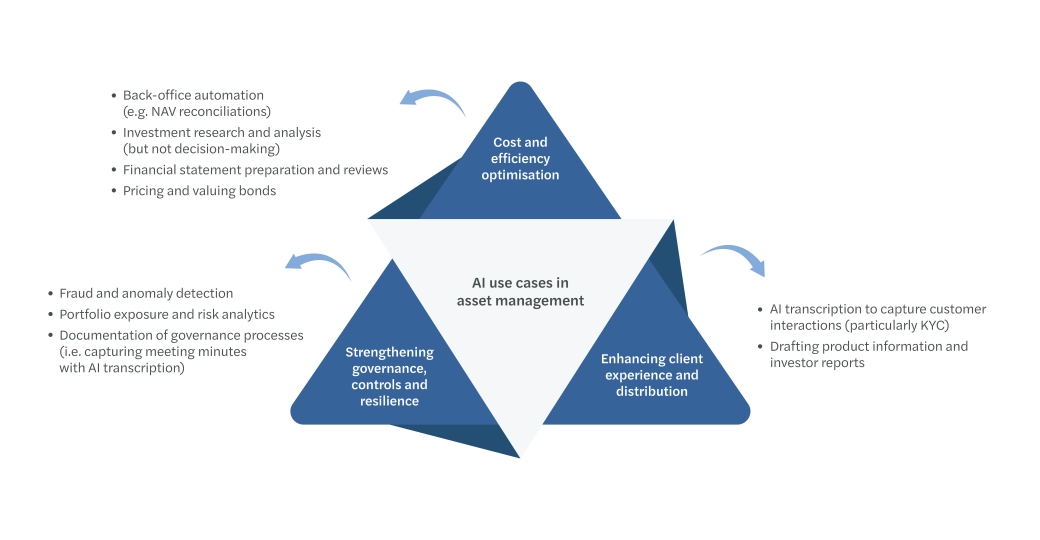
The diagram below highlights a selection of practical AI use cases currently emerging across the asset management industry, grouped by the key business outcomes they are designed to deliver: cost and efficiency optimisation, stronger governance and controls, and enhanced client experience and distribution.
The risks: confidence without competence
In its March 2026 guidance, the Financial Reporting Council (FRC) notes that AI outputs can be affected by hallucinations, omissions, distortions, faulty reasoning and inconsistencies, and warns against over-reliance on AI without appropriate human oversight. While the FRC guidance is aimed at audit firms, the valuable lesson it emphasises is that firms should mitigate these risks through robust system design, certification, staff education, and ongoing human review.
There is also a risk that foundational skills erode if teams rely on shortcuts before they understand the underlying work. AI can accelerate tasks, but it should not replace the learning, challenge and technical judgement because investment decisions and fiduciary responsibilities continue to require human oversight and accountability.
In The Mills Review, the FCA notes that AI is likely to amplify fraud and cyber risks. The review also highlights that firms' defensive capabilities must evolve simultaneously.
What firms should do now
As AI enters its ROI era, asset managers should take a structured approach to adoption, ensuring investments are aligned to clear business outcomes and supported by appropriate governance.
- Start with the end goal: identify the specific business outcomes AI is expected to deliver, whether improving investment insights, enhancing controls, reducing operating costs or strengthening client service. Clear objectives and success metrics will be increasingly important as investors and stakeholders seek evidence of return on AI investments.
- Establish an AI governance framework: document policies covering acceptable use, review requirements, model oversight, escalation procedures and compliance with regulatory and ethical expectations.
- Assess and strengthen data quality: AI outputs are only as reliable as the data used to generate them. Firms should ensure underlying data is complete, accurate, appropriately governed and subject to regular review and audit.
- Evaluate technology and security readiness: assess whether existing IT infrastructure can support AI deployment at scale and ensure appropriate controls are in place to protect confidential, client and commercially sensitive information.
- Test, monitor and refine: AI models and workflows should be subject to ongoing testing and validation, with feedback loops established to identify errors, improve performance and ensure outputs remain aligned with business objectives.
- Invest in skills and training: employees should understand both the capabilities and limitations of AI, including how to critically evaluate outputs, apply professional judgement and use AI responsibly within their roles.
Ultimately, firms that combine clear strategic objectives with strong governance, high-quality data, effective risk management and workforce capability will be best positioned to realise sustainable value from AI while maintaining trust with clients, regulators and investors.
Get in touch with our specialists to discuss how your firm can realise sustainable value from AI. |
Key contacts

Pooja Sajanani Manager - Audit & Assurance - London