AI at scale: from experimentation to real business value

The fiscal environment of 2026 has brought AI hype to its peak, bringing with it far higher expectations for value-driven delivery.

This marks a clear shift. Organisations can no longer rely on speculative investment or scattergun implementation approaches. There was a time when momentum alone, fuelled by this escalating trend and a persuasive transformation pitch, was enough to secure budget and goodwill. Now, Investors and shareholders are equipped – and willing – to draw a much sharper distinction between AI hype and AI value. 

  • 60of UK C-suite leaders say AI is a top investment priority.
  • 88have restructured teams because of AI.
  • 97include AI in their tech transformation strategy.
  • Source: Data from our UK C-suite barometer 2026

“The questions being asked in boardrooms have shifted; it is no longer enough to say that AI is being explored or piloted. Stakeholders want to see what it has actually delivered.”

Guillaume Devaux Partner, Head of Technology, Media, Telecommunications, Forvis Mazars Group

The AI ROI gap

Six months on from our initial 2026 C suite outlook, fresh findings from our global mid-year insights reinforce the confidence leaders have in AI’s potential and now reveal initial returns from AI investments. However, you can’t really value the overall returns without considering the scale of investment.

To what extent of ROI should leaders, their businesses (and their investors and stakeholders) be expecting?   

  • 86of C-suite leaders confirmed AI has made their teams more productive.
  • 63C-suite leaders report up to 10% returns on their AI investments, with a fifth seeing higher gains.
  • 33Claim their business is fully equipped and ready to adapt its strategy in response to the pace of future AI developments.
  • Source: Data from our Global C-suite barometer

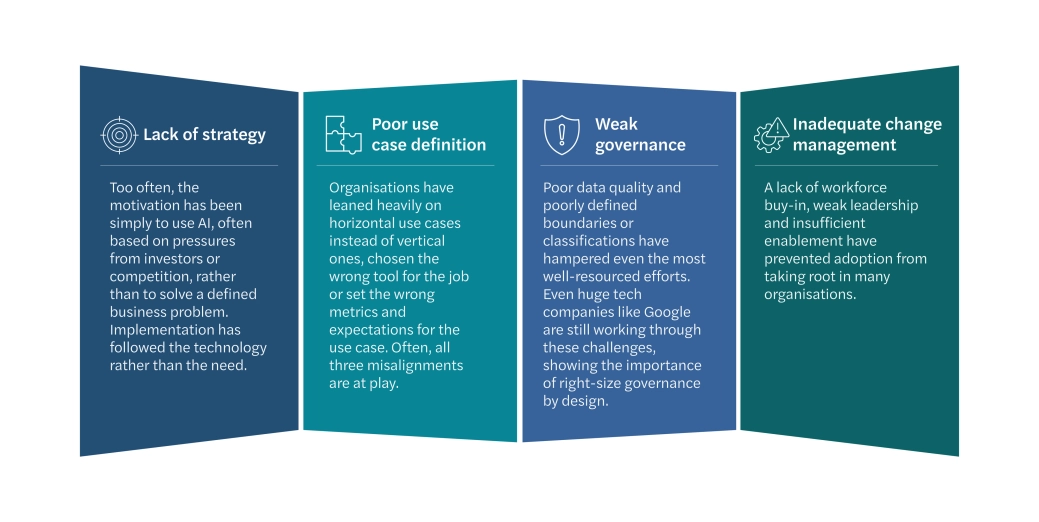
For most organisations, lack of ROI from AI investment tends to result from four critical components

infographic showing critical components affecting ROI from AI investments

None of this is to suggest that organisations should stall in their AI ambitions. The pace of innovation is not slowing; rather, it is accelerating exponentially and organisations that fail to embrace its potential risk falling behind. Being strategic about use case evaluation and definition, along with laying strong foundations in data and governance, will allow organisations to move quickly and generate real value as the technology continues to evolve. 

How to use AI to generate real business value 

AI reflects such a fundamental shift in operating models and priorities, touching so many different parts of the business, that it cannot be approached as a bolt-on technology. This means a solid foundation of data and governance is required, as is clarity around the business problem the technology is actually helping to solve.


The most mature organisations are not testing AI models in isolation. They are making sure they can govern and retain control of AI systems as they are deployed and connected to data, tools, workflows, users, third parties and business processes.

Sofia Ihsan AI Consulting Leader

In any use case, AI should be treated as a potential tool – albeit a very powerful one – for solving a strategic problem, rather than an end in itself. It is not a silver bullet, and approaching AI implementation with the sole priority of finding a way to leverage it is unlikely to yield real value and is likely to result in disproportionate, ineffective “solutions”. AI is one tool in a vast toolkit of technologies to leverage for any given business problem. The key lies in knowing when to reach for it, versus when something else will better solve the business problem at hand.

However, simply identifying a business problem AI can solve is not enough. Effective, value-generating implementations require clarity of purpose, proportionality of response and a relentless focus on outcomes that matter.

Use case clarity: defining where AI creates value

The first question any organisation should ask is whether there are multiple business problems with overlapping inefficiencies, data sets or requirements that a single solution could help solve. Treating use cases in isolation often leads to duplicated effort and fragmented results. Looking across the business for related problems can reveal opportunities for a more coherent and higher-value implementation.

Valuable use cases for AI implementation are those that address real business problems and present with quantifiable success metrics.  

Not every business challenge requires AI. Organisations generating the greatest value start by identifying the problems AI is best placed to solve and defining what success looks like from the outset. 

 The most successful AI initiatives are built around clearly defined outcomes, whether that is improving efficiency, enhancing decision-making, reducing risk or creating a better customer experience. 

A strong use case should answer four key questions

Is AI the right tool for the job? 

AI is an extreme solution and should be proportionate to the business value of the problem it is solving. Leaders should resist the urge to crack a nut with a sledgehammer; if a rules-based automation, a process redesign or a better-built dashboard will do the job just as effectively, that is usually a better answer than AI implementation. Environmental concerns and data quality and availability should also be weighed at this stage, before any commitment is made. 

Indeed, sustainability concerns belong at the scoping stage rather than as an afterthought. Quantifying an AI footprint is difficult, even with your own GPUs, and AI is established to be environmentally damaging – this is especially true for agentic AI systems. It is important to consider sustainability ambitions, goals and compliance early, because there may be equally effective (or nearly as effective) solutions that are less environmentally taxing. Non-AI solutions can often get you most of the way there without the same sustainability (or even monetary) cost. 

What type of AI is best suited to this work? 

If AI is the right tool, the next question is what type. The benefits and challenges vary significantly across chat interfaces, retrieval-augmented generation, agentic systems and multi-agent architectures.  

Task-level AI is often a waste of potential; one use case's leveraging of AI can frequently enable another, and thinking in terms of capability ecosystems rather than isolated tasks tends to yield better returns. In this way, one implementation (or coordinated implementation) can help address multiple business problems, or a single business problem with multiple contributing factors across different areas of the business. 

e9d8599c4a96-Laurent-Inard.jpg.jpg

“The organisations getting real value from AI aren't thinking task by task – they're thinking in capability ecosystems. One well-designed implementation can address several business problems at once, but only if you're willing to step back from the immediate use case and look at the wider operating model.” 

– Laurent Inard, Partner, Head of Research & Development, Forvis Mazars in France 

Established LLMs (versus proprietary models) are the most common design choice; they will usually be more robust and efficient and will be kept up to date with the right capabilities. They do, however, come with risks and requirements that must be considered, including heightened third party risk management (TPRM) considerations. Borrowed models do not reduce the maturity required for governance and oversight; if anything, they increase it. 

What are the right success metrics for this use case? 

One of the biggest hurdles for organisations in moving from “capability talk” to “performance talk” is defining the wrong success metrics for implementation. Every use case’s KPIs should be tied back to the strategic problem being solved and demonstrate real business value in their articulation. Quantifiable value like reduced turnaround time, improved exception rates and shortened value generation cycles will always be better than productivity, milestone or vague “efficiency” metrics. 

Is this use case operating effectively without AI?

Even if a use case isn’t performing against the relevant success metrics, in most instances, it should be operational without AI. If the process is poorly defined or ineffectual as is, adding AI will only exacerbate those failings, not solve them. 

Read a corporate tax use case

Catherine Hall

“Human-in-the-loop decision-making is key. AI is delivering clear value for corporate tax teams, but the real value of AI lies in what you do with the insight it gives you and the time saved in the process.”

Catherine Hall Partner, International Tax Lead,  Forvis Mazars in the UK

Governance and data readiness: building the foundations for scale

Governance is too often treated as the brake on AI implementation, when in fact it is the accelerator. Governance without gridlock is achieved by defining governance strategies early. Addressing governance, compliance and risk at the start, even as early as use case evaluation, helps prevent what is often called "pilot purgatory": the state in which a project stalls just before launch, because these considerations have been introduced too late, yet have thrown up valid concerns that require redesign.

Successful AI adoption requires more than the right technology. Organisations need clear governance, trusted data and defined processes to ensure AI is used responsibly and delivers consistent results.

Organisations must align their AI ambitions with their actual level of data maturity, as premature or misaligned implementations will generate little to no value, even if “successfully” implemented.

“Organisations tie themselves up in knots because they don’t have right-size governance in place. They’re governing every use case the same way, regardless of the risk profile or the opportunity for value. This is when governance becomes a blocker to value generation.”

Sofia Ihsan AI Consulting Leader, Forvis Mazars in the UK

Maturity alignment also matters: ambitions should be aligned to the organisation's current readiness across data integration, architecture and workforce skills, not to where leadership wishes the organisation were. If ambitions and maturity don’t align in reality, that signals the need for deep transformation prior to implementation.   

Establishing a workflow contract 

To move from ambition to action, a "workflow contract" should be established for each use case. This contract sets out five key elements: 

Workflow boundary – identifying exactly where the process starts and ends.
Outcome metric – defining the specific, measurable change expected.
Decision boundary – explicitly stating what the AI can do autonomously, versus what requires human review.
Data boundary – specifying which data the system is permitted to use, and what is prohibited.
Project owner – assigning a specific leader who is accountable for adoption and results.

Data readiness underpins all of this. Leaders must align their ambitions with the reality of their maturity along a practical maturity continuum, or their AI implementations are likely to fail. 

At best, premature or misaligned implementations will generate little to no value, even if “successfully” implemented. 

Security and compliance by design

Security and compliance should be embedded into AI initiatives from the start, not applied as a final review gate. 

As AI regulation evolves, organisations need repeatable governance approaches, clear data and audit standards, and proportionate cybersecurity measures aligned to risk. 

Just as importantly, they should define ownership, monitoring processes and clear fallback procedures before deployment, ensuring continuity if AI quality drops or a model behaves inappropriately.

Change management: turning AI adoption into transformation

A successful move from AI pilot to scaled implementation begins with clearly defined scope and timelines for both stages, each with its own appropriate success metrics. A pilot that succeeds against scale metrics is a pilot that has been judged on the wrong terms, and the same is true in reverse. But further than that, workforce enablement – and encouragement, as we will see – is the biggest challenge of scaling a solid, vertical AI use case.

Workforce adoption and buy-in 

Organisations seeing the greatest value from AI use it to enhance workforce efficiency and support growth, rather than replace employees. 

Clear communication is essential. Employees are more likely to embrace AI when they understand how it supports their role, contributes to business objectives and creates new opportunities. Visible results, ongoing education and clear governance help build confidence and encourage wider adoption.

Leadership sets the tone 

Successful AI adoption starts at the top. Leaders who actively use AI, communicate openly about its opportunities and limitations, and encourage responsible experimentation create the conditions for lasting change. 

The tone set by leadership shapes how employees perceive, adopt and engage with AI across the organisation.

How can leaders in different areas of the business enable real, tangible business value generation through AI? 

The CEO

Define where value should be created 

The main risk isn’t doing too little – it’s doing too much without delivering impact. 

  • Anchor AI in business outcomes: require every AI initiative to be tied to a revenue lever, a cost driver or a key decision process.  
  • Narrow the focus to drive real impact: prioritise a limited number of high value, multifaceted use cases, and avoid spreading investments across too many initiatives. 
  • Own the transformation narrative: clearly position AI as a productivity and decision enhancement lever, not a workforce reduction programme; communicate consistently across the organisation.
  • Align the leadership team on value and time horizon: ensure the CFO, CIO and business leaders agree on what success looks like, how value is measured and when returns are expected.
  • Institutionalise adaptability in execution: move away from static transformation roadmaps, implementing quarterly reprioritisation of initiatives and rapid decision loops at the executive level.
  • Champion compliance by design: demand rigorous right-size governance and compliance, even where regulation remains a moving goalpost. Advocate for proportionate, risk-based measures where clear frameworks may not be available. 

The CFO

Ensure value is measured and realised 

Treating AI like a traditional IT investment is a mistake. Value is progressive, linked to adoption, and uneven across use cases. 

  • Move the conversation from capability to performance: source and track operating metrics, not just technical outputs (cycle times, productivity gains, error reduction, capacity creation, etc.).
  • Build a robust ROI and value tracking framework: track real investment costs (including data, integration, change) and realised benefits (not just projected ones); distinguish between short-term efficiency gains and longer-term business impact.
  • Fund capabilities, not fragmented initiatives: allocate budgets to data foundations, AI platforms and shared components. 
  • Stage investments and enforce discipline: link funding to milestones and measurable outcomes/adoption rates.
  • Reallocate resources as value materialises: proactively adjust workforce allocation and cost structures.
  • Include compliance concerns in “performance talk”: push for compliance and governance visibility as a part of use case performance conversations. Establish continuous audit controls to ensure ongoing alignment. 

The CIO and CTO

Make value scalable and sustainable

Chasing the latest AI trend without strong foundations will increase fragility rather than value.

  • Prioritise data and governance as foundations: invest in data quality, accessibility and ownership, and integrate governance into all transformation initiatives, not just AI.
  • Design for enterprise-wide transformation: move beyond tactical use cases, identify multipurpose capabilities, ensure reusability across functions and align AI initiatives with broader digital transformation.
  • Establish repeatable patterns for scale: standardise data classification approaches, approved AI processing environments (“zones”) and human-in-the-loop validation mechanisms.
  • Focus on integration into core workflows: embed AI into existing business processes and decision-making flows, and ensure interoperability across systems.
  • Evaluate technology choices based on business needs: start with the problem, not the tool; select technical solutions that fit the use case, the data environment and the risk level.
  • Operationalise compliance: bridge the gap between compliance strategies and technical execution. Ensure transparency at every stage.

Non-executive director

Provide effective oversight and challenge

Ensure the organisation is pursuing the right AI opportunities, managing risks appropriately and creating long-term value.

  • Challenge the strategic rationale: ensure AI initiatives support business objectives, competitive advantage and stakeholder value.
  • Provide independent scrutiny: test assumptions around investment, benefits, timelines and organisational readiness.
  • Oversee AI-related risks: monitor operational, regulatory, cyber, data and reputational risks.
  • Champion responsible AI: promote fairness, transparency, accountability and appropriate human oversight.
  • Monitor governance: ensure AI oversight is embedded within board, risk and audit frameworks and evolves as technology and regulation change.

Pivoting from AI hype to AI value 

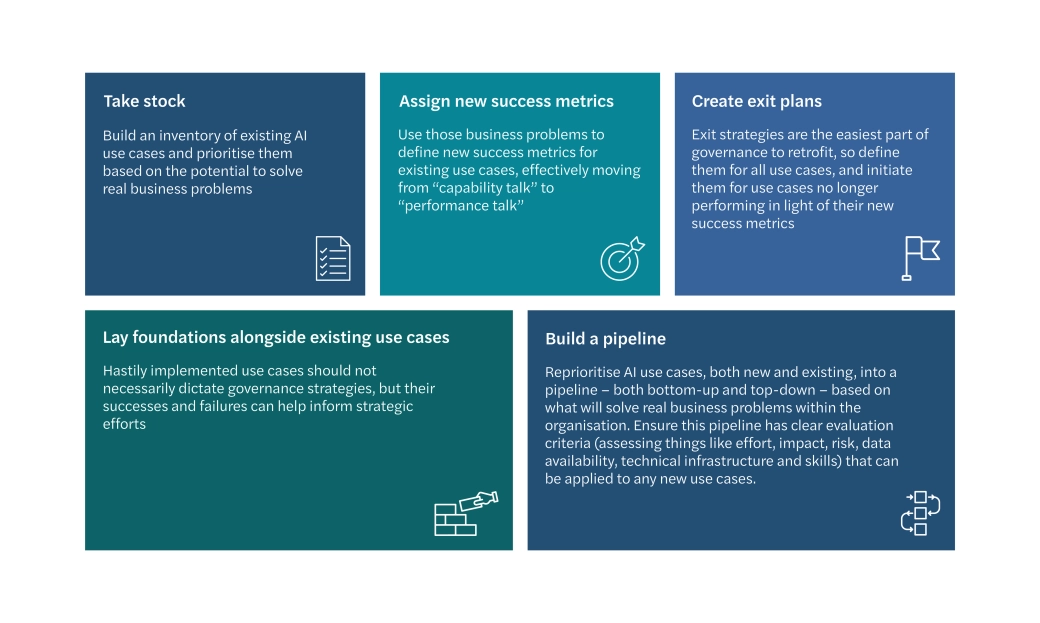
For organisations who have either delayed AI implementation or seen little value return from their use cases, how can they pivot quickly, establishing the right foundation without losing ground?

The good news is that, while true transformation takes time, there are ways to pivot current AI endeavours effectively:  

AI at Scale - Pivoting from AI hype to AI value.png

Hear from AI experts 


*Footage from our NED Series events

Our experts